


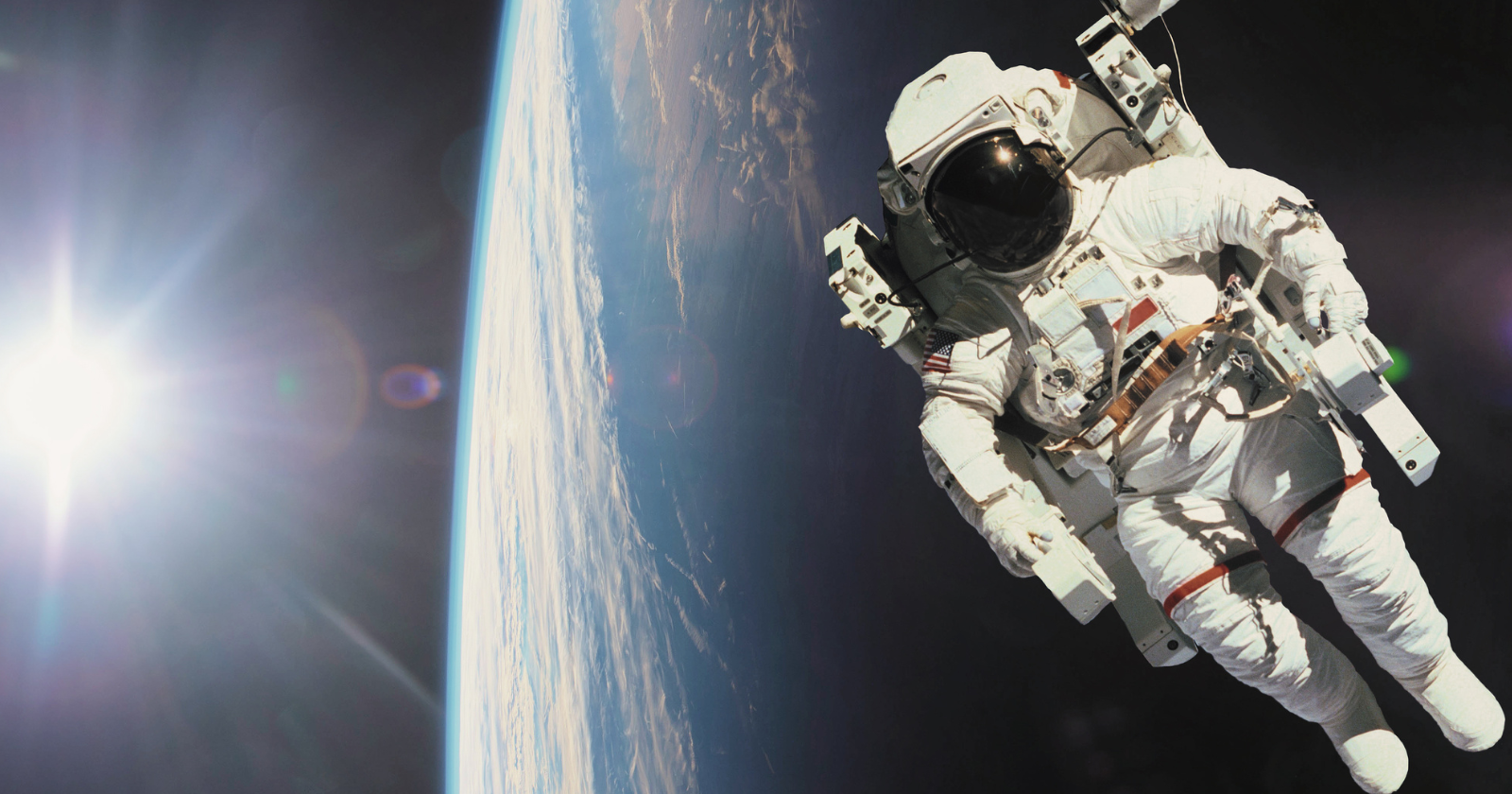

When cosmonaut Valeri Polyakov climbed out of his Soyuz capsule on the Kazakh steppe in March 1995, after more than a year aboard the Mir space station, he did something the recovery crew did not expect. He refused to be carried. Returning crews are almost always lifted out of the capsule and lowered into reclining chairs, because a body that has spent more than a year unloaded from gravity can barely hold itself upright. Polyakov instead insisted on walking the short distance to a waiting chair under his own power — a deliberate demonstration that a human body could still work at the end of a journey as long as the one to Mars. He had launched from Baikonur in early 1994; he came back several centimetres taller, his spine stretched by fourteen months without a planet pulling on it.
Polyakov’s flight remains the longest continuous stay in orbit ever logged: 437 days, from January 1994 to March 1995. His height gain was not a quirk of his own physiology. Astronauts who spend more than a few weeks in orbit come home taller, typically by several centimetres. The effect is so reliable that flight surgeons plan around it, and Russian recovery crews built their post-landing protocols around the assumption that a returning spacefarer’s spine is, for a brief window, a different shape than it was at launch.
What the spine actually does in orbit
The human spine on Earth is a stack of vertebrae separated by intervertebral discs, each disc a small cushion of fibrous cartilage wrapped around a gel-like core called the nucleus pulposus. That core is mostly water. Under the constant downward pull of gravity, the discs compress slightly during the day, which is why most adults are measurably shorter at bedtime than they were at breakfast. Sleep lets the discs rehydrate. Morning resets the cycle.
In microgravity, the cycle never resets back to compression. There is no gravity pulling the spine into its loaded shape, so the discs keep drawing in fluid and the natural curves of the spine — the lordosis of the lower back, the kyphosis of the upper back — begin to flatten out. A research summary compiled by the Nature Index on musculoskeletal responses to microgravity describes how the loss of normal loading patterns disrupts skeletal integrity within days, with the spine reacting fastest because its discs are the most fluid-dependent structures in the body. The pattern of disc swelling during unloading and the painful reloading on return has been documented directly in spaceflight crews.
The result is straightforward mechanics. Take the load off a stack of waterlogged cushions and the stack gets taller. Astronauts report the change within the first week. By the end of a six-month rotation on the International Space Station, the difference is visible on flight suits that no longer reach the wrist.
Three percent sounds small until it’s your back
For a 180-centimetre astronaut, a few centimetres of additional length distributed across the spinal column means the body’s soft tissues — the muscles, ligaments, and nerve roots that thread between the vertebrae — do not stretch quite as obligingly as the discs swell. Many astronauts develop back pain in orbit that ranges from a dull ache to sharp, radiating discomfort that resembles a herniated disc on Earth. Some report sciatica. A few have come home with disc bulges that took months of physical therapy to resolve.
The pain tends to peak in the first weeks of a mission, then settles into a manageable background as the body adapts. Returning to gravity reverses the process, and the reverse can be more uncomfortable than the original swelling. Discs that have been hydrated and unloaded for months suddenly take on the full weight of a torso plus a head plus everything the astronaut tries to lift. The risk of disc herniation in the first year after a long-duration flight runs several times higher than baseline.
Why everything else shifts at the same time
The spine is the most visible change, but it is not the only one. Without gravity to pull blood and lymph toward the feet, fluid migrates upward into the chest and head. Astronauts on the ISS routinely report a sensation of constant head-cold congestion, puffy faces, and thin legs — the so-called “puffy-head bird-leg” syndrome that flight surgeons have catalogued since the Skylab era, linked to the same fluid redistribution that puffs up the discs in the spine.
The fluid shift also raises intracranial pressure, which has been implicated in Spaceflight Associated Neuro-ocular Syndrome, where astronauts return with measurable changes to the back of the eye and, in some cases, persistent shifts in vision. Bone loses minerals in the weight-bearing parts of the skeleton. Muscle in the calves and back atrophies even with two hours a day on the station’s resistance machines; computed-tomography studies of returning crews have measured selective shrinkage of the deep lumbopelvic muscles that stabilise the spine.
The brain itself does not fully adjust. A study covered by Scientific American found that astronauts in microgravity continue to grip objects as if those objects still carried Earth weight, even after months in orbit. The internal model of how heavy things should feel, built up over a lifetime of living on a planet, never quite recalibrates.
The countermeasures, and what they can and can’t fix
NASA, Roscosmos, ESA, and JAXA all run their crews through extensive in-flight exercise protocols. The Advanced Resistive Exercise Device on the ISS simulates free-weight loading. The treadmill and stationary bike keep the cardiovascular system from deconditioning into something dangerous on return. The exercise prescription runs about two and a half hours per day, and it works well enough that astronauts come home with most of their muscle mass intact and bone loss reduced to manageable levels.
It does not stop the spine from stretching. There is no easy way to load the intervertebral discs in microgravity without inventing a centrifuge large enough to spin a person, and no ISS module has the room. Ongoing work on compression suits and harnesses aims to apply axial load to the spine for several hours a day, mimicking gravity’s downward pull. The Russian space program has long used loading suits with systems of elastic bands — the Pingvin garment first flown on Salyut — that force the wearer’s muscles to work against resistance.
The suits help. They do not eliminate the height gain. They were built to keep muscles working, not to compress the discs, and even cosmonauts who wore them came home measurably taller than they left.
What recovery actually looks like
The return to Earth-normal height takes weeks. For a six-month ISS rotation, astronauts typically return to their baseline within a few months, sometimes slightly shorter than before they launched because the discs overshoot in the other direction during the painful resettling period. The first 48 hours after landing are the worst. Crews are kept horizontal, monitored for orthostatic intolerance — the inability of the cardiovascular system to maintain blood pressure when standing — and walked carefully through their first vertical movements.
For Polyakov’s extended flight, recovery took longer. A National Academies strategy document on space biology and medicine notes that the endocrine, nervous, and immune systems all participate in readjustment, and the longer the flight, the longer the cascade of adaptations the body has to unwind. Bone density takes the longest to rebuild, sometimes years, and in some cases never fully returns.
What does come back, in nearly every case, is height. The discs lose their excess fluid as the spine reloads. The lumbar curve reasserts itself. The flight suit fits again. Within a season or two, a returned astronaut measures within a millimetre or two of their pre-flight self, and the only sign that anything happened is the medical chart and, for some, the lingering ache that flares up when the weather changes.
The future, and the bodies that will live in it
NASA’s Artemis program plans to return crews to the lunar surface, where gravity is one-sixth of Earth’s. A Mars transit, by current mission architectures, would take roughly six to nine months each way with a long surface stay in between, much of it in partial gravity. The spine on such a mission would stretch, partially compress on Mars, and stretch again on the return. No human has yet experienced that cycle. A 2026 study from National Jewish Health, which scanned three astronauts before and after the 18-day Axiom Mission 4, found no significant joint damage and suggested that brief missions cause less harm than feared — but the dose-response curve for years-long exposure is still mostly theoretical.
Polyakov is still the data point. He logged his record-breaking stay, came home, walked from the capsule to his chair under his own power, returned to medical practice, and lived until September 2022. His final height, after full recovery, was within the normal range of measurement error from where he started. For more than a year in the mid-1990s, however, he was the tallest version of himself he would ever be, drifting through Mir’s modules with a spine longer than the one his parents gave him, slowly unspooling from the gravity well he had left behind.
Somewhere above the planet right now, on the ISS, several people are doing the same thing. By the time they come home, their flight suits will not fit at the cuffs. The recovery team will be ready with the chair.
