

In the summer of 1932, a radio engineer named Karl Jansky was standing in a field in New Jersey, next to a contraption his colleagues had nicknamed Jansky’s merry-go-round — a lattice of brass pipes and wooden beams mounted on wheels from an old automobile, rotating slowly on a circular track. Bell Telephone Laboratories had given him a simple assignment: figure out what was causing the static that kept interrupting transatlantic shortwave calls. What he found instead was a faint, steady hiss that rose and fell on a schedule no thunderstorm or power line could explain — a hiss that returned every 23 hours and 56 minutes, the exact length of a sidereal day, which meant it was coming from somewhere outside the solar system entirely.
He had pointed a microphone, essentially, at the center of the Milky Way. He didn’t know that yet. Nobody did.
An engineer with a static problem
Jansky was not an astronomer. He had a degree in physics and a job description that involved keeping radiotelephone customers happy. Bell Labs cared about static because static cost money. Every crackle on a ship-to-shore call was a small dent in the company’s reputation, and the engineers wanted to know which kinds of interference came from local storms, which from distant ones, and which from the equipment itself.
His antenna was tuned to 20.5 megahertz, a wavelength of roughly 14.5 meters in the shortwave band. The merry-go-round let him sweep the horizon and figure out the direction any given burst of noise was coming from.
Most of what he heard was unsurprising. Thunderstorms nearby. Thunderstorms far away. And then a third thing — a quieter, smoother hiss that didn’t behave like weather at all.
The clock that didn’t match the clock on the wall
For months Jansky tracked the third hiss. At first it seemed to peak once a day, and he assumed the Sun was the source. But the peak kept drifting. Each day it arrived about four minutes earlier than the day before.
That drift was the clue. A solar day is 24 hours; a sidereal day, measured against the fixed stars rather than the Sun, is 23 hours and 56 minutes. Anything tied to the rotation of Earth relative to the stars beyond the solar system beats to that shorter clock. By the end of 1932 Jansky had enough data to be certain the signal was sidereal, which meant it was anchored to something far outside our own neighborhood.
He plotted the direction it came from. The strongest hiss arrived from the constellation Sagittarius — the densest, brightest part of the band of light people had been calling the Milky Way for centuries. He was, in the most literal sense, listening to the galactic center.
The New York Times put it on the front page. Bell Labs put it aside.
Jansky announced his result in 1933, and on May 5 of that year the New York Times ran the discovery on its front page under a headline about new radio waves traced to the center of the Milky Way. Ten days later, NBC’s Blue Network broadcast a sample of the hiss to listeners across the country; reporters compared the sound to steam escaping from a radiator.
Then Bell Labs moved him to a different project.
The company had its answer about the static — it wasn’t anything they could fix — and saw no commercial reason to keep an engineer pointed at Sagittarius. Jansky asked to build a bigger dish to study the signal further. The request was denied. He spent the rest of his career on other telecommunications problems and died in 1950, never having worked in astronomy again.
The hobbyist who built the next telescope in his backyard
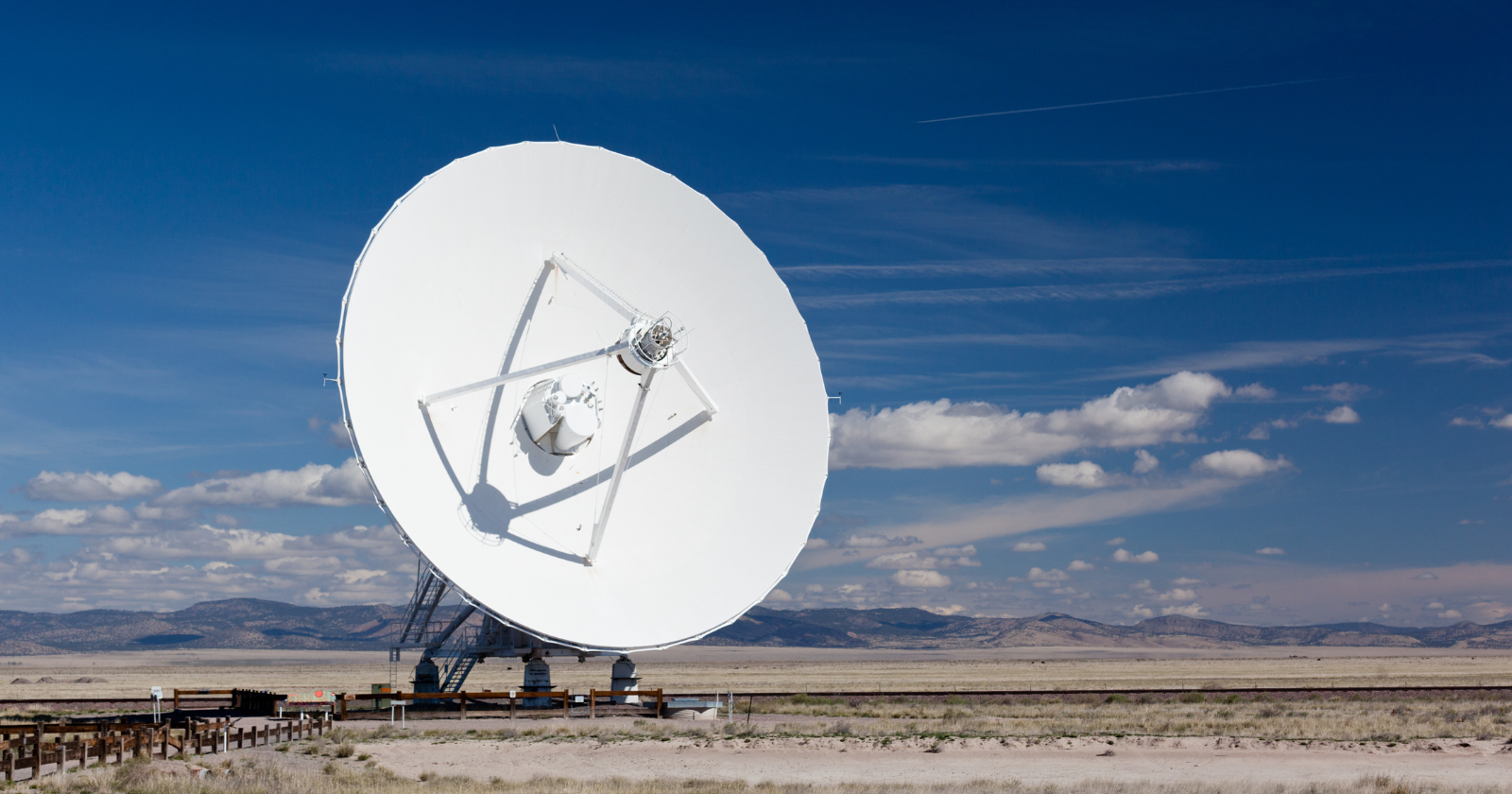
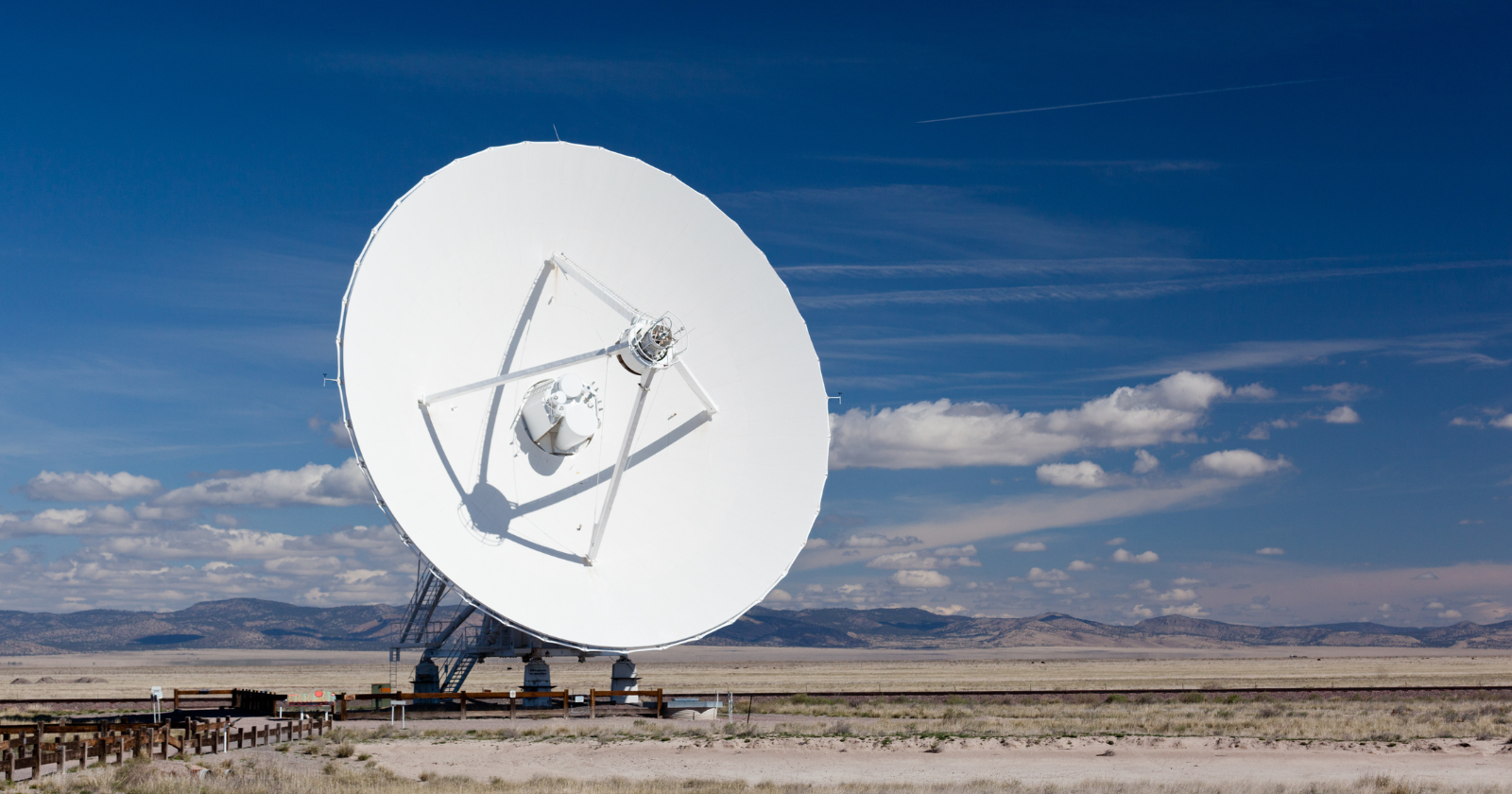
The field he had just invented sat almost dormant for years. Professional astronomers, trained on telescopes that gathered visible light, were slow to take radio seriously. The person who picked up the thread was Grote Reber, an engineer who read Jansky’s paper and decided to build his own radio telescope.
Reber finished his parabolic dish in his backyard in Wheaton, Illinois, in 1937. It cost him his own money. For most of the next decade he was, by a wide margin, the only radio astronomer on Earth. He mapped the sky at radio wavelengths, confirmed Jansky’s detection of the galactic center, and found other bright radio sources that would later be identified as supernova remnants and distant galaxies.
The discipline Jansky accidentally founded eventually grew into one of the most productive branches of modern astronomy. The unit used to measure the strength of a cosmic radio source is now called the jansky, abbreviated Jy, in his honor.
What he was actually hearing
The hiss Jansky picked up in 1932 was synchrotron radiation — the broadband electromagnetic noise produced when electrons spiral through magnetic fields at close to the speed of light. The center of the Milky Way is dense with such electrons, accelerated by supernovae, stellar winds, and the supermassive black hole now known as Sagittarius A*.
His antenna couldn’t resolve any of that. To him it was just an undifferentiated hiss, the radio equivalent of a smear of light. But the smear contained, encoded, the violence of an entire galactic core.
Modern radio telescopes have since pulled the smear apart into extraordinary detail. The MeerKAT array in South Africa released a panoramic radio image of the galactic center that revealed previously unknown filaments threading the region. Astronomers unveiled a new full-disk view of the Milky Way in radio colors, stitched from years of survey data, showing supernova remnants and star-forming regions in tones the human eye cannot see.
The Fermi bubbles — two enormous lobes of high-energy gas bulging above and below the galactic plane — were only recognized in 2010, and astronomers are still arguing about what produced them. Recent observations found unexpected pockets of cool gas embedded inside the million-degree bubbles, evidence of a violent eruption from the galactic core within the last few million years.
All of this traces back, in a direct genealogical line, to a brass-pipe antenna rolling slowly on old car wheels in a New Jersey field.
The hiss is still arriving
The signal had been there the whole time, of course. The Milky Way had been pouring radio noise into Earth’s atmosphere for as long as there had been a Milky Way. What changed in 1932 was that someone built a receiver sensitive enough to detect it, kept careful enough notes to recognize a 23-hour-56-minute period, and possessed enough physics to know what that period meant.
It was a discovery that required almost no money and almost no time on the actual instrument. What it required was a person willing to chase a quiet anomaly past the point where his employer cared about the answer.
The instinct to sift static for meaning never went away. The SETI@home project, which let home computers sift radio data for signs of extraterrestrial intelligence, wound down after decades of crowdsourced searching that found no aliens but trained a generation of programmers to think about cosmic signals.
If you understand how radio works, you can experience a faint version of what Jansky heard. Tune an FM radio between stations and the soft static that fills the speaker is partly atmospheric, partly thermal noise inside the receiver — and a small fraction is the cosmic microwave background, the leftover thermal glow of the Big Bang, plus the diffuse radio emission of the Milky Way itself.
The center of the galaxy rises and sets every 23 hours and 56 minutes, just as it did in 1932. The original merry-go-round is long gone, but a full-scale replica stands at Green Bank Observatory in West Virginia, and at the Holmdel site Bell Labs erected a sculpture of the antenna, fixed in the exact orientation the original held at 7:10 p.m. on September 16, 1932, at a moment of maximum signal — pointed at Sagittarius, low on the southern horizon.
The hiss Jansky chased is still pouring down through the sky, through the roof of any house, through the antenna of every car parked on the street, unheard by almost everyone, every four minutes earlier than the day before.
