

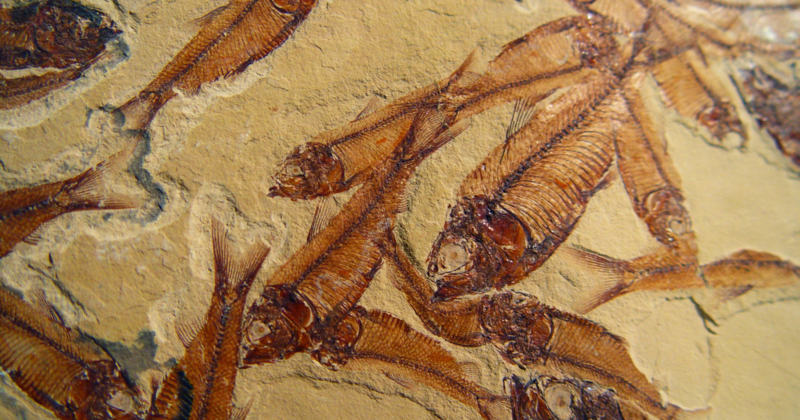
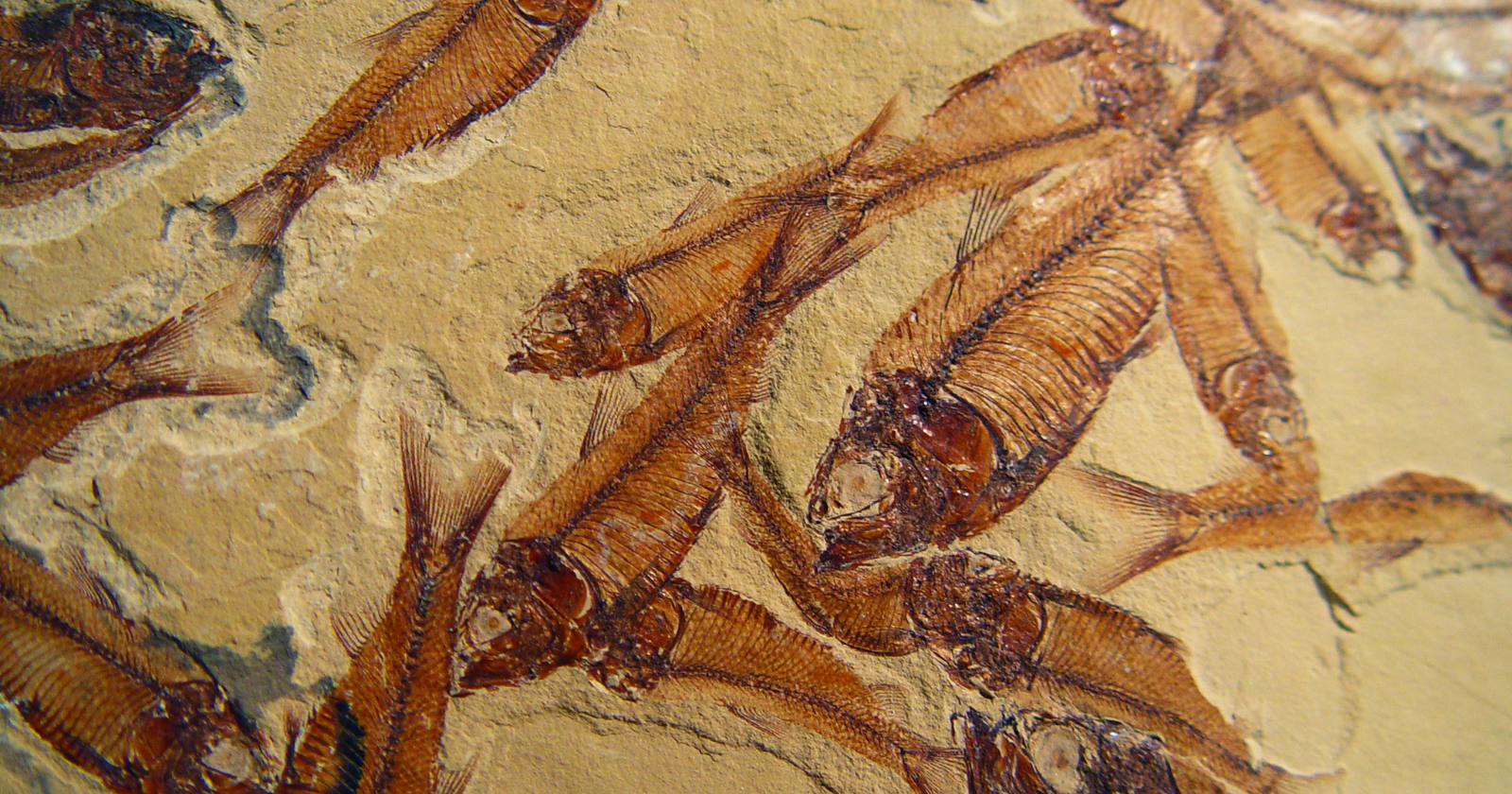
Robert DePalma was digging at a ranch in the Hell Creek Formation of southwestern North Dakota, in a place he eventually named Tanis. What he found there, layered into about a metre and a half of mudstone, reads less like a fossil bed and more like a crime scene photograph of the worst day in the history of complex life on Earth: paddlefish and sturgeon piled together with their gills clogged by tiny glass spheres, a churned tangle of tree trunks and ammonites, and a thin capping layer of iridium-rich clay that geologists have used for decades as the signature of the Cretaceous–Paleogene boundary.
The asteroid had hit roughly 3,000 kilometres away, in shallow sea off the Yucatán Peninsula. By the time the shaking reached North Dakota, the fish were already dead, suffocated by glass.
A ten-minute window, frozen in mud
The Chicxulub impactor was about ten to fifteen kilometres across. It struck what is now Mexico 66 million years ago and gouged a crater more than 150 kilometres wide. Seismic waves from an impact that size race through the crust far faster than anything moving across water: the fast compressional P waves would have reached present-day North Dakota roughly six minutes after the strike, with the slower, more destructive shear and surface waves arriving around ten and thirteen minutes after impact. It is that heavier shaking, not the first faint tremor, that matters here.
That timing matters because of what falls from the sky in the same window. When an asteroid hits, it throws molten rock above the atmosphere on ballistic trajectories. Those droplets cool into tiny glass beads called spherules, typically less than a millimetre across, and they re-enter the atmosphere over the following minutes to hours. For a site about 3,000 kilometres from Chicxulub, the spherule rain begins arriving at roughly the same time as the seismic waves and keeps falling for the next hour or two.
Tanis sits inside that overlap. The fish at the site have spherules wedged in their gill rakers but not in their digestive tracts, which is exactly what you would expect if they breathed in glass for a few minutes and then died before they could swallow any of it.
The wave that was not a tsunami
The first instinct, given the impact, is to assume a tsunami swept up the Western Interior Seaway and dumped fish on the floodplain. DePalma’s team argued for something stranger and more local: a seiche, the sloshing standing wave that forms in an enclosed or partly enclosed body of water when the ground beneath it shakes.
Anyone who has carried a casserole dish across a kitchen has seen the principle. The water in the dish does not flow out; it tilts back and forth, building amplitude with each oscillation until it spills over the rim. Earthquakes do the same thing to lakes and rivers. The 2011 Tōhoku earthquake produced measurable seiches in Norwegian fjords, more than 8,000 kilometres from the epicentre.
At Tanis, the trapped water was a tributary channel branching off the seaway. The seismic waves arriving from Yucatán shook the channel hard enough to drive a surge the team put at a runup height of at least ten metres, an estimate drawn from the structure of the deposit and the way fish bodies were oriented against tree trunks. The surge ran upstream, not downstream, which rules out an ordinary flood and is consistent with a seismic standing wave reflecting off the channel walls.
Glass beads that point back to the crater
The spherules are the part of the story that turns Tanis from a strange fish kill into a forensic timestamp. They are not generic impact debris. Their chemistry, when measured against the melted bedrock at Chicxulub, matches. Some of them contain tiny inclusions of unaltered limestone and gypsum, the same rocks that made up the seafloor at the impact site before the asteroid vaporised them.
The angles also work. Spherules embedded in tree resin at Tanis sit at trajectories consistent with ballistic arrival from the southeast, which is the direction of Chicxulub. Geologists analysing ejecta from much older impacts on the Moon have used the same logic in reverse, reading the distribution and angle of debris layers to reconstruct where the original blast came from. The principle is identical: a glass bead launched on a ballistic arc carries the memory of its launch site in the angle at which it lands.
What the fish were doing when the sky fell
The paddlefish and sturgeon at Tanis were not unusual residents of a late Cretaceous river. What is unusual is the preservation. Their bodies are articulated, meaning the bones are still in roughly the positions they held in life, which means they were buried fast. Scavengers did not get to them. The water did not have time to scatter them.
Inside their gill arches, researchers found spherules of the same chemistry as the ones falling from the air. A few of those spherules had been partially digested by stomach acid in other fish at the site, but the gill-trapped beads were intact. The simplest reading is that the fish were pulled out of the water by the surge, inhaled glass beads as they thrashed on the bank, and were buried under more mud and beads within minutes.
Patches of skin attributed to a Triceratops were recovered from the same beds. Large primitive feathers, thought to have come from a dinosaur, are preserved nearby. A pterosaur embryo, still curled inside its egg, was reported from the same deposit.
Why other scientists pushed back
Tanis has been controversial since DePalma’s first major paper appeared in 2019. Some of the criticism is about access: DePalma controlled the site tightly, and much of the most dramatic material was described in media coverage before it appeared in peer-reviewed journals. Some is about specific claims, including the identification of the pterosaur embryo and a partial dinosaur leg said to preserve skin.
The underlying geology has held up better than the headline-grabbing specimens. Independent teams have confirmed the iridium layer, the spherule chemistry, and the timing. The argument is mostly about how much of the rest of the story the rocks actually support. Even sceptics generally accept that Tanis captures something close to the day of the impact, within a margin of hours.
That alone is remarkable. The fossil record usually resolves time in units of thousands or millions of years. A site that resolves a single afternoon is, in geological terms, almost impossible.
What preserved bone can still tell us
The ability to read a single day out of 66-million-year-old rock depends on the same techniques that have transformed dinosaur palaeontology more broadly. Radiometric dating of volcanic ash layers above and below the boundary clay pins the absolute age. Trace-element chemistry identifies the impact signature. And increasingly, researchers are finding that the bones themselves retain more original material than anyone expected.
A 2026 study led by the University of Liverpool reported organic molecules preserved in a 66-million-year-old Edmontosaurus fossil, including fragments that appear to derive from the original animal rather than later contamination. That work is not from Tanis, but it sits in the same time window and uses the same boundary clay as a stratigraphic anchor. The combination of preserved chemistry, preserved sediment, and preserved geometry is what makes the last day of the Cretaceous legible at all.
The reach of a planetary impact
Chicxulub’s effects were not limited to the Gulf of Mexico. Spherule layers from the same event have been identified at sites across North America, in Europe, and in deep-sea cores from the Pacific. The crater itself, buried under younger rock and partly under the sea, was only confirmed in the 1990s when geophysicists matched a gravitational anomaly off Yucatán to a circular structure visible in subsurface mapping.
Modern asteroid science extends the same physics forward in time. Astronomers have spent the past two decades cataloguing near-Earth objects and modelling what would happen if one struck. Even relatively small bodies, such as the 60-metre asteroid 2024 YR4, draw serious attention when their orbits cross Earth’s. A potential lunar impact by that object in 2032 could fling ejecta toward Earth as a brief meteor shower, a scaled-down echo of the process that buried the fish at Tanis.
For readers who want to follow the broader trail of how scientists piece together ancient catastrophes from physical evidence, Make Tech Easier’s coverage of science and discovery regularly traces the instruments and software behind these reconstructions.
A river bank, ten minutes after
Stand at Tanis today and the landscape is quiet ranch country, low hills cut by seasonal creeks, the kind of place where the wind is louder than anything else. The rock face where DePalma’s team works exposes the boundary clay as a band roughly the width of a thumb, pale grey against the darker sediments above and below.
Below the band: a Cretaceous world with non-avian dinosaurs, pterosaurs in the air, ammonites in the sea. Above it: a stripped, smouldering planet that would take millions of years to grow back its forests. The band itself, in this one stretch of North Dakota, is not a smooth line but a chaotic tangle of fish bodies and glass and splintered wood.
The spherules in the fish gills are still there. They are still the colour of weak tea, still small enough to fit through the eye of a needle, still oriented in the directions they were travelling when they came down. They fell out of a sky that was, for a few minutes, full of glass falling from space, while the ground beneath them rocked with the news that something three thousand kilometres away had just ended the world.
