


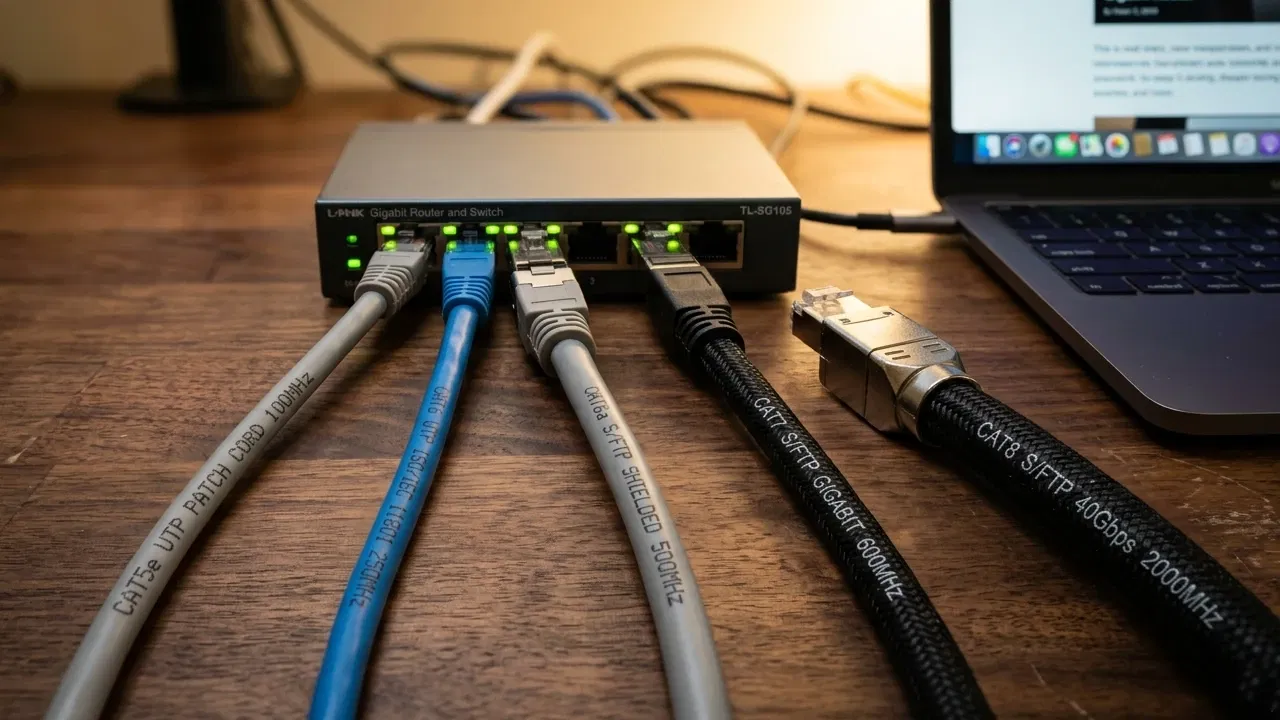
Ethernet cables are a key part of everyone’s home-computing experience, but very few people understand the difference between them and how important they can actually be in the long run. Let’s clear that up so you can understand how to make informed buying decisions with Ethernet cables.
What is “Cat”
The “Cat” branding of an Ethernet cable is perhaps one of the most important parts of purchasing one, since it provides key information about the speeds of the cable in addition to the Mhz (frequency) of the cable.
“Cat,” in this case, stands for “Category.” When buying Ethernet cables, you should only be buying Cat-5 cables or higher. Lower-standard cables aren’t actually Ethernet cables, offer very low speeds, and are typically used for telephone applications.

Here’s the difference between the main types of cables you’ll be buying:
- Cat-5 cables offer speeds up to 100 Megabits per second and operate at 100 MHz.
- Cat-5e cables offer speeds of up to 1 Gigabit per second and operate at 100 MHz.
- Cat-6 cables offer speeds of up to 10 Gigabits per second, though using this full capacity shortens the maximum length of the cable down to 55 meters as opposed to the 100 meters normally offered by Cat cables. These cables also run at 250 MHz.
- Cat-6a cables offer speeds of up to 10 Gigabits per second, with no such length restriction as their predecessor. These cables run at 500 MHz.
- Cat-7 cables offer speeds of up to 10 Gigabits per second, much like Cat-6A. However, unlike Cat-6A and previous generations, this is a proprietary standard that doesn’t actually use the same connector as other Ethernet cables.
- Cat-8 cables are a proper successor to Cat-6a cables, offering a whopping speed of 25 Gbps with Cat 8.1. With Cat 8.2, these maximum speeds are nearly doubled to 40 Gbps. This is because these cables run at up to 2 GHz, which is a massive leap over Cat-6a’s previous 500 MHz.
You may be wondering what type of cable is best for you. To test it in the simplest way, run a speed test to gauge your connection speed or ask your ISP what its maximum speed provided is.
For instance, if you’re limited to a 1 Gigabit Internet connection, you have no reason to buy anything newer than a Cat-5 cable. In fact, Cat-5e is fast enough to cover most consumer-level Internet needs, but for schools and businesses with faster networks, investing in better cabling is well worth the money.
Note: if you are seeing that your Ethernet speed is capped at 100Mhz in Windows, check out these fixes.
Where Are Cat-9 Ethernet Cables?
At time of writing (2026), nowhere! But the cables do exist in theory. However, the spec of existing cables cover essentially all consumer applications and the majority of enterprise applications, so we’re likely a decade or more away from the earnest adoption of Cat-9 Ethernet cables.
Benefits of Ethernet Cables
There are numerous benefits to using Ethernet cables instead of Wi-Fi, though of course this may not always be feasible due to environmental factors. In short, those benefits boil down to the following:
- Connection Stability – without speeds changing over distance or wireless interference being a factor, an Ethernet cable will provide the most stable connection to your router. This is integral for sensitive work, high-volume work, or gaming.
- Connection Speed – while faster Wi-Fi standards do exist these days, Ethernet cables can be supremely fast. Even if you don’t have particularly fast home Internet, use cases like in-home streaming or media servers will also benefit greatly from an Ethernet cable.
- Control – say you’re a parent or a network administrator, and you need to control when certain devices are online or not. Keeping certain devices connected only through Ethernet cables can help keep your network more secure and under your control. While you can blacklist or kick users off of your Wi-Fi router manually in your router’s control panel, that’s a lot more tedious than just taking a moment to unplug a cable.
Note: Using a Powerline Ethernet adapter can reduce these benefits depending on the age and quality of your home’s electrical system.
Shielding and Jackets
There are two forms of protection for an Ethernet cable: shielding and jackets.
Shielding is a form of shielding inside the cable that prevents signal degradation and interference, which is important when running cables in harsher environments. It’s also very important when running multiple cables together simultaneously. Newer Cat standards will typically have better shielding, especially as you go past Cat-6, due to the sensitivity of the higher-frequency signals.
For the most part, you don’t need to use heavily shielded cables unless you’re routing a network for a large business or school. You also don’t want to use these cables where they’re unneeded because they are both more expensive and more cumbersome to work with.

Jackets cover the body of the cable. These are vital for ensuring the cable remains undamaged when routing it around the house. The stronger the jacket, the stronger the cable’s integrity and the longer it’ll last you. Most consumer-grade cables use a PVC jacket, which is fine, but be aware of cables with low-quality jackets that tear and break down easily.
If you’re buying your Ethernet cables online, take a look at reviews to ensure that shielding and jacketing are up to standard. If people are complaining about signal loss or fragile cables, that’s usually a good sign to keep away.
Buying Ethernet Cables: Length
Ethernet cables vary greatly in length and max out at 100 meters without the usage of repeaters. I will say this, though: never buy a cable under 10 feet unless you’re extremely sure you’ll never need the extra length.

If you look for the bottom-of-the-barrel cables, you may see that many Ethernet cables cost something like $10 for 5 feet. Many people would make the assumption that doubling the length would double the price, but it doesn’t. You can purchase 50-foot cables for $10-15 if you look in the right places!
Always buy cables that are a little longer than what you need. You may need to reroute them at some point, or you may move your router or computer. Spending extra for the extra length will save you a lot of time and headaches in the long run. Don’t skimp on it!
Power Over Ethernet and Solid Core Ethernet Cables
Most Ethernet cables are what’s called “stranded.” They’re called this because they’re formed from multiple smaller wires twisted into each other, and this makes them easy to bend and twist and turn for routing purposes.
Some Ethernet cables, especially Power over Ethernet cables, are instead “solid core.” A solid core Ethernet cable is exactly what it sounds like – a cable with a thick, dense, single core wire running through it. These are better for routing cables outdoors and through extreme conditions but are much harder to bend and twist in smaller spaces due to their construction.
Not all solid core Ethernet cables support Power over Ethernet, but all Power over Ethernet cables are solid core.
Where to Buy Affordable Ethernet Cables
Finally, let’s talk about where you should buy your Ethernet cables.
Amazon and Newegg. That’s it. Don’t go to Walmart, or Best Buy, or really any physical outlet. Cables in physical outlets are almost always horribly overpriced, and if you can stand to wait a few days for an Ethernet cable to ship, it’s typically the far better option. Buying online also allows you to take a closer look at specifications and user reviews, which will help you stay away from low-quality network cabling.
That said, there is also value in supporting local businesses. So if you want your Ethernet cables today, consider getting them from your local PC repair or hardware shops instead of a big retail chain or online ordering.
Wrapping Up
All in all, Ethernet cables are an integral part of any network, home or business. Most people who shop for Ethernet cables don’t know much about them, though, and we’re hoping with this article, you’ve been given all the information you need to make an informed buying decision.
