

Drop a small ring of superconducting metal into a bath of liquid helium, nudge a current through it, and remove the power supply. The current does not fade. It circulates around the loop for years, indistinguishable at the end from the day it began. There is no battery, no source, no work being done against friction — because inside the metal, there is no friction to work against. This is not a metaphor or a rounding error. Experimental upper limits on the decay of persistent currents in superconducting rings suggest the current would still be measurable long after everyone who built the experiment is gone.
The effect was discovered by accident. On 8 April 1911, the Dutch physicist Heike Kamerlingh Onnes, working in his cryogenic laboratory at Leiden, cooled a thread of solid mercury to around 4.2 kelvin — just above absolute zero — using liquid helium he had been the first to produce three years earlier. He expected the electrical resistance of the frozen metal to drop smoothly as the temperature fell. Instead, at a specific temperature, it fell off a cliff. Onnes noted in his lab book that “Kwik nagenoeg nul” — mercury practically zero. He had discovered a new state of matter. Two years later, he was awarded the Nobel Prize in Physics, largely for the helium liquefaction that had made the discovery possible.
What “zero resistance” actually means
In an ordinary copper wire at room temperature, electrons drift through a lattice of vibrating atoms. They scatter off impurities, off defects, and off the thermal jiggle of the lattice itself. Each collision hands a tiny amount of the electrons’ kinetic energy over to the metal as heat. That dissipation is what physicists mean by resistance, and it is why a laptop charger gets warm and why long-distance power lines lose several percent of their energy in transit.
Below a material’s critical temperature, that scattering process shuts off completely. Not “mostly.” Completely, within the limits of any measurement yet devised. Experiments looking for a decay in persistent currents in superconducting loops have set lower bounds on the decay time of at least 100,000 years, and some estimates run far longer. A superconducting current is, for all practical purposes, permanent.
The reason took nearly half a century to work out. In 1957, three American physicists — John Bardeen, Leon Cooper and Robert Schrieffer — published the theory now known by their initials, BCS theory. Their insight was that at very low temperatures, electrons in certain metals can pair up. An electron moving through the lattice slightly distorts the positive ions around it, creating a faint wake of positive charge. A second electron feels that wake and is drawn along behind. The two form what is called a Cooper pair.
Cooper pairs behave nothing like individual electrons. They condense into a single collective quantum state, a coherent wavefunction that stretches across the entire piece of metal. To scatter one pair, the lattice would have to disrupt the whole condensate — and at low enough temperatures, it simply does not have the energy to do so. The electrons flow as one thing. Resistance disappears.
The Meissner effect and levitating magnets
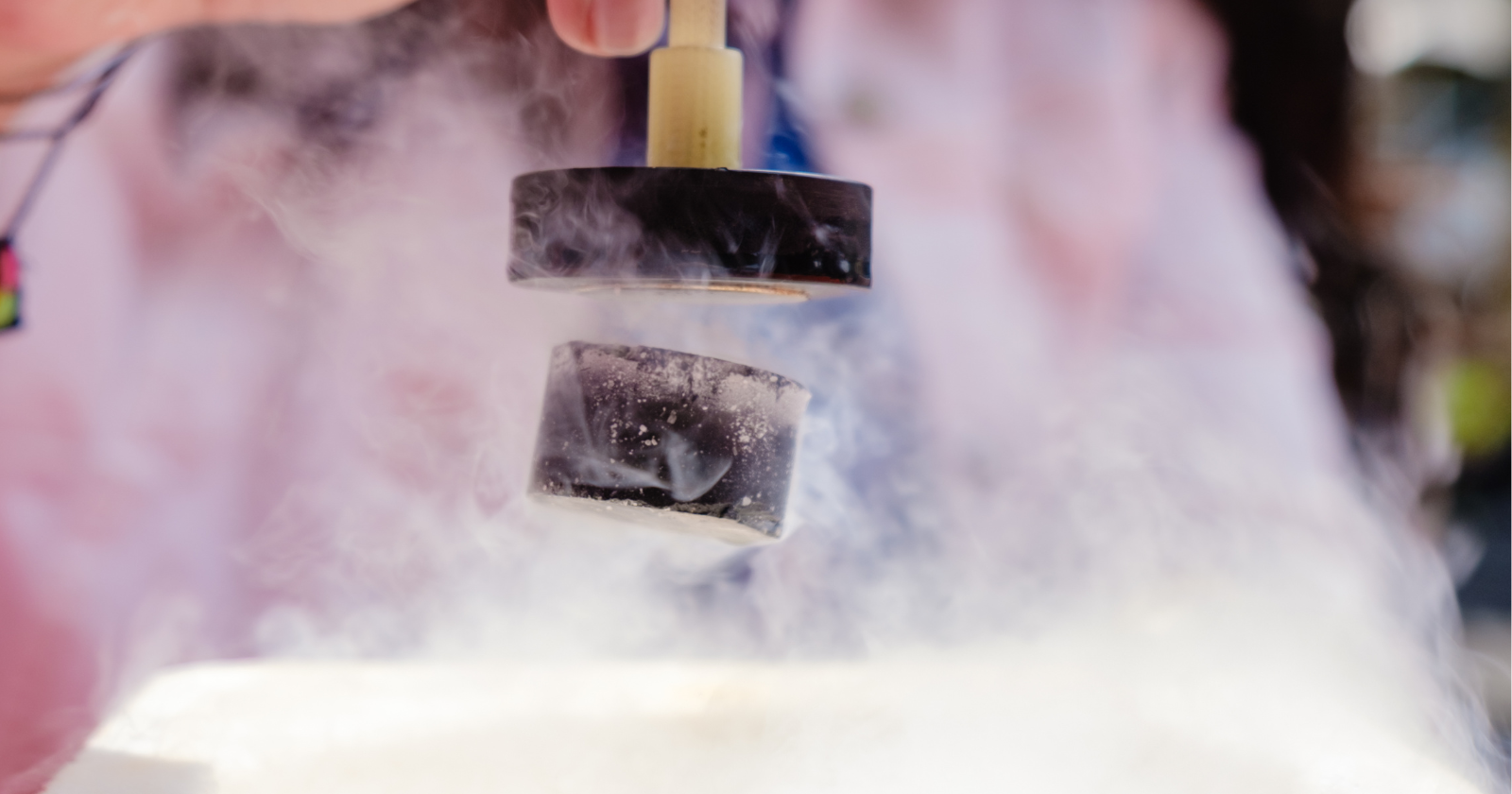
Zero resistance is only half the story. In 1933, Walther Meissner and Robert Ochsenfeld discovered that a superconductor also actively expels magnetic fields from its interior — an effect that cannot be explained by perfect conductivity alone. Cool a superconductor through its critical temperature in the presence of a magnet, and the field is pushed out. Place a small magnet above a cold superconducting disc, and the magnet floats, stably, in mid-air. The Meissner effect is the reason superconductors are not merely very good conductors; they are a genuinely distinct phase of matter, defined by symmetry as much as by conductivity.
This is what makes maglev trains possible, and what allows the enormous magnets inside an MRI scanner to hold field strengths of several tesla — thousands of times stronger than a fridge magnet — with no ongoing power draw once the current is set circulating. The current in an MRI’s superconducting coils is, in the same sense as Onnes’s mercury, essentially permanent for the life of the machine.
Why the cold is the problem
Onnes needed 4.2 K to see the effect in mercury. Most classic superconductors — lead, niobium, tin — behave similarly, with critical temperatures below about 20 K. That means liquid helium, which is expensive, finite (helium is a non-renewable extract of natural gas wells) and awkward to handle.
The picture changed in 1986, when Georg Bednorz and Alex Müller at IBM Zurich found a copper-oxide ceramic that became superconducting at 35 K. Within a year, related compounds pushed the critical temperature above 77 K — the boiling point of liquid nitrogen, which is cheap and pours out of a tap in any well-equipped lab. Bednorz and Müller won the Nobel Prize in 1987, one of the fastest turnarounds in the prize’s history. The current record for a superconductor at ambient pressure sits above 130 K, still deeply cryogenic by everyday standards but no longer exotic.
Nobody fully understands why these “high-temperature” cuprate superconductors work. BCS theory, so successful for metals, does not cleanly explain the ceramics. The mechanism of pairing in a cuprate is one of the outstanding open problems in condensed matter physics. Something pairs the electrons; what plays the role of the lattice vibrations in BCS is still argued about, three decades on.
The hunt for room-temperature superconductivity
The prize, obvious to everyone, would be a material that superconducts at room temperature and ambient pressure. Power grids would shed their transmission losses. Computers could run without heat sinks. Fusion reactors, which rely on superconducting magnets to confine plasma, would become dramatically cheaper. Trains could levitate on cold rails without needing to be encased in cryogenic sleeves.
Progress has been real but incremental — and, in recent years, occasionally embarrassing. Claims of room-temperature superconductivity in hydrogen-rich compounds under enormous pressures have been made and, in some cases, retracted. The 2023 excitement around a Korean material called LK-99, which briefly seemed to levitate on video and swept social media, evaporated within weeks under careful replication attempts. What remains true: no one has yet demonstrated a superconductor that works in the conditions of a normal room, and the theoretical arguments for whether such a thing is possible at all remain unsettled.
What is settled is the underlying phenomenon. Onnes’s mercury, immersed in helium colder than the surface of Pluto, still carries the same lossless current it did in 1911. The theory has been refined, the materials multiplied, the applications built out into billion-dollar industries — but the basic strangeness has not gone away. A ring of the right metal, cold enough, will hold its current the way a spinning top in the vacuum of space would hold its spin: not forever, in principle, but for so long that “forever” is the only useful word for it.
It is one of the cleanest examples in physics of a rule that quietly runs everything else: at low enough temperatures, matter stops behaving like a crowd of individual particles and starts behaving like a single coherent thing. The electrons in a superconductor are not flowing past each other. They are marching in step. And nothing in the lattice they move through has enough energy to break the formation.
