

Suzanne Simard’s 1997 forest experiment did not show trees whispering to each other. It showed something narrower, stranger, and easier to test: carbon that began in the air around a paper birch seedling later appeared inside a neighbouring Douglas fir, after passing through roots and fungal tissue in the soil.
The experiment, published in Nature in August 1997, used two carbon labels in the field. Paper birch and Douglas fir seedlings were sealed in plastic labelling chambers, exposed to carbon-14 dioxide or carbon-13 dioxide, left for a nine-day chase period, then harvested and analysed to see where the labelled carbon had gone.
The result was not a fairy tale about kindness. It was a measurement. Carbon moved both ways between Betula papyrifera, the paper birch, and Pseudotsuga menziesii, the Douglas fir, with a net gain by Douglas fir in the second year of the field experiment.
That was enough to change the argument about forests.
What the threads actually are
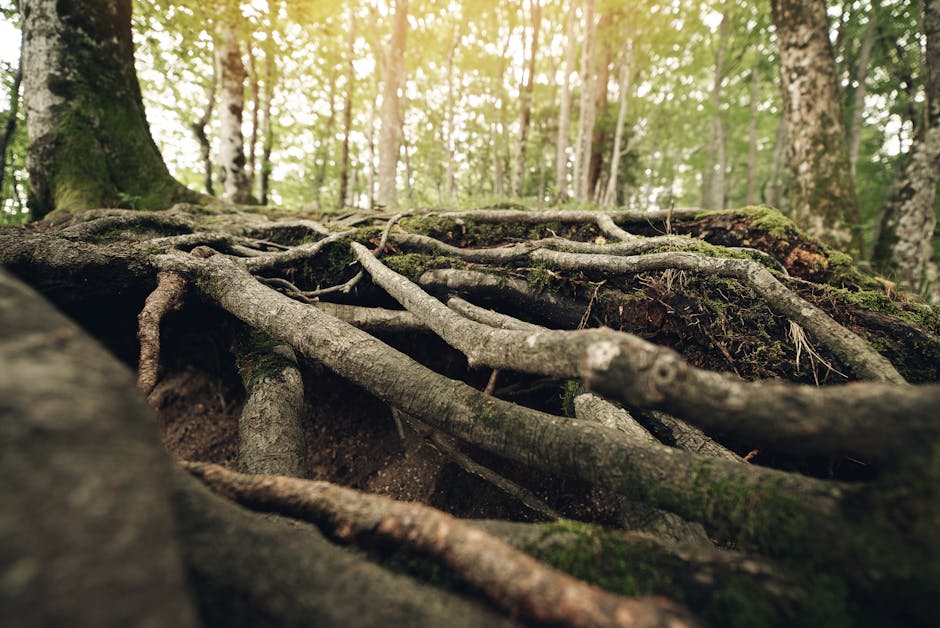
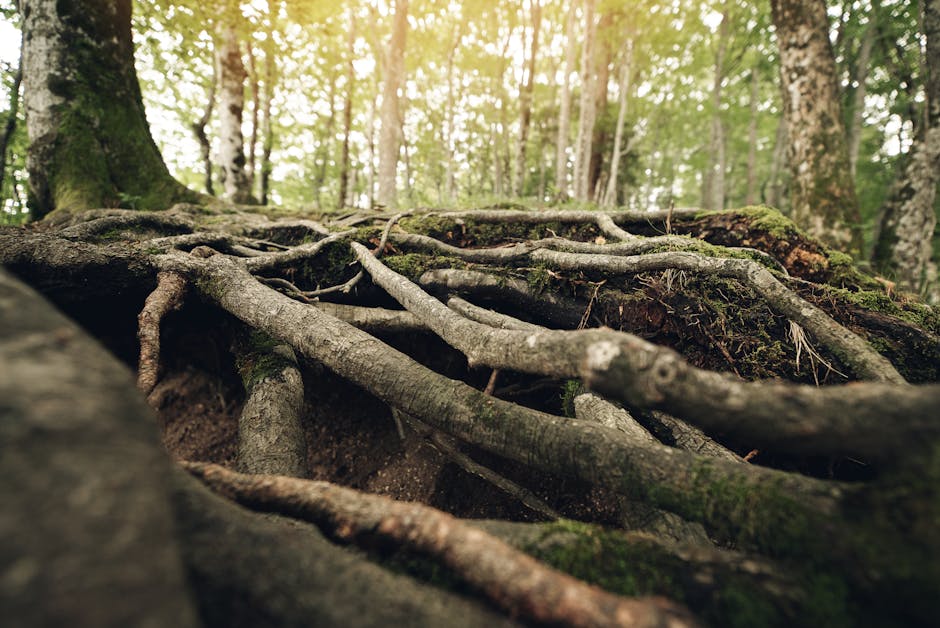
Under most forest floors, the fine root tips of trees are wrapped, entered, or extended by fungal tissue. These partnerships are called mycorrhizae. The word comes from Greek roots meaning fungus and root, and the name is literal: a living junction between plant and fungus.
The exchange is ancient and practical. The tree makes carbon-rich sugars by photosynthesis. The fungus receives carbon from the tree and, in return, helps the plant reach water, phosphorus, nitrogen, and other soil resources at a scale that roots alone cannot easily cover.
Mycorrhizal fungi grow as microscopic filaments called hyphae. A single filament is thinner than a human hair. Massed together, they form mycelium, a branching underground body that can run through soil in mats, fans, cords, and threads.
When different plants share compatible fungal partners, those fungal networks can create pathways between root systems. The network is not a cable laid for the trees’ benefit. It is fungal tissue, alive in its own right, but it can become the bridge through which atoms move.
This is the structure that later became famous as the wood-wide web, a phrase attached to the 1997 Nature cover story about Simard and her co-authors’ work. The metaphor stuck because it was vivid. It also caused trouble, because it made a difficult ecological system sound like a social network with roots.
Simard’s birches and firs
Simard’s study was built to answer a clean question: could carbon move between two tree species in the field through shared ectomycorrhizal fungi, rather than merely leaking through soil or being recycled as stray carbon dioxide?
The design used three-seedling groups planted half a metre apart in forest soil: paper birch, Douglas fir, and western red cedar. The cedar mattered because it lacked the same ectomycorrhizal connection and served as a check on indirect isotope movement through soil pathways.
After the labelling period, the seedlings were separated into foliage, stems, coarse roots, and fine roots. Carbon-13 was measured by mass spectrometry. Carbon-14 was measured by liquid scintillation. This was not a simple field moment where a handheld counter settled the question in an hour.
What the analysis showed was bidirectional transfer. In the first year, carbon moved both ways without a clear net winner. In the second year, when the seedlings were older and root-fungal connections were more developed, Douglas fir gained carbon overall from paper birch.
The effect changed with light. Douglas fir seedlings in deeper shade received more net carbon from birch than seedlings in partial shade or full light. In the authors’ interpretation, the flow fit a source-sink pattern, with more carbon moving toward the tree under greater carbon stress.
That detail is the reason the experiment still matters. It did not merely show that labelled carbon could be detected elsewhere. It showed that the amount of transfer changed with the condition of the receiver.
What is settled, and what is not
The cautious version of the finding is well supported: mycorrhizal networks exist, trees can share compatible fungal partners, and labelled carbon can move between connected plants under experimental conditions.
The broad public version is more contested. In 2023, researchers writing in New Phytologist re-examined the evidence behind the mother-tree hypothesis and argued that significant net carbon transfer through common mycorrhizal networks, in a way that clearly benefits receiving seedlings, remains insufficiently demonstrated.
That critique did not say the fungi are imaginary. It challenged the stronger story that large old trees routinely feed younger trees through fungal pipelines in a way that explains forest regeneration.
Simard and her collaborators have kept building the other side of the case. The Mother Tree Project, housed at the University of British Columbia’s forestry program, lists later work on Douglas fir networks, kin effects, harvest intensity, retention of legacy trees, and mycorrhizal inoculum after logging.
The argument, then, is not over whether fungi and roots matter. It is over how far the carbon-transfer result should be pushed. A measured transfer of labelled carbon is one thing. A forest behaving like a single nurturing organism is another.
The eavesdropping problem
The most cinematic version of the wood-wide web says that plants warn each other of insect attack through fungal networks. That claim has also become harder to state simply.
In January 2025, a University of Oxford-led team reported a modelling study on plant-fungal signalling and argued that plants are more likely to be eavesdroppers than altruists. The question was evolutionary: why would a plant under attack spend energy warning competitors?
Plants do release chemical cues when damaged by herbivores or pathogens. Neighbours can detect changes and increase their own defences. The Oxford team’s point was that the cue does not have to be a deliberate warning. It may be leakage, surveillance, manipulation, or the fungus itself monitoring one host and altering conditions for another.
That distinction matters. A smoke alarm and the smell of smoke both tell you something is burning. Only one was built to warn you.
The forest may carry information. That does not mean the sender is generous, or even trying to send.
Why the fungus matters most
The fungus is not a passive wire. It is an organism with its own metabolism, its own survival problem, and its own bargaining position.
Mycorrhizal fungi receive carbon from plant hosts because they cannot photosynthesise. In exchange, they gather mineral nutrients and water from soil. This relationship is old enough to predate forests as we know them. University of Guelph evolutionary biologist Hafiz Maherali has described plant-mycorrhizal partnerships as more than half a billion years old, and noted that over 90 percent of plant species form mycorrhizal symbioses.
From the fungus’s point of view, a forest is not a family. It is a living exchange system. Multiple trees can be carbon suppliers. Multiple fungi can be nutrient brokers. The lines between cooperation and competition blur because the same thread can serve both.
That is why the marketplace metaphor often fits better than the friendship metaphor. Carbon, nitrogen, phosphorus, water, and information can move through biological networks, but every participant is under selection pressure. The fungus has no obligation to act like a postal service for trees.
This makes the result less sentimental but not less remarkable. A carbon atom fixed from air by one species can enter another species through a third organism that is neither plant’s servant.
What the isotope trail actually proved
Back in the British Columbia forest soil used for Simard’s experiment, the important evidence was not maternal love, memory, or intention. It was labelled carbon in the wrong plant.
One atom had been in carbon dioxide around a seedling. Photosynthesis pulled it into living tissue. Roots and fungi carried it below ground. Days later, it appeared in a neighbouring tree of a different species.
That is the fact at the centre of the story. The rest, the mother trees, the warnings, the cooperation, the fungal bargaining, is the argument that grew around the isotope trail.
For readers who want the broader pattern, this article belongs beside other Fact Explainers about hidden systems that only become visible when someone measures them, from Voyager 1’s 22-hour radio delay to the Carrington storm that made telegraph wires spark and the lost bath toys that exposed ocean currents.
The soil under a forest path can look still from above. Underneath, it is threaded with fungal bodies older in design than roots, older than trunks, older than the word forest itself, carrying atoms through darkness from one living thing into another.
