

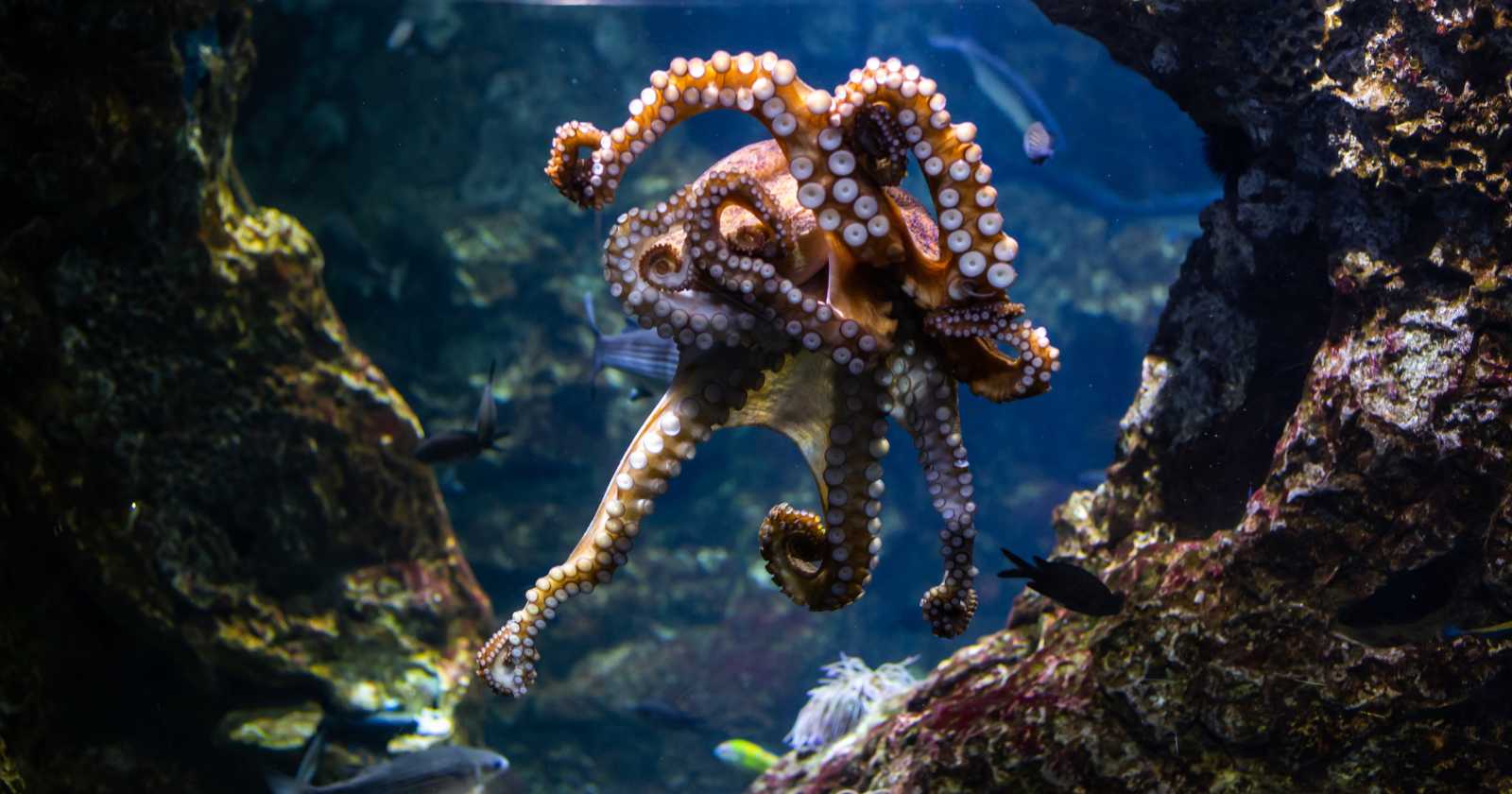
A common octopus (Octopus vulgaris) can solve a maze with one arm while another arm, on the far side of its body, is independently unscrewing the lid of a jar to get at a shrimp. The two limbs are not coordinated by a central command. They are, in a real sense, thinking separately. Each of those eight arms contains its own bundle of about 40 million neurons, and together they hold roughly two-thirds of the animal’s half-billion nerve cells — a nervous system so radically decentralised that biologists studying it have started calling the octopus the closest thing on Earth to an intelligent alien.
Half a billion neurons puts the octopus in the rough neighbourhood of a dog. The strange part is where they sit.
In a human, almost every neuron lives in the brain or the spinal cord. In an octopus, the central brain — a donut-shaped organ wrapped around the oesophagus — holds only about 180 million. The other 350 million are spread through the arms, with smaller clusters in the optic lobes behind the eyes.
An arm that tastes what it touches
Each sucker on an octopus arm is a sensory organ in its own right. A large Octopus vulgaris can carry around 2,000 of them, and every single one is studded with chemoreceptors that let it taste whatever it touches. The animal does not need to bring food to its mouth to know whether it is food.
When an arm slips into a rock crevice, the suckers along its length are sampling the chemistry of every surface they brush. Researchers have identified a family of receptors unique to cephalopods that detect bitter and greasy molecules — the chemical signatures of prey hiding in the dark. The arm reaches into a hole the octopus cannot see into, and the arm itself decides whether what it found is worth grabbing.
That decision happens locally. The signal does not have to travel back to the central brain, get processed, and come back as an instruction. The arm has the wiring to act on its own.
What “distributed” really means
Neuroscientists describe the octopus nervous system as a confederation rather than a hierarchy. The central brain sends a goal — find food in that direction — and the arms work out the motor details themselves. Researchers writing in Ars Technica’s coverage of cephalopod neurology describe the arms as carrying out complex movements with only loose oversight from above.
Severed octopus arms, kept alive in oxygenated seawater for an hour, still reached toward food when their skin was touched. They still curled. They still pulled. The arm did not need the brain to know what an arm was for.
This is not a reflex in the way a chicken running headless is a reflex. The movements were shaped, goal-directed, and adapted to the stimulus. The arm contains, in its axial nerve cord, the circuitry for a small repertoire of intelligent-looking behaviour.
Eight problem-solvers attached to one animal
Watch a hunting octopus on a coral reef and you will see something that looks impossible. Two arms might be unwrapping a crab from a shell on the left side of its body. A third is poking experimentally into a different crevice on the right. A fourth is anchoring the animal to a rock. The eyes are pointed somewhere else entirely.
None of those tasks are being micromanaged from headquarters. The brain is doing something more like supervising a team. It sets the broad intention; the arms execute, negotiate, and improvise.
And the arms talk to each other. Signals run directly between arms through a ring-shaped nerve at their base, without routing through the brain at all. One arm finding food can trigger neighbouring arms to converge on the same spot — a kind of peripheral group chat.
The mating arm that tastes a partner
The sensory autonomy of the arms shows up in some genuinely strange places. Male octopuses possess a specialised mating arm called the hectocotylus, used to transfer sperm packets to a female. Recent work covered by Smithsonian magazine found that this arm carries chemoreceptors capable of tasting reproductive hormones — effectively letting it confirm, by chemical sampling, whether the female it has reached toward is sexually mature and the right species.
This matters because female octopuses sometimes eat males. An arm that can identify its target by taste, while the rest of the octopus keeps a wary distance, is a useful piece of biology.
Why the body got smarter than the brain
The octopus body has no skeleton. An octopus arm can bend at any point, in any direction, twist, elongate, and shorten. It has, in engineering terms, a near-infinite number of degrees of freedom.
A centralised brain trying to compute the exact position of every point along eight infinitely flexible limbs would drown in its own calculations. Evolution’s answer was to push the computation outward. Each arm handles its own geometry. The brain only has to issue intent.
This is why some roboticists studying soft robotics have spent the last fifteen years copying octopus arms directly. A rigid arm with motors at every joint is easier to model but limited. A soft arm with distributed sensors and local control can squeeze into spaces and grip irregular objects in ways a traditional robot cannot.

Tested with mirrors and mazes
Octopuses do not just react. They learn, plan, and recognise. They can be trained to open childproof pill bottles. They distinguish individual human keepers, sometimes squirting water at the ones they dislike. They carry coconut shells across the seafloor to use as portable shelters — one of the few documented cases of tool use in an invertebrate.
A 2025 experiment found that octopuses can use a mirror to locate prey hidden from direct view, the first invertebrate shown to do so. The animal understands that the reflection corresponds to something real in space, and it uses that information to redirect an arm.
The implication is uncomfortable for any neat theory of intelligence. Most models of cognition assume a central processor doing the thinking. The octopus suggests intelligence can be a network — smeared across a body, with the part you would call the “brain” acting more like a coordinator than a CEO.
What it might feel like to be one
The philosopher Peter Godfrey-Smith, whose book Other Minds brought octopus cognition to a wider readership, has argued that we have almost no framework for imagining the subjective experience of an animal whose nervous system is built this way. Does the central brain feel what the arms feel? Or does each arm have something like its own narrow stream of attention, with the central self only getting summaries?
The honest answer is that nobody knows. The neural architecture is genuinely unlike anything in a vertebrate. Even comparing it to a brain feels slightly wrong — it is more like nine semi-independent nervous systems that have learned to cooperate.
Octopuses last shared a common ancestor with humans more than 600 million years ago, before the Cambrian explosion. That ancestor was probably a flat, simple worm-like creature with a scattering of nerve cells. Everything sophisticated about octopus cognition evolved independently, on a separate branch of the animal tree. It is intelligence reinvented from scratch.
A short life for so much brain
The cruellest fact about octopuses is how briefly they get to use any of this. Most species live one to two years. A female common octopus lays her eggs, stops eating, guards the clutch for months, and dies shortly after they hatch. The giant Pacific octopus, the longest-lived species, manages around four to five.
Every generation of these animals is, in a real sense, starting from zero. Whatever the eight arms learn — how to open this jar, how to fit through that gap, how to fool that crab — goes with them. There is no octopus culture passed down, no parent teaching a child.
A creature with half a billion neurons spread through its body, capable of tasting with its skin, problem-solving in parallel, and recognising itself in a mirror, gets perhaps eighteen months to do it all. Then the arms that learned to think for themselves stop moving, and a new generation begins again on the seafloor, working out the world one sucker at a time.
