



Key Points
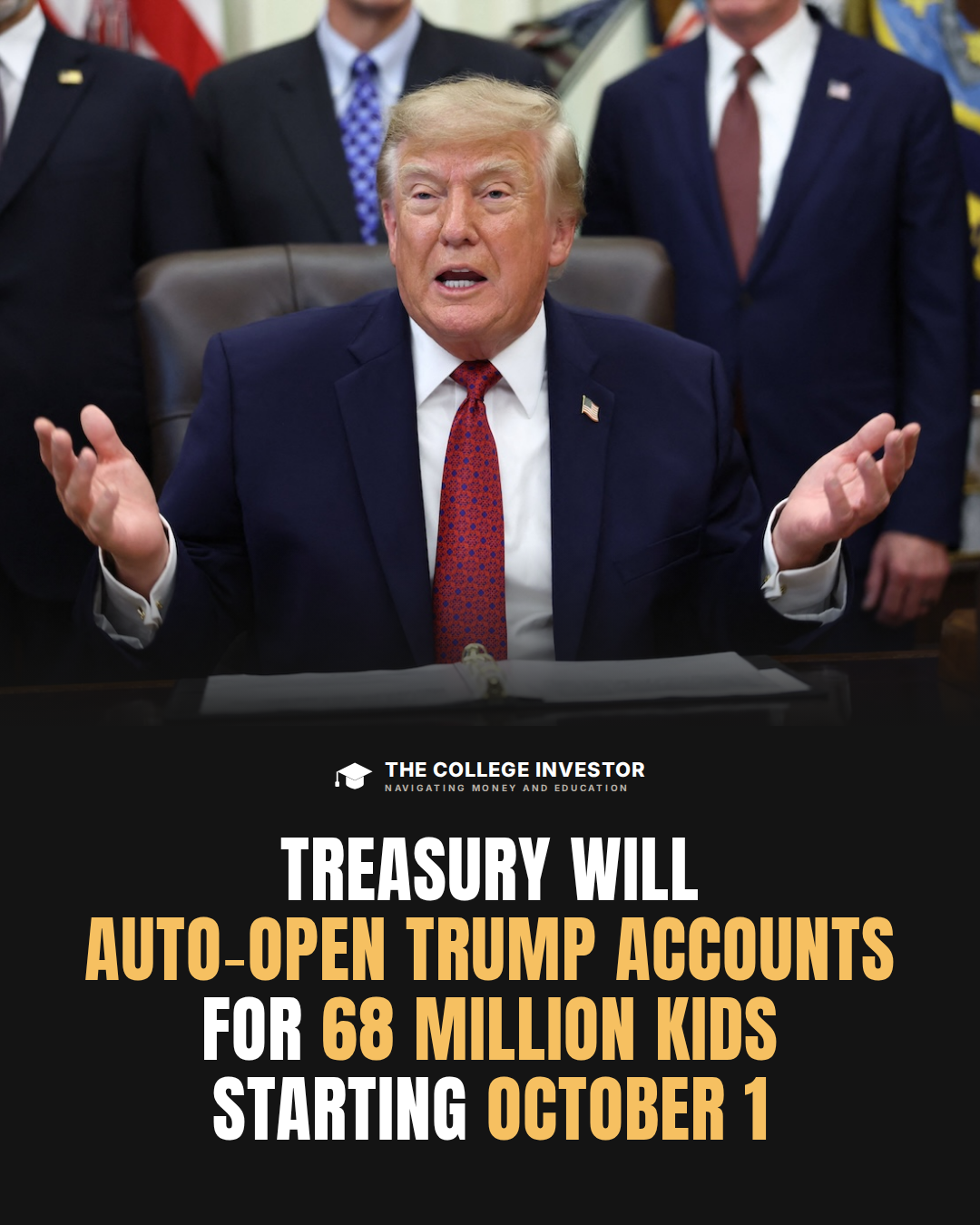
- Starting on or about October 1, 2026, Treasury will open a Trump account for every eligible child under 18 with a Social Security number, no parent action required.
- The move follows weak sign-ups: about 5.6 million Forms 4547 processed against 73.37 million eligible kids as of July 30, under 8%.
- Auto-opened accounts can only receive the $1,000 federal seed deposit if a parent files the tax-form election.
The Treasury Department and IRS on September 29 released temporary regulations directing the Treasury Secretary to open a Trump account for every eligible child in the country, “on or about October 1, 2026.”
The rules, published in the Federal Register on September 30 and effective the same day, reverse the position Treasury took in March, when it said it would require a parent to file Form 4547 to open a Trump account for a child.
The reason for the reversal is in Treasury’s own numbers. As of July 30, 2026, the IRS had processed about 5.6 million electronic Forms 4547 against an estimated 73.37 million eligible children, or under 8%. “In most states, the number of processed electronic Forms 4547 was less than 10% of the estimated number of eligible children,” the regulations state. That is only modestly ahead of the 4 million accounts the IRS reported in April, and Treasury concluded an opt-in program would have plateaued “close to 50% of eligible families.”
Why It Matters
Treasury estimates the change will add more than 60 million Trump accounts in 2026 alone, impacting 73 million children in 44 million families. It’s also estimated that roughly two million additional accounts year will be opened going forward.
Every child under 18 with a Social Security number is included, not just the 2025 through 2028 babies who qualify for the $1,000 federal seed deposit. Parents who have been weighing a Trump account against a 529 plan will soon find the Trump account already exists whether they wanted one or not.
It’s important to note that this policy will impact lower-income families significantly more than those at a higher income. Middle- and higher-income families have been opening these accounts at a much higher rate than lower-income families.
Treasury’s Table 1 shows about 8.61 million eligible children in households with no adjusted gross income or a missing return, and roughly 10,000 processed forms for that group, a take-up rate near 0.1%. The agency’s blunt summary: “Proportionately, children in lower income groups are the biggest beneficiaries” of the rule.
That matters for families who have never had a reason to think about how a Trump account affects financial aid because they never had one.
The Catch: Auto-Opened Accounts Do Not Get The $1,000 Automatically
The auto-opened account, which the regulations call an “auto account,” can only accept two kinds of money during the growth period. The first is qualified general contributions from states, tribal governments, and 501(c)(3) nonprofits. The second is the $1,000 pilot contribution, but only “if a pilot program election has been made by a pilot program-electing individual,” which under the March proposed rules is generally the parent claiming the child as a dependent.
Treasury says the statute does not let the Secretary make that election on a family’s behalf, so the $1,000 baby bonus still requires a Form 4547 election.
The auto account also cannot take money from parents, grandparents, or employers. To contribute, a parent or guardian has to “claim” the account through an electronic application or web page, verify their identity, and establish their legal authority to see the child’s tax information.
Claiming triggers a trustee-to-trustee rollover of the full balance into either a “claimed initial Trump account” at Treasury’s trustee or a rollover Trump account at a provider of the family’s choosing. Only then can it accept the $5,000 annual contribution that a standard Trump account allows.
How The Money Gets Invested
Until a family claims it, an auto account’s only holding is an interest in a “master group trust” that Treasury runs for all auto accounts collectively. The trust can hold only eligible investments, meaning U.S. equity index funds charging 0.1% or less with no leverage, plus donated stock and, after the growth period, cash.
Neither the trustee nor the Secretary will have discretion over proxy voting or other corporate actions, which Treasury says keeps administration uniform across tens of millions of accounts. That is a narrower menu than the fund lineups families can choose in a 529 plan.
The regulations also formalize how donors like the Michael & Susan Dell Foundation, which pledged $6.25 billion to children born between 2016 and 2024 living in ZIP codes with median household income below $150,000, will move money in.
Donors contribute to Treasury first, and Treasury then makes equal contributions to every account in a “qualified class” of at least 5,000 beneficiaries defined by birth year, geography, or both. Donated public stock may be held directly in accounts, subject to a five-year minimum holding period. Treasury wrote that donors “prefer that their contributions reach all children, not just children whose parents have the awareness to opt in,” which is a large part of why it built the auto-enrollment structure at all.
For reference, when I opened Trump accounts for my kids, it took about 90 days before the Dell Foundation money was posted.
How This Connects
Treasury’s own math shows why the seed deposit and any class contribution are worth chasing. Using broad U.S. equity returns for birth cohorts from 1926 to 2006, the regulations estimate $1,000 invested at birth grows to a median $6,180 by age 18, with a 10th-percentile outcome of $2,980 and a 90th-percentile outcome of $13,800.
Even $1,000 invested at age 17 lands at a median $1,160 a year later. Those figures track the projections in our Trump accounts explainer, and they are the case for making sure a 2025 through 2028 baby’s parent actually files the pilot election rather than assuming the auto-open handles it.
What’s Next
Treasury will make its first round of elections on or about October 1 and says subsequent rounds will be frequent enough to make parent-initiated openings a “rare exception.”
The temporary rules apply to tax years beginning January 1, 2026, and expire September 30, 2029. A companion proposed rule takes comments through November 30, 2026, including on how ABLE rollovers should work for auto accounts whose beneficiaries Treasury knows nothing about.
Watch for the claim portal’s launch and for whether the IRS moves the pilot election onto the same screen. Until then, the Form 4547 process remains the only path to the $1,000.

Get the latest financial news and actionable insights.
-
1
Enter your email and subscribe.
-
2
Get the latest personal finance and education news delivered every week.
-
3
Take control of your finances with real insights.
-
4
We won’t spam you, ever!

Robert Farrington is the founder of The College Investor and is widely recognized as one of the nation’s leading voices on student loan debt and saving for college. He holds an MBA from UC San Diego Rady School of Management and has spent over 15 years researching, writing, and advising on student loans, 529 plans, financial aid programs, and saving and investing for young professionals.
Robert has been featured in the The New York Times, The Wall Street Journal, The Washington Post, NBC News, and Forbes, where he has been a regular personal finance contributor for over a decade. His work combines both professional expertise and personal experience – he successfully navigated his own student loan repayment journey and has helped thousands of readers do the same.
He is committed to making the intersection of personal finance and education transparent and accessible. You can learn more about Robert on the About Page or on his personal site RobertFarrington.com.
