


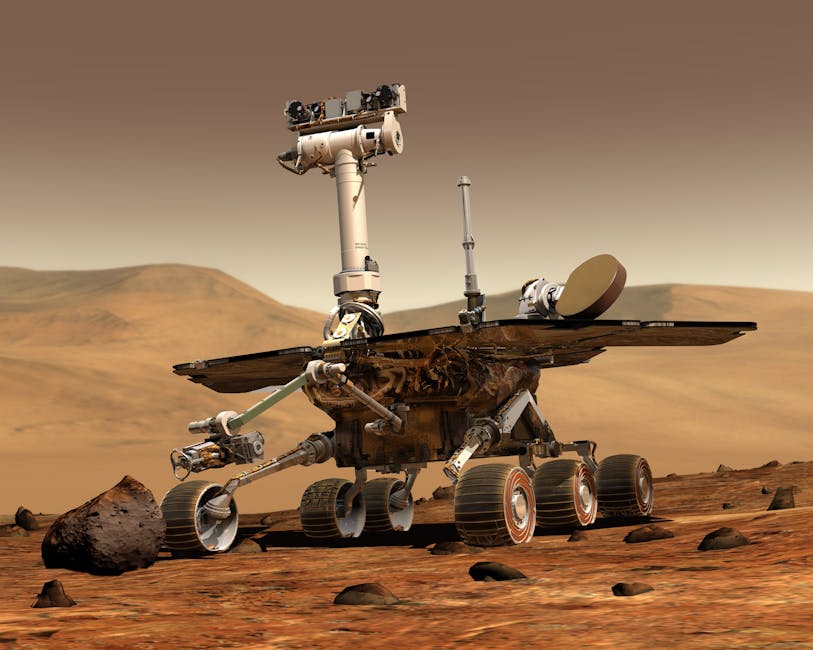

Perseverance landed in Jezero Crater on February 18, 2021, in a basin that scientists believe held a lake roughly 3.5 billion years ago, and almost everything the rover has photographed since then is haunted by water that is no longer there. The crater floor is dry. The river that fed it is gone. What remains are rocks arranged in ways that look, to a human eye scrolling through raw image downloads from JPL, slightly too neat to be random.
That tension is the central puzzle of the mission: ancient Martian water sorted rocks with such consistency that the results trick human pattern recognition into seeing intent. Engineers at NASA’s Jet Propulsion Laboratory in Pasadena spend their days looking at piles of rubble on a planet no person has ever set foot on, trying to work out which arrangements were made by ancient water, which by wind, and which by the rover itself bumping into something on a slope. Almost every one of those arrangements, once decoded, points back to a river that vanished three billion years ago.
What a stack of rocks looks like on Mars
The Martian surface is not the empty red plain of old paintings. Jezero is strewn with cobbles, layered outcrops, sand drifts, and clusters of stones that sit on top of finer material in ways geologists call “perched.” A perched rock is one that does not match the ground around it. It came from somewhere else, carried by water or ice or a long-ago landslide, and then dropped.
When several perched rocks end up close together, sometimes stacked, sometimes lined up along an invisible contour, the images that come back from Perseverance’s Mastcam-Z and Navcam systems start to look uncannily like something a hiker might build on a trail. They are not cairns. Nobody built them. But the pattern-recognition machinery in a human brain does not know that on first glance.
The river that vanished three billion years ago
Jezero was chosen for a reason. Orbital imagery showed a clear delta on the crater’s edge, the fan-shaped sediment deposit a river leaves behind when it flows into standing water. On Earth, deltas are excellent places to look for preserved organic chemistry. The same logic put Perseverance on top of one.
The water that built that delta stopped flowing roughly three billion years ago, give or take, when Mars lost most of its atmosphere and the surface temperature dropped below the point where liquid water could persist. What the rover drives across now is the dry skeleton of that system. Rocks that look stacked were, in many cases, sorted and deposited by currents that have not existed since before complex life appeared on Earth.
Arethusa and the oldest rocks anyone has ever touched with a robot
In March 2026, the rover reached an outcrop the team named Arethusa, after a freshwater spring in Greek mythology. On the 1,797th Martian day of the mission, Perseverance ground a circular abrasion patch into the rock and trained its instruments on the fresh face. According to NASA JPL’s account of the survey, the Arethusa outcrop is composed of igneous minerals that likely predate the formation of Jezero Crater itself. According to reporting on the find at Earth.com, the rocks at Arethusa may be among the oldest ever studied on the Martian surface, possibly dating back around four billion years.
That detail reframes the stacks. Some of the cobbles scattered across Jezero are not pieces of dried lakebed. They are fragments of crust that existed before the lake, before the delta, before the rivers, blasted out and redistributed by the impact that formed the crater and then nudged around for billions of years by wind and seasonal frost. A “stack” of three rocks might contain material from three different eras of Martian history sitting on top of each other by coincidence, but coincidence shaped, again, by the same vanished water that did the heavy sorting.
Why the human eye keeps finding faces and shapes
The instinct to see arrangement where there is none has a name. It is called apophenia, the tendency to perceive meaningful patterns in random data, and it is the same reflex behind seeing animals in clouds or significance in repeated numbers. A primer on apophenia at Psychology Today notes how easily the brain assembles coincidence into story.
Mars is a particularly fertile ground for it. Every new image is a fresh field of rocks the viewer has never seen, photographed in unfamiliar light, with shadows that fall at angles the eye does not quite trust. The famous “Face on Mars” from the Viking 1 orbiter in 1976 turned out, decades later when higher-resolution cameras revisited it, to be an ordinary mesa. The face was in the resolution, not the rock.
The Perseverance team works hard to suppress that reflex internally and to lean on geochemistry instead. Instruments like PIXL and SHERLOC fire X-rays and ultraviolet lasers at rock surfaces to read their mineral composition. A pattern is interesting only if the chemistry backs it up, and on Jezero’s floor, the chemistry keeps pointing to water-sorted sediment.
Why the stacks are scientifically useful, not just photogenic
When a cluster of cobbles ends up sorted by size, that sorting is data. Fast-moving water tends to drop the heaviest rocks first and carry the lighter ones further downstream. A geologist looking at a streambed on Earth can read the flow speed off the rock sizes. The same logic works on Mars, but the stream has been gone for three billion years.
So NASA engineers have analyzed Perseverance images showing rock patterns that appear organized by ancient water flows dating back three billion years. The intention belongs to physics, not to anything that lived. The rocks were sorted because water has rules about what it can carry, and those rules are the same on every planet.
That is the part the science team tries to communicate when a new image of a peculiar arrangement makes the rounds on social media. The arrangement is real. The intentionality is not. What is real is the water that did the arranging.
Reading Jezero through a rover’s eyes
Perseverance has been on the ground for more than five years, and the further it drives, the clearer the picture of Jezero’s history becomes. The rover has also begun choosing some of its own short routes, completing what JPL described as the first AI-planned drives on another planet in December 2025, with waypoints generated by a vision-language model rather than human route planners. According to coverage of the demonstration at ScienceDaily, the rover used the same imagery and orbital data that human planners would have used, but ran the analysis itself. Mars sits at an average distance of about 140 million miles from Earth, which is what makes that autonomy useful in the first place. NASA currently targets the 2030s for a crewed Mars landing, with the next decade dominated by habitat testing and life-support development. The closest any human has been to a Martian rock is a screen at JPL.
The samples Perseverance has drilled are sealed in titanium tubes, cached on the surface for a future return mission that has been repeatedly redesigned and rescheduled. The answer to the question the whole mission was sent to ask, whether anything ever lived in Jezero, is sitting in a tube on Mars, waiting.
Which brings the story back to that 2022 image: a small heap of broken rocks resting on the Martian surface in a pattern that looked almost intentional. What the team eventually offered was not a discovery of design but a reconstruction of flow. The cobbles in that frame had been graded by current, perched by receding water, and left in place when the river that did the work froze out of existence three billion years ago. The pattern was the river’s signature, written in the only ink it had left. The rover that found it is still driving across the dry bed, photographing more of the same handwriting, frame by frame, for people at desks 140 million miles away who keep reading.
FAQ
Did Perseverance actually find a “stack” of rocks made by something intelligent?
No. The arrangements that look intentional are the work of ancient water currents, wind, and impact-redistributed crust. The mission’s geologists treat unusual patterns as clues to past flow, not signs of activity.
How old are the oldest rocks Perseverance has examined?
At an outcrop named Arethusa, abraded in March 2026, the rover encountered igneous material that likely predates the formation of Jezero Crater itself, putting it among the oldest rocks ever studied on the Martian surface.
Is the rover really driving itself now?
On December 8 and 10, 2025, Perseverance completed the first drives on another planet planned by a vision-language model rather than by human route planners at JPL.
When will humans actually walk on Mars?
NASA currently targets the 2030s for a crewed Mars landing. Space agencies are still in the habitat, life-support, and propulsion testing stages, with uncrewed precursor missions planned for the upcoming Earth–Mars launch windows.
