

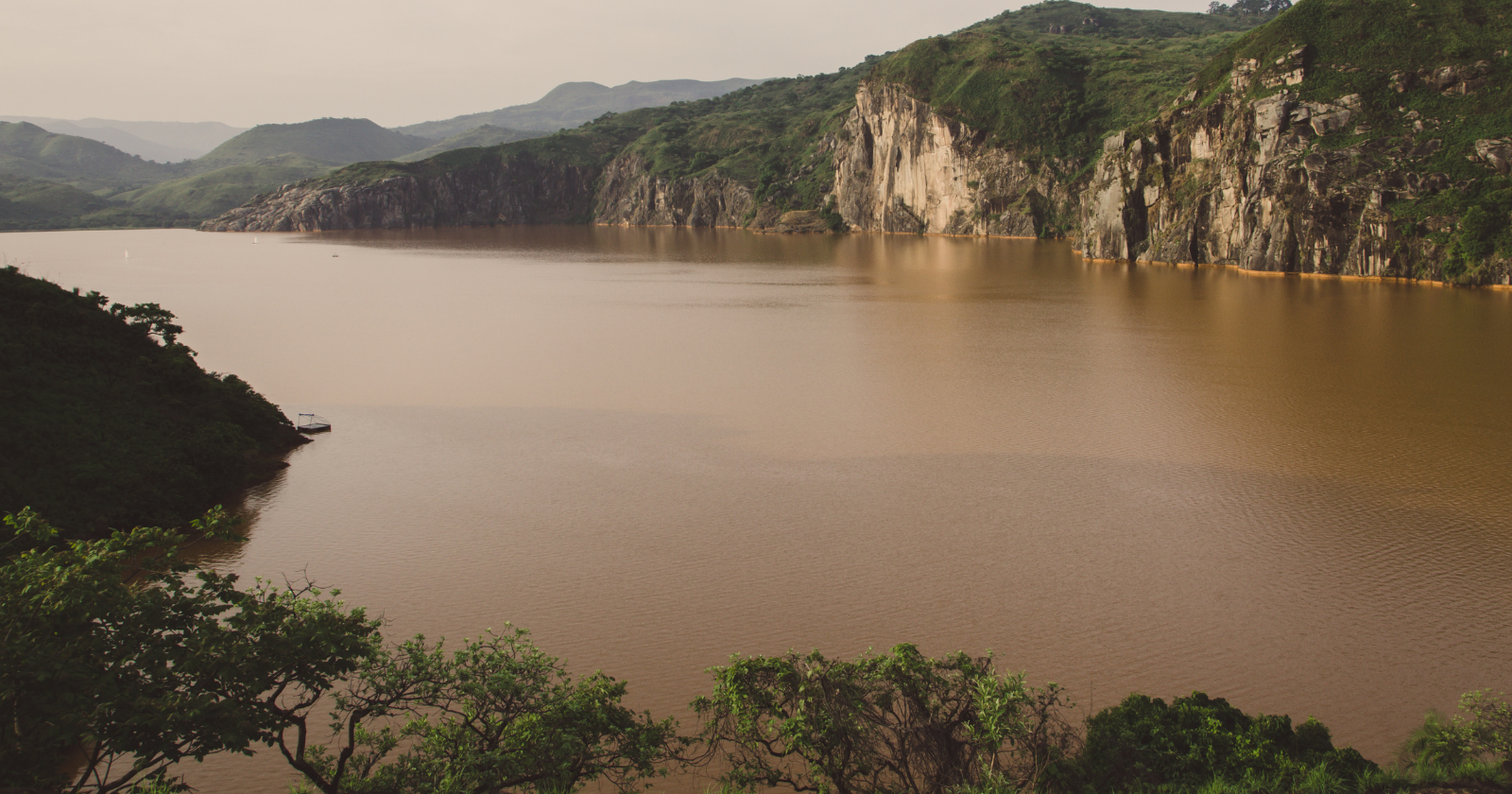
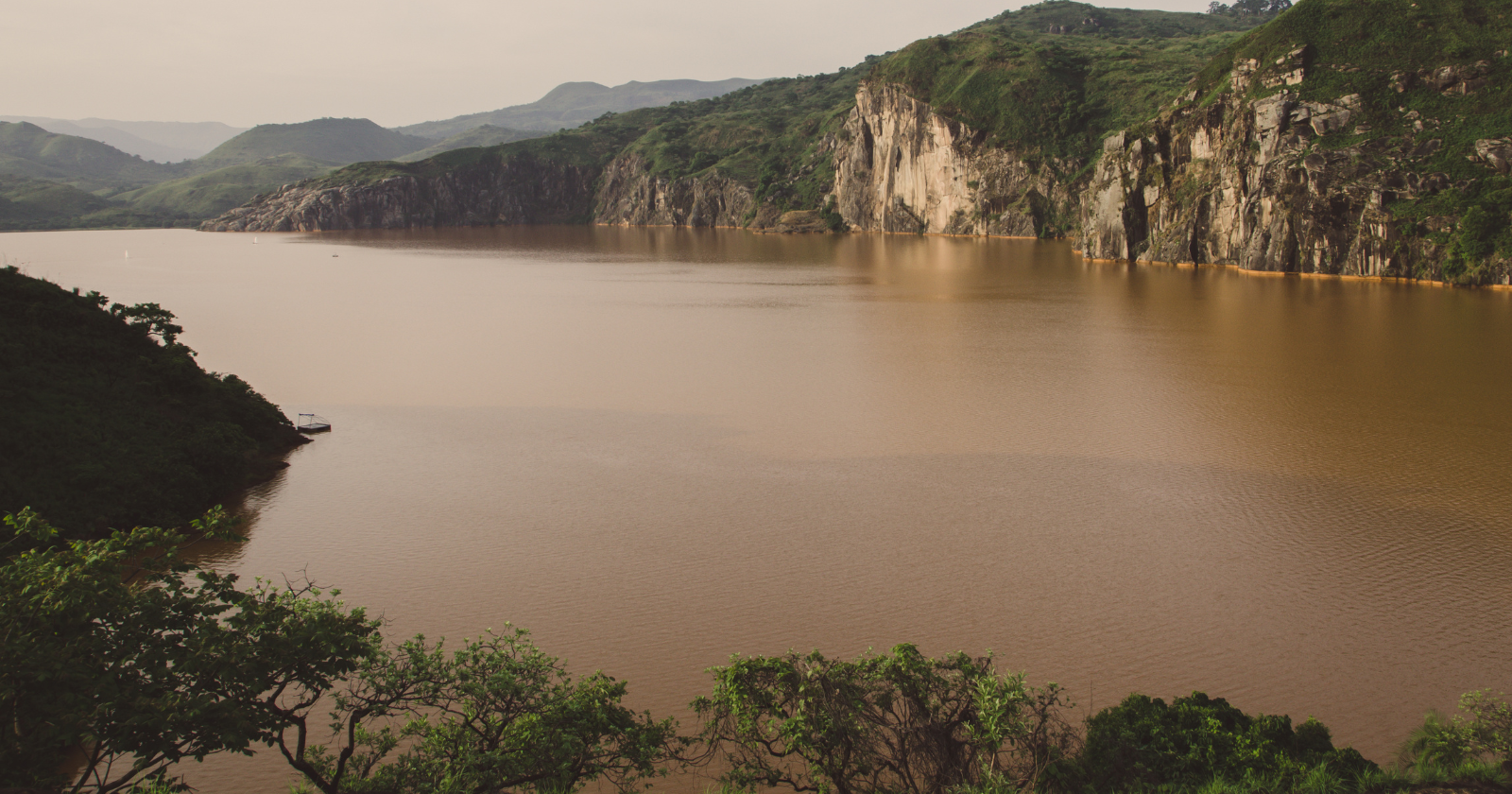
Just before 10 p.m. on 21 August 1986, a low rumble rolled across the hills above Lake Nyos in northwestern Cameroon, loud enough that survivors later described it as thunder in the distance. A white mist rose off the water of the crater lake, slid down the valley walls under its own weight, and poured into the villages of Nyos, Kam, Cha, and Subum. By the time the sun came up the next morning, 1,746 people were dead, along with thousands of head of livestock, and the lake itself had turned a rusty red color.
There was no fire. No flood. No blast crater. The bodies had no wounds. Survivors who woke up found their relatives lying exactly where they had been sitting, cooking, or walking the night before. The killer was carbon dioxide, the same gas that comes out of a soda bottle, released from the bottom of a freshwater lake in a single colossal burp.
A lake that had been quietly loading itself for centuries
Lake Nyos sits in the crater of an extinct volcano along the Cameroon Volcanic Line. The volcano is dead. The magma chamber beneath it is not. For centuries, possibly millennia, CO2 from that deep magma had been seeping up through the lake bed and dissolving into the cold, dense water at the bottom of the crater.
The lake is over 200 metres deep. Water that deep is under enough pressure to hold staggering amounts of dissolved gas, the same way a sealed bottle of seltzer holds far more fizz than an open glass. The lake had effectively become a massive soda bottle, and the cap was the weight of the water above.
What scientists later worked out is that Nyos was meromictic, meaning its layers almost never mixed. Warm water stayed on top, cold gas-saturated water stayed on the bottom, and nothing stirred the two. The bottom layer kept loading. By August 1986, the lower half of the lake was carrying massive amounts of dissolved CO2.
The night the cap came off
Nobody knows for certain what triggered the release. A landslide on the steep crater wall, a small underwater rockfall, a temperature shift, a heavy rain cooling the surface, any of these could have been enough to push a parcel of deep water upward. Once it started rising, the pressure on it dropped, the dissolved CO2 came out of solution as bubbles, and the bubbles dragged more water up behind them in a runaway chain reaction.
The lake essentially turned itself inside out. Witnesses on the rim described a fountain of water shooting high into the air and a wave that scoured trees off the southern shore. Then came the cloud. A massive amount of CO2 boiled out of the water in a matter of minutes.
Carbon dioxide is heavier than air. It hugs the ground. The cloud, possibly 50 metres thick, poured over the lip of the crater and ran downhill at high speed, displacing the breathable air in every valley it filled. It travelled far from the lake before dispersing.
Why CO2 kills so quickly at high concentrations
At normal atmospheric levels, CO2 is about 0.04 percent of the air. Humans exhale air at around 4 percent and feel nothing wrong. Above roughly 7 to 10 percent, things change fast. According to the National Academies’ acute exposure review, inhaling air with CO2 concentrations above about 10 percent causes loss of consciousness within a minute or two, and high concentrations are rapidly fatal.
The cloud that came down off Lake Nyos was almost certainly in that lethal range at ground level. People did not suffocate slowly from a lack of oxygen. They were knocked out within a breath or two, and their respiratory drive shut down. A separate review on submarine atmospheres notes how sharply human physiology breaks down once CO2 rises past a few percent in sustained exposure, which is why submarines and spacecraft monitor it so obsessively.
Survivors who happened to be sleeping in second-storey rooms, or on hillsides above the cloud, mostly lived. Survivors at ground level who lived often woke many hours later, disoriented and surrounded by the dead, and a number of them had blistered or ulcerated skin. Rescuers first assumed these were burns from acidic gas, but the medical team that reviewed 845 survivors concluded the lesions were tied to the hours the victims had spent lying unconscious, not to acid in the air.
The clue from two years earlier
What happened at Nyos was not the first time. In 1984, the same thing had happened on a smaller scale at Lake Monoun, roughly 95 kilometres to the south. That eruption killed 37 people. Cameroonian authorities and visiting scientists had argued at the time about whether it was a terrorist attack, a volcanic eruption, or something stranger.
By the time the Nyos catastrophe was investigated, the pattern was clear. Both lakes sat in volcanic craters. Both were deep, stratified, and saturated with CO2 from below. The phenomenon was given a name: a limnic eruption. As far as the geological record shows, those two events at Monoun and Nyos remain the only confirmed limnic eruptions in recorded history.
The pipes that now keep Nyos breathing
After 1986, an engineering team began work on a solution that sounds almost too simple. If the problem is that gas-saturated deep water never reaches the surface to release its load, the answer is to give it a shortcut.
The team installed a vertical polyethylene pipe running from near the lake bottom up to a raft on the surface. Once a small pump primed the column with rising water, the dissolved CO2 began bubbling out of solution inside the pipe, which made the column lighter than the surrounding water and turned the whole thing into a self-sustaining fountain. The first pipe at Nyos started operating in 2001. Two more were added in 2011. Monoun got its own degassing pipes starting in 2003.
The fountains now jet high into the air, day and night, slowly venting the gas the lake had spent centuries hoarding. Researchers monitoring CO2 levels in the deep water have tracked a steady decline since the system went online.
The lake nobody talks about that is much bigger
Nyos held massive amounts of dissolved CO2. Lake Kivu, on the border of Rwanda and the Democratic Republic of the Congo, holds far more dissolved CO2 and methane. It is roughly a thousand times the inventory of Nyos. Around two million people live on its shores.
Kivu is also stratified, also volcanic, and also slowly loading. A limnic eruption there would not be a village-scale tragedy. It would be a regional one. The good news, if it can be called that, is that Rwanda has been quietly extracting methane from Kivu’s deep water since 2015 to generate electricity, which has the side benefit of relieving some of the gas pressure. Whether the extraction is fast enough to outpace the loading is a question scientists genuinely argue about.
Why the story still matters to anyone who breathes
The Nyos disaster is one of the only times in modern history that a natural release of CO2 killed people in large numbers in a single event. It is not a climate story in the usual sense. The cloud dispersed within a day, and the lake’s contribution to atmospheric CO2 was a rounding error against what humans emit every minute from cars and power plants.
What it did reveal is how exquisitely tuned human physiology is to a very narrow band of CO2 in the air, and how strange the gas’s behaviour becomes once it leaves that band. The CO2 that humans add to the whole atmosphere is measured in parts per million; the cloud that came down off Nyos was measured in tens of percent at ground level. The doses are different by orders of magnitude. The chemistry is the same.
The villages that came back
For years after 1986, the Nyos valley was a forbidden zone. Survivors were resettled to camps. Cattle that wandered back to graze in the lush grass near the lake sometimes died on the spot when small pockets of CO2 still pooled in low ground. Slowly, the Cameroonian government allowed people to return as the degassing pipes brought the gas inventory down.
The lake today looks almost ordinary. It is blue again, not red. Birds nest in the surrounding cliffs. Fish, which were entirely killed in the 1986 event, have been reintroduced. The fountains from the degassing pipes glitter in the middle of the water like a permanent installation, hissing softly. They will need to keep running for decades, maybe centuries, because the magma below the dead volcano has not stopped exhaling, and the lake will keep filling back up, breath by quiet breath, for as long as anyone is around to watch it.
