

Key Points
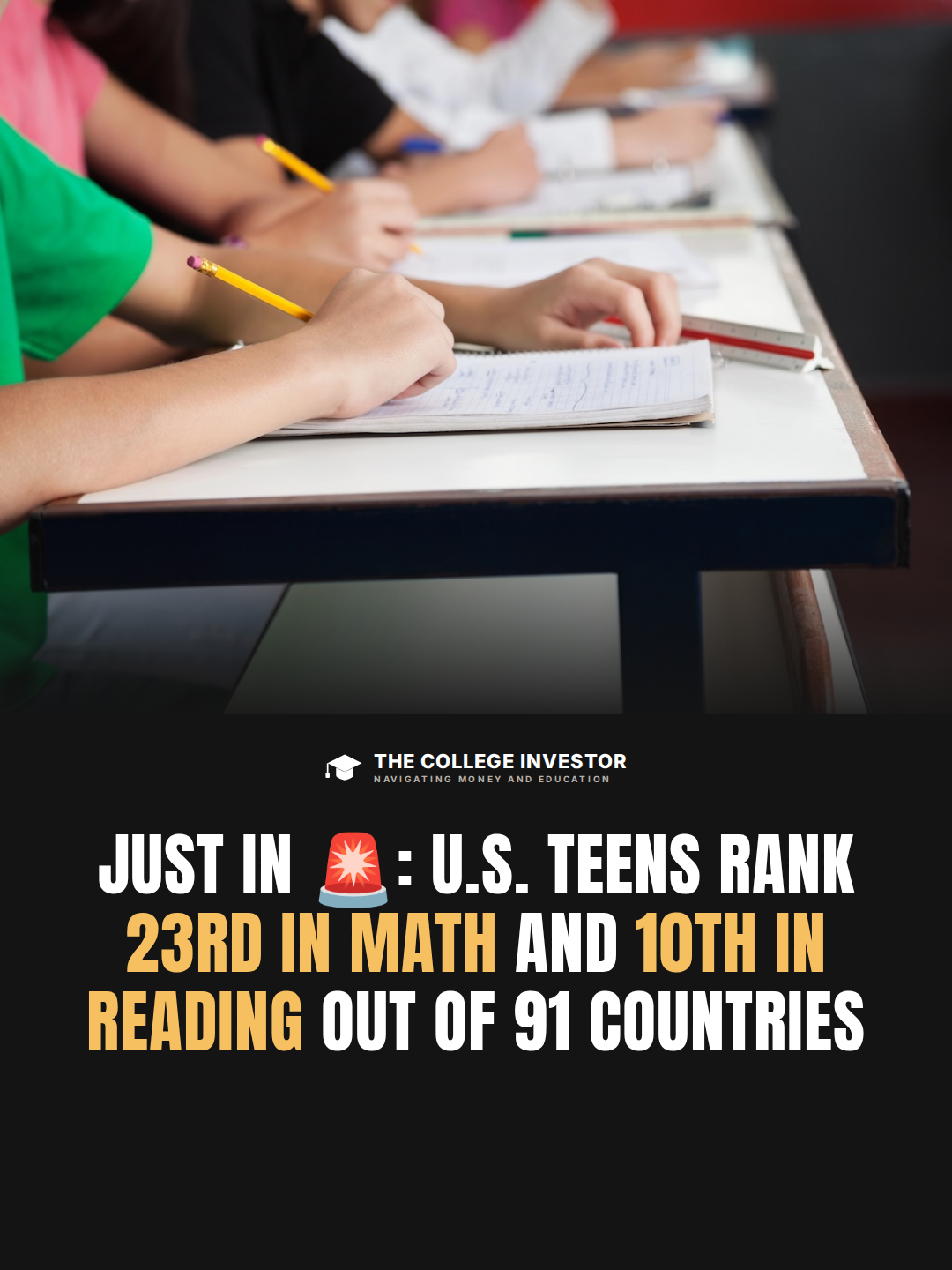
- U.S. 15-year-olds tied for 10th out of 91 school systems in reading. They tied for 23rd in math and placed 13th in science.
- U.S. reading scores fell 14 points in three years. That is close to the worst American showing since the test started in 2000.
- Only 31% of U.S. students go to a school that bans phones. Across other wealthy high-performing countries, half of students do.
American 15-year-olds tied for 10th out of 91 worldwide school systems in reading on the 2025 PISA exam, released September 8. In math, they tied for 23rd. Science was the bright spot for the U.S. at 13th.
U.S. reading dropped 14 points from 2022. New York Times reporting puts that near the worst American result since PISA began in 2000.
But it’s important to note that the general learning decline is worldwide. Reading across rich countries fell 28 points from 2015 to 2025, and math fell 22 points. One in five 15-year-olds now misses the basic skill level in all three subjects, up from 16% in 2022.
More than 760,000 students took the test. About 4,600 were American, spread across 144 schools. Here’s where the U.S. stands.
Why It Matters: Grades Say One Thing, Skills Say Another
Grade inflation is the story we should be focused on. Report cards keep getting better, but our students’ actual skills aren’t. ACT found the average high school GPA rose from 3.17 in 2017 to 3.38 in 2022, while test scores stayed flat.
PISA now says the skills behind those grades are getting weaker. Some districts are pushing back. Indianapolis Public Schools ended its no-zero grading policy in August, so teachers can give a real zero for work a student never turned in. Meanwhile, in California, San Diego Unified still uses lax rules, where a B can start at 67%.
We see the same issues on college campuses. UC San Diego found that the share of freshmen testing below college-level math jumped from under 1% to almost 12% between 2020 and 2025. More than a quarter of the students who landed in remedial math had earned a 4.0 in high school math. The correlation between high school math grades and placement scores was 0.25, which is close to random.
That disconnect costs families money. An inflated GPA ends up costing students more when they get to college. Students show up needing catch-up classes that cost full price and earn no credit toward a degree. That means extra semesters and bigger loans. Sallie Mae says families spent $34,019 on college last year, up 10% in a single year, and the average cost of college keeps climbing.
Where The U.S. Lands
Ranked by reading, out of 91 school systems:
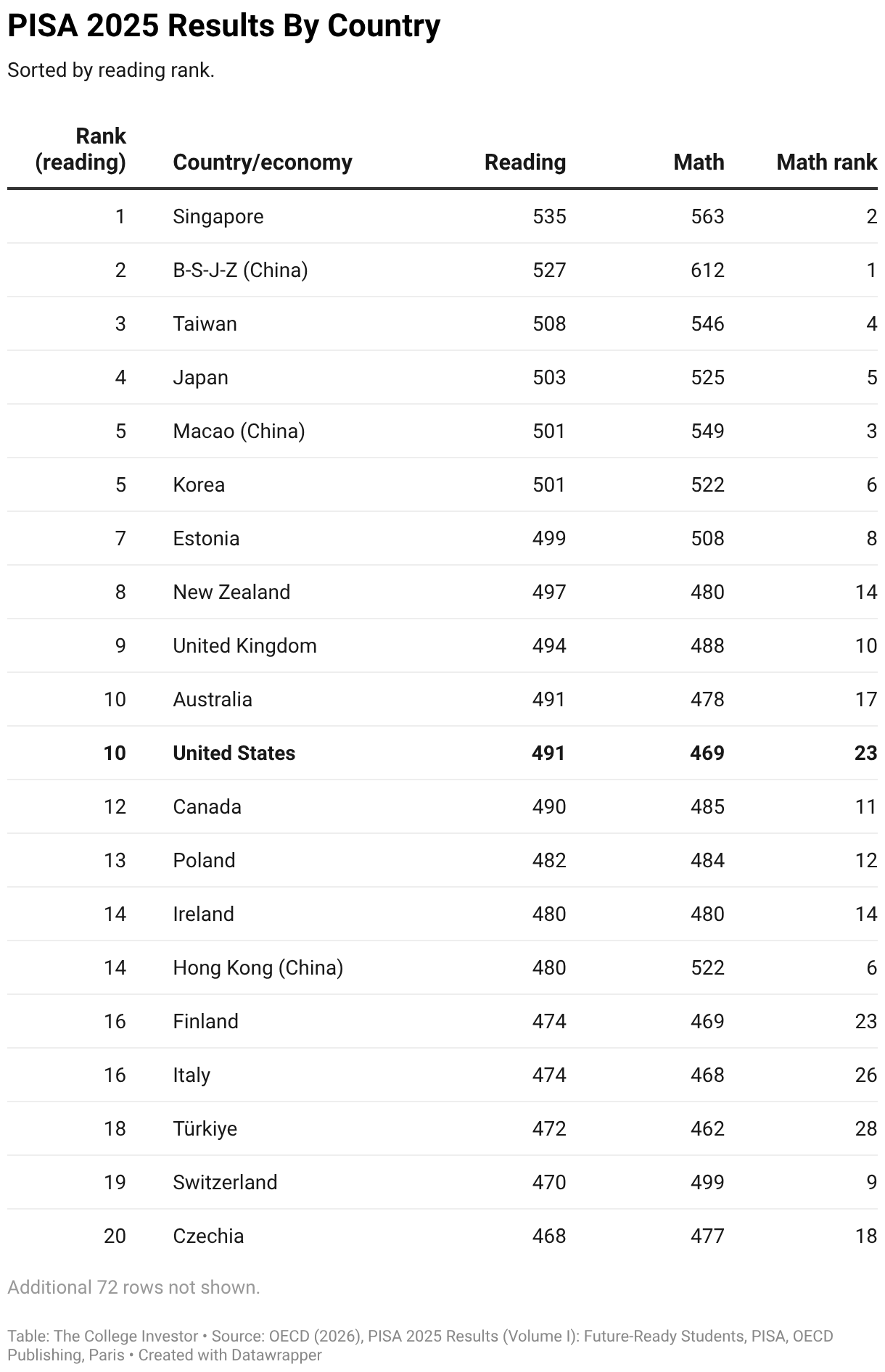
Math is where the U.S. really drops fast. Twenty-two countries beat the U.S. Singapore scored 563. The U.S. scored 469. Canada, Australia, Ireland, Poland and Czechia all finished ahead. Reading and science look better, but neither is improving.
That also comes at a time when confidence in higher education has already dropped to 38% in Gallup polling.
What The Data Points To
The OECD does not blame the pandemic. Reading levels peaked around 2012 and have fallen ever since. The report says the drop “predates the COVID-19 pandemic in many countries.”
What changed is how kids read. The share of “hasty readers” nearly doubled between 2018 and 2025. Those are students who skim a passage, answer fast, and get it wrong. The OECD ties weaker scores to screen time during the school day and less reading for fun. Those are the same worries behind the Surgeon General’s push for bell-to-bell phone bans.
U.S. schools are outliers on cell phone-in-school policies. Just 31.3% of American students attend a school that bans them, against 49.5% across the OECD. Only 34.1% say devices never distract them in science class.
On AI, 37.3% of U.S. students use it at least weekly to help them learn, below the 45.5% OECD average. Students who use chatbots to summarize assigned reading score lower in science than students who do not. That echoes what Bill Gates said about heavy AI use and learning less.
What Parents Can Do
Two things move the needle. The OECD found that asking your kid what they did at school, at least once a week, is linked to a 26-point gain in science. That holds even after adjusting for family income. The share of students who say a parent asks fell from 77% in 2022 to 71% in 2025.
Second, families need to get back to focusing on reading at home, especially reading for fun. Reading is the key driver behind so many results, including both math and science, as kids who are more fluent in reading find it easier to tackle things like word problems in math.
We’ve heard that many families are basically throwing up their hands and saying, “Well, AI will solve a lot of these problems for kids.” But, like any tool, if the child doesn’t understand how it works, how to use it, what the outputs are, and how to verify it against fact, AI just becomes a folly in the student’s toolkit.
Furthermore, as tools like AI continue to develop, we need the scientists, engineers, and computer programmers to build the next generation of tools. If students lack a fundamental understanding of reading and math, they may never get to that point.
What’s Next
Watch three things. Do more states pass phone-free school rules now that data shows the U.S. is an outlier? Does the next round of NAEP results show the same reading drop at across the U.S. states? And do colleges keep bringing back test scores, the way UC faculty are pushing for? Each one changes how families should weigh the return on a degree against what they borrow in student loans to get it.

Robert Farrington is the founder of The College Investor and is widely recognized as one of the nation’s leading voices on student loan debt and saving for college. He holds an MBA from UC San Diego Rady School of Management and has spent over 15 years researching, writing, and advising on student loans, 529 plans, financial aid programs, and saving and investing for young professionals.
Robert has been featured in the The New York Times, The Wall Street Journal, The Washington Post, NBC News, and Forbes, where he has been a regular personal finance contributor for over a decade. His work combines both professional expertise and personal experience – he successfully navigated his own student loan repayment journey and has helped thousands of readers do the same.
He is committed to making the intersection of personal finance and education transparent and accessible. You can learn more about Robert on the About Page or on his personal site RobertFarrington.com.
