


Voyager 1 is currently drifting through interstellar space at roughly 38,000 miles per hour, more than 15 billion miles from the Jet Propulsion Laboratory antenna in Pasadena that still talks to it, and a radio command sent from Earth today will not arrive at the spacecraft until tomorrow evening. The light-speed delay one way is over 22 hours. A round-trip conversation, send a command and hear the acknowledgement, takes nearly two days.
This means every instruction NASA transmits is, in a strict sense, aimed at a ghost. The spacecraft the engineers are commanding does not exist yet at the coordinates they are aiming for. It will exist there, roughly, by the time the radio waves catch up.
In April 2026, engineers at JPL sent a command to switch off Voyager 1’s Low-energy Charged Particles instrument, a 49-year-old detector that had been measuring ions and electrons since 1977. The command left Earth at the speed of light. It arrived at Voyager about 22 hours and 40 minutes later. The confirmation that the instrument had powered down came back a day after that.
The math of a 22-hour delay
Light travels 186,282 miles every second. That is fast enough to circle the Earth seven times in the time it takes to blink. It is also, on the scale of the outer solar system, agonisingly slow.
Voyager 1 is currently around 15.6 billion miles from Earth, or roughly 167 astronomical units, where one AU is the distance from the Earth to the Sun. Divide that distance by the speed of light and you get about 22 hours and 40 minutes, one way. The number changes by a few seconds every day because the spacecraft is still moving outward at about a million miles every 27 hours.

By comparison, a radio signal from the Moon takes 1.3 seconds. From Mars at its closest, about four minutes. From Pluto, roughly four and a half hours. Voyager 1 sits in a different category of distance entirely, far enough that the Sun itself is just a particularly bright star in its sky.
Commanding a spacecraft that has already moved
When a JPL operator sends Voyager 1 a command, the spacecraft at the moment of transmission is in a specific position, moving in a specific direction. By the time the signal arrives, Voyager has travelled roughly 836,000 more miles. So the team is not pointing the Deep Space Network’s giant dishes at where the probe is. They are pointing them at where it will be.
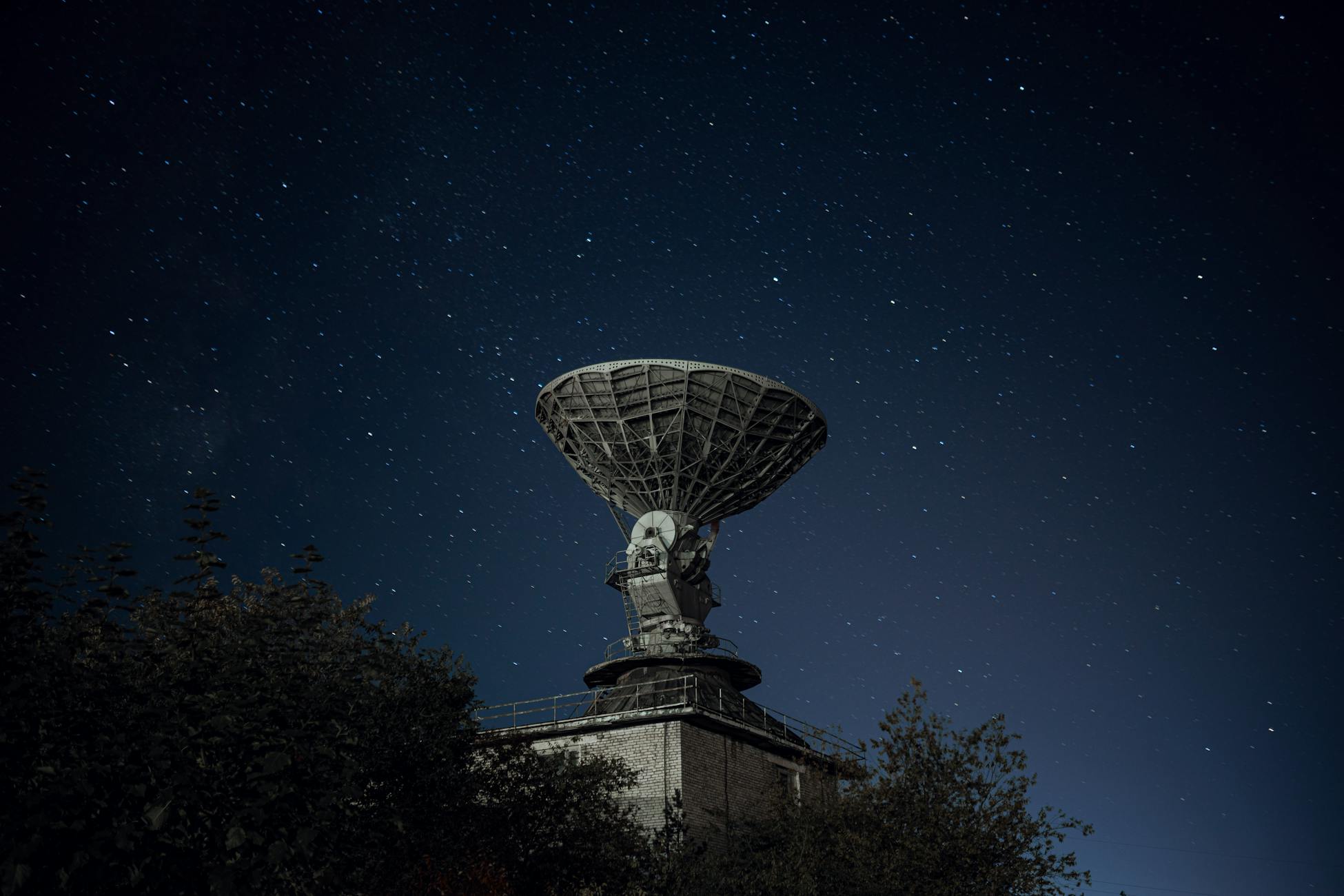
The 70-meter dish at the Goldstone complex in California, and its sister antennas in Madrid and Canberra, are the only instruments on Earth large enough to hear Voyager’s whisper. The probe’s transmitter is broadcasting at 22 watts, which is roughly the power draw of the bulb in a refrigerator. By the time that signal reaches Earth, it has been spreading out for nearly a day, and what the dish picks up is about a billion-billionth of a watt.
Aiming the antenna requires precise knowledge of where Voyager will be when the command lands, and where it will be again when the reply leaves. Trajectory teams calculate this from years of tracking data, refined constantly by listening to the carrier signal itself.
Why the delay shapes every decision
There is no real-time troubleshooting at this distance. If something goes wrong, by the time engineers on Earth see the problem in the telemetry, the spacecraft has been struggling with it for nearly a day. Whatever fix they send takes another day to arrive. Two days is the minimum response time for any anomaly.
This is why Voyager carries fault protection software that can put the spacecraft into a safe configuration on its own, without waiting for Earth. The probe has to be able to keep itself alive between conversations.
It also means commands have to be planned with surgical care. The team writes sequences weeks in advance, models them on ground simulators, and uploads them in batches that the spacecraft executes from its own memory. A mistake in a sequence cannot be caught and corrected mid-stream the way it could on a low-Earth-orbit mission. The error has already happened by the time anyone sees it.
The instrument that died on a delay
The April 2026 shutdown of the Low-energy Charged Particles experiment was a deliberate choice to extend Voyager’s life. The spacecraft’s three radioisotope thermoelectric generators, fuelled by decaying plutonium-238, have been steadily losing power for half a century. They produce a few watts less every year. To keep the most important systems running, JPL has been turning instruments off one by one.
The LECP had been measuring charged particles since launch in 1977, the same year Apple incorporated and Star Wars opened in cinemas. Its shutdown left Voyager 1 with only two working science instruments. Each remaining instrument is now a finite resource, and every command that touches one has to travel almost a day before it acts.
What 22 hours feels like in operations
Imagine writing a letter to someone, knowing the postal service takes exactly 22 hours and 40 minutes each way, and that the recipient cannot ask you a clarifying question. Whatever you write has to be complete, unambiguous, and survivable on its own. If the letter contains an error, you will not know until two days from now, and the recipient will already have acted on it.
That is roughly the cognitive frame Voyager operators work in. The challenge of working with long temporal delays is unusual enough that the team has built rituals around it. Commands get peer-reviewed. Sequences get dry-run on hardware testbeds. Critical operations get scheduled for moments when the Deep Space Network has guaranteed availability on both ends of the two-day loop.
The team also lives with a strange kind of patience. A mission controller working on a Mars rover gets feedback within minutes. A Voyager controller might send a command on Monday morning and not know if it worked until Wednesday.
The 1970s code still in charge
Voyager’s onboard computers were built in the early 1970s and have less memory than a single text message takes up on a modern phone. The flight software is written in an assembly language that almost no living programmer was trained on. The handful of engineers who still understand the system are mostly retired, called back when something goes wrong.
In 2023, a single corrupted bit caused Voyager 1 to begin transmitting unintelligible static. It took the team months to locate the fault, partly because every diagnostic command they sent took 22 hours to arrive and another 22 hours to confirm. A back-and-forth that on a modern system would have taken an afternoon stretched across half a year of two-day cycles.
How the signal gets back
Voyager 1 broadcasts on a frequency near 8.4 gigahertz, in the X-band. The signal leaves the spacecraft’s 3.7-metre high-gain antenna, which has to be pointed at Earth to within a fraction of a degree. The probe maintains that pointing using a set of thrusters and a sun sensor that locks onto our star, which from Voyager’s vantage is just one bright point among many.
The signal spreads out as it travels. By the time it reaches Earth, the wavefront is wider than the planet itself. Only a tiny fraction of the original power lands in any given antenna dish. The Deep Space Network’s 70-metre antennas integrate this faint trickle of energy and reconstruct the data, which arrives at about 160 bits per second. A single high-resolution photo, if Voyager were still taking them, would take days to download.
The closing window
The plutonium powering Voyager will not last much longer. Engineers estimate the spacecraft can continue operating in some reduced form into the early 2030s, after which the power will fall below the threshold needed to run even a single instrument. Eventually the radio itself will go silent.
When that happens, Voyager will keep moving. It will keep travelling outward at 38,000 miles per hour, carrying the Golden Record and the names of the engineers who built it, drifting through the interstellar medium for tens of thousands of years before it passes anywhere close to another star. The 22-hour delay will keep growing. By 2030, a one-way signal will take closer to 24 hours. By 2040, if anyone were still listening, more than a day.
For now, the conversation continues. A command goes out from Pasadena. Twenty-two hours and forty minutes later, in a stretch of space where the sun is just another star, a 49-year-old machine the size of a small car hears it, and does what it is told.
