

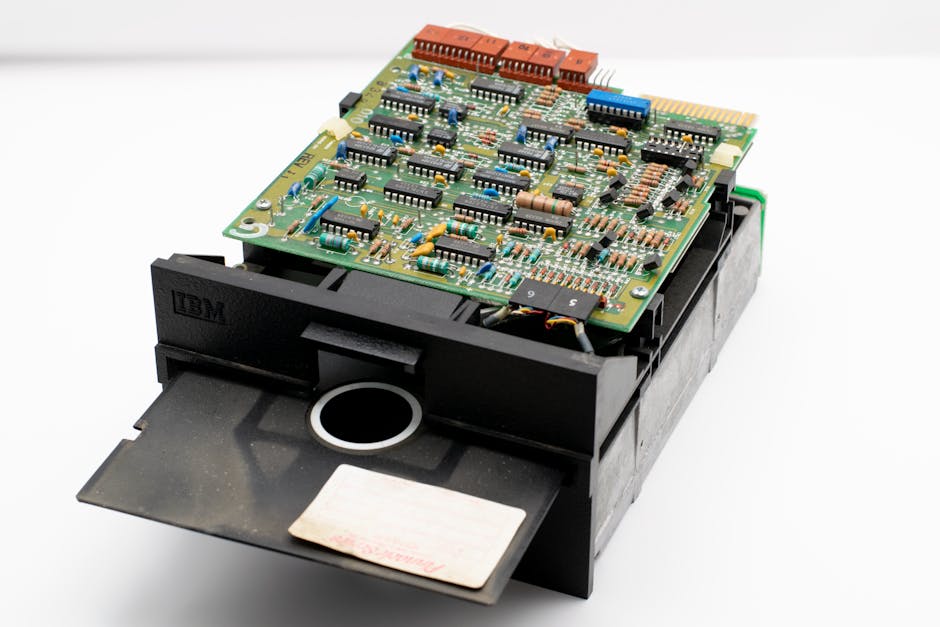
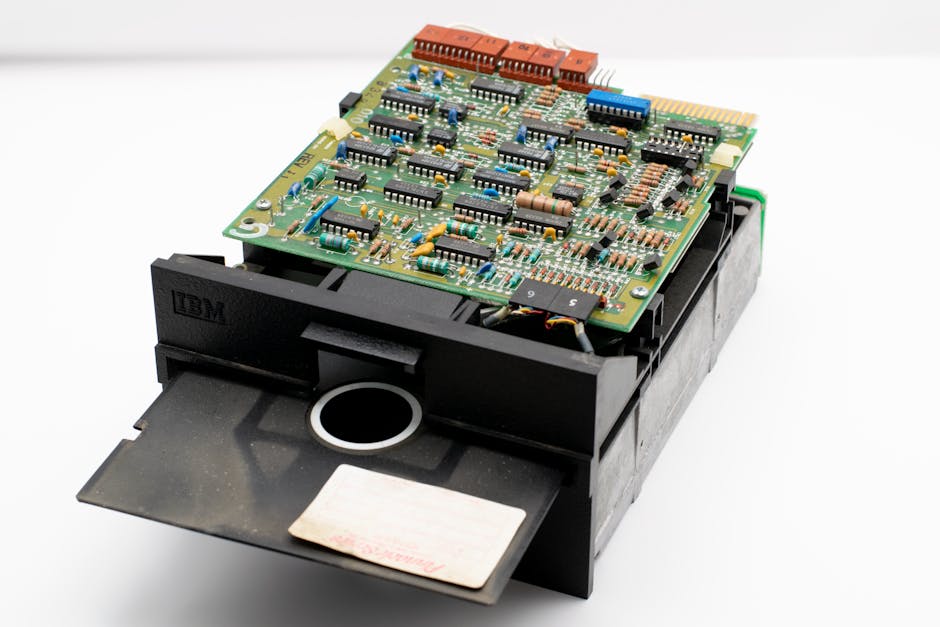
In 1956, IBM showed businesses a refrigerator-sized storage cabinet that could reach a record in less than a second instead of forcing clerks to shuffle through trays of punched cards. The IBM 305 RAMAC system and its IBM 350 disk storage unit turned fifty spinning aluminum platters into something that looked, for the first time, like instantly reachable corporate memory.
The numbers are almost comic now. The disk unit stored five million 6-bit characters, the equivalent of about 3.75 megabytes of data, on fifty 24-inch disks rotating at 1,200 revolutions per minute. The Computer History Museum notes that the unit stood roughly five feet high, stretched about six feet wide, weighed more than a ton with its compressor, and leased for $750 a month by itself.
Five million characters. One modern phone photo can take more room than that.
And yet companies signed up because the alternative was worse. The alternative was a room full of filing cabinets, punched cards, tape reels, and people paid to wait.
The machine that made data physical
The 305 RAMAC did not arrive as a neat box. It came as a system: the processing unit, the IBM 350 disk storage unit, the printer, the card punch, the console, and the power equipment. The disk cabinet alone had the presence of industrial furniture, the kind of object that changed the room around it.
Inside the IBM 350, two access arms moved up and down the stack, selected the right disk surface, and then moved inward to the right track. The average access time was under one second. A modern solid-state drive does the same basic act thousands of times faster and has no spinning platters at all, which is why the old distinction between a disk and a drive still carries so much historical baggage.
But in 1956, less than a second felt startling. Punched-card systems made operators sort, feed, file, and retrieve physical records. Magnetic tape could hold large amounts of information, but it had to be wound past everything that came before the record you wanted.
RAMAC changed the shape of waiting.
Why random access mattered
RAMAC stood for Random Access Method of Accounting and Control. The key phrase was random access, not accounting. IBM was selling a business machine, but what it had really built was a new relationship with stored information.
IBM describes RAMAC as the first computer to use a random-access disk drive. Before it, information retrieval through a computer could take hours or even days. With RAMAC, a record no longer had to wait behind all the records physically stored in front of it.
That single change is the ancestor of almost everything people now expect from storage. A database query, a file search, a banking record, a cloud photo pulled from years ago, and the split-second choice between an HDD and an SSD all descend from the same premise: data should be reachable by address, not by patience.
The machine did not make data invisible. It made data mechanically findable.
Reynold Johnson and the San Jose lab
The engineer most closely associated with RAMAC was Reynold B. Johnson, a former high school science teacher who had already invented an electromechanical test-scoring machine before IBM hired him in 1934. IBM credits Johnson with leading the team that created the world’s first commercial computer disk drive.
In 1952, IBM sent Johnson to San Jose to set up a West Coast laboratory. The Computer History Museum’s Johnson papers describe the move as the start of the San Jose team’s work on magnetic disk storage, which became the IBM 305 RAMAC in 1956.
The team experimented with several ways of storing information before settling on coated aluminum disks. The early work was not sleek. It belonged to a period when computing still smelled of oil, hot electronics, dust, paper, and machine-room air.
That roughness matters. The first hard drive was not born as a polished consumer device. It was born as a one-ton accounting machine meant to replace human delay.
What five million characters meant
The IBM 350’s storage capacity is often rounded to five megabytes because IBM described it as five million characters. The Computer History Museum gives the stricter data equivalent as 3.75 megabytes, because those characters were 6-bit characters rather than modern 8-bit bytes.
Either way, it was not less than a 1990s floppy disk. A standard 3.5-inch high-density floppy held 1.44 megabytes, so the RAMAC’s disk unit held more than twice that amount by the conservative 3.75 MB comparison, and more than three times that amount by the five-million-character shorthand.
The comparison is still absurd in the other direction. A 1.44 MB floppy weighed almost nothing and slipped into a shirt pocket. The IBM 350 weighed more than a ton, needed power and air handling, and occupied the kind of floor space that businesses had to plan around.
By 1960, IBM was using RAMAC publicly enough that the machine helped with scoring at the Winter Olympics in Squaw Valley. IBM says 36 employees staffed a center there, where electronic data processing did in minutes what manual scoring calculations had previously taken hours to complete.
Why customers paid anyway
IBM rarely sold systems like the 305 RAMAC in the simple consumer sense. Customers leased the equipment, and IBM handled the installation and maintenance burden. The monthly cost was high, but so was the cost of clerical delay.
A bank, an insurer, or a large inventory operation did not need the RAMAC because it was elegant. It needed the RAMAC because punched-card work consumed time, staff, space, and attention. A machine that could reach records directly could turn a room full of waiting into a smaller number of operators and faster answers.
That is why the 305 RAMAC stayed in production until 1961 and why more than a thousand systems were built. It was not the fastest computer of its era, and it was not the cheapest. It proved that businesses would pay heavily to stop waiting for records to be physically found.
The same bargain still sits under modern storage. Whether someone keeps backups on a local hard drive or decides to back up physically or in the cloud, the question is still how quickly stored information can be reached when it matters.
The long arc to the data center
Nearly seventy years after RAMAC, spinning disks have still not disappeared. In early 2026, Western Digital told investors that it was effectively sold out of hard-drive capacity for calendar 2026, with long-term agreements already reaching into later years. The company’s Q2 FY2026 earnings transcript tied that demand to cloud customers and nearline storage.
At the same time, the largest hard drives have become almost unrecognizable beside the IBM 350. Seagate announced Exos M drives up to 36 TB, using HAMR-based Mozaic 3+ technology and 10-platter designs. One such drive holds millions of times more data than the RAMAC cabinet.
Some executives argue that the mechanical era is close to ending. Pure Storage CEO Charles Giancarlo told CRN in 2023 that he did not think hard disks would be sold within five years. That prediction may prove right, early, or self-interested, but the direction is obvious: fewer moving parts, more density, less waiting.
The irony is that the old machine still explains the new one. Data centers now chase capacity with the same hunger that drove RAMAC leases, only at the scale of exabytes instead of filing cabinets.
Reynold Johnson died in 1998, when ordinary consumer hard drives were already measured in gigabytes. By then, the machine his team built had become an ancestor rather than a product.
At the Computer History Museum in Mountain View, a restored IBM 350 actuator and disk stack remains on display. The platters no longer look like the future. They look like industrial archaeology: broad metal circles, magnetic coating, mechanical arms, and the visible weight of a time when five million characters needed a cabinet larger than a vending machine.
The phone in a visitor’s pocket may hold tens of thousands of times more data. It weighs about half a pound. Nobody had to reinforce the floor to bring it in.
