


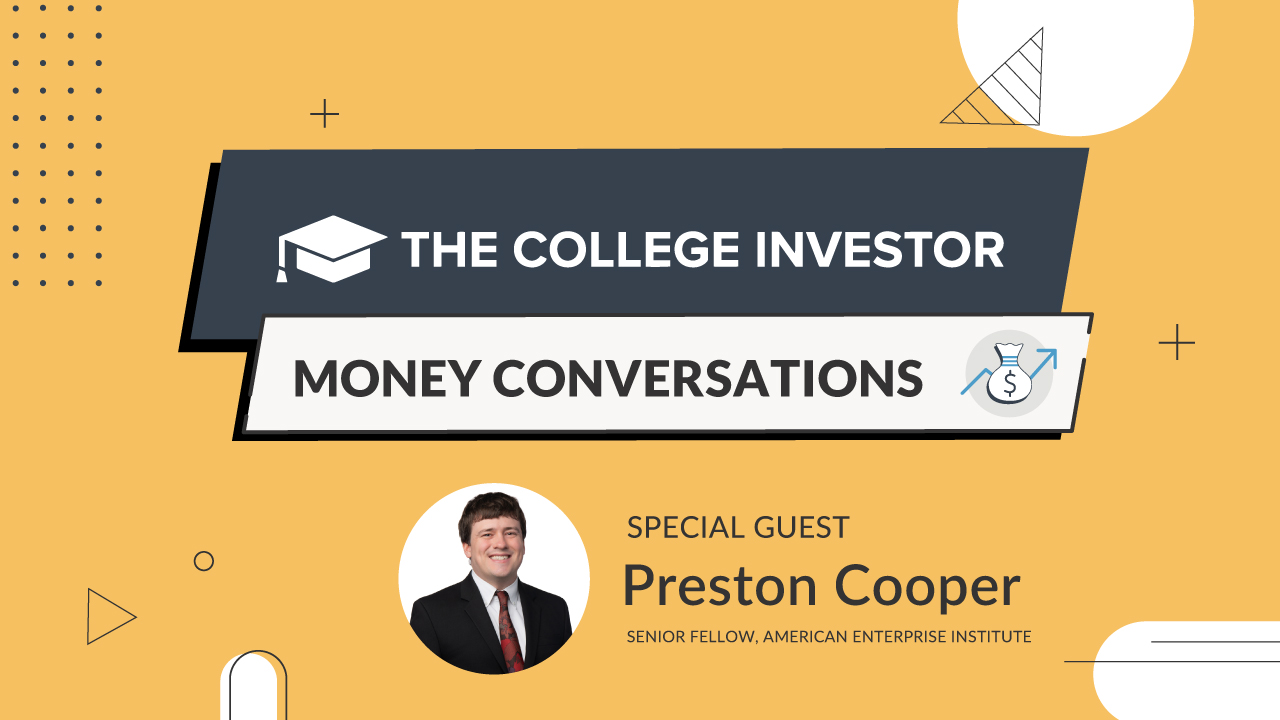

Higher education economist Preston Cooper joins The College Investor Audio Show at the ASU+GSV Summit to talk about when a bachelor’s degree pays off, where grad school goes wrong, and how families should think about ROI in a labor market that is changing fast.
Recorded live at the ASU+GSV Summit in San Diego, Robert Farrington sits down with Preston Cooper, the researcher behind some of the most widely cited work on the return on investment of college and graduate school, to unpack what the numbers actually say — and what students and families should do with that information during admissions season.
Cooper’s key takeaway: College pays off most of the time, but about 20% to 30% of bachelor’s degree pursuers do not come out ahead. The reasons fall into three buckets: overpaying for the degree, not completing it, or choosing a field with weak labor-market demand.
The interview works through each of those, then carries the framework into grad school and into the AI question that is now driving a lot of family conversations.
Episode Summary
- The three reasons a bachelor’s degree fails to pay off and how to avoid each.
- Why completion rate is the single biggest factor in college ROI.
- How to evaluate a school using the College Scorecard.
- Where grad school still pays and where MBAs, master’s in education, fine arts, and psychology programs get risky.
- The state-licensing trap that forces some careers to buy a low-ROI master’s degree.
- What the latest computer science unemployment data really says about AI and college majors.
Three Reasons College Fails To Pay Off
Cooper said about 20% to 30% of bachelor’s pursuers do not come out ahead financially, and almost always for one of three reasons:
- They paid too much (“a degree which is worth it at $50,000 may not be worth it at $150,000”)
- They did not graduate
- They picked a field with limited job opportunities
That framing sets up the rest of the conversation — every other ROI question maps back to one of those three risks.
Completion Rate Is The Number One Factor
Only 60% and 70% of four-year college students finish a degree within six years, which means 30% to 40% do not. That is the worst financial outcome of all: you carry the tuition cost, possibly student debt, without the credential needed to land the jobs that justified the spend.
Cooper’s rule of thumb for families: ask whether the school has a track record of getting students across the finish line, and ask honestly whether the student is academically ready to complete the program.
Robert added the financial side — if freshman year is already a stretch, senior year almost always gets harder as prices rise and front-loaded aid drops off, which itself drives non-completion.
Field of Study: How To Vet A Program
Behind completion, field of study is the next biggest ROI driver. Engineering, nursing, economics, and computer science still tend to deliver. Fine arts, psychology, and even education are more often net-negative on a dollars-and-cents basis.
Cooper was careful not to say those degrees never pay off — only that students pursuing them need to be more selective about the specific program and its job placement record.
For families researching schools, he pointed to the Department of Education’s College Scorecard as a solid starting point. It lists six-year graduation rates, typical starting salaries by program, and net cost. Not perfect, but enough to compare schools 20 through 200, the range where the data matters most because the brand doesn’t carry the decision.
Grad School: Where It Pays And Where It Doesn’t
Cooper’s rule of thumb on graduate education: if the program provides specific training for a specific high-paid occupation (medicine, law, dentistry) it usually pays off. Completion rates are high, and graduates often land jobs paying $200,000 or more.
Master’s degrees are the much shakier bet. Even some MBA programs do not pay off because of the price point. Master’s programs in fine arts, humanities, education, and psychology are particularly mixed — some are strong, but most are not.
Robert noted his own takeaway from Cooper’s MBA data set: a large share of programs break even or go negative, while a small slice deliver outsized returns, which is exactly the kind of distribution that should make students cautious.
Robert’s practical tip: if you are unsure about an MBA, don’t pay for it out of pocket. Many Fortune 500 employers will cover the cost as part of a tuition reimbursement program, and that single move can flip the ROI math.
State Licensing Trap
Some fields (teaching is the clearest example) pay more for a master’s degree even though there is little evidence the degree makes practitioners more effective. Cooper said the longer-term fix is reforming state licensing rules so workers are not forced to buy a low-ROI credential just to do the job. Until that happens, his advice is to manage the risk: stay in-state, stay public, and stay out of debt.
He gave his own example. He earned his graduate degree at George Mason University and paid in-state tuition rather than going to GW or Georgetown for what he called “basically the same product.”
The principle: if the goal is to check a licensing box, the cheapest accredited path is the right path.
AI, Computer Science, and the Five-Year Question
Robert pressed Cooper on whether the data even applies to today’s 18-year-olds, who will not enter the job market until around 2030. Cooper said this is the most common question he gets in college talks: should students still major in computer science if AI is going to take the jobs?
His read on the current data: early-career unemployment for computer science majors has risen to about 7%, above the all-college-graduate average. But the CS majors who do land jobs still earn around $90,000 in their mid-20s — more than mechanical engineering, nursing, economics, or business.
“The bottom has not completely fallen out,” he said, calling that a corrective to some of the media coverage.
His larger point: nobody has perfect information about the future labor market, which is why risk-aversion is the right posture. Pick a field with a strong payoff, take a varied course load, look for programs that are forward-looking about future skills, and keep the student loan debt low so a pivot is possible.
Bottom Line
Cooper closed with a frame worth repeating: the assumption that a college degree is a golden ticket to prosperity is no longer accurate. College still pays off for most students, but there is real risk involved, and managing that risk (on price, completion, and field of study) is what separates a degree that works from one that does not.
Don’t Miss These Other Stories:
Are MBAs Worth It In 2026? How Valuable Is Business School
How To Pay For College: The Best Order Of Operations
37% of Google AI Finance Answers Are Inaccurate in 2025
The post Preston Cooper on the ROI of College, Grad School Risks, and What AI Changes About the Math appeared first on The College Investor.
