

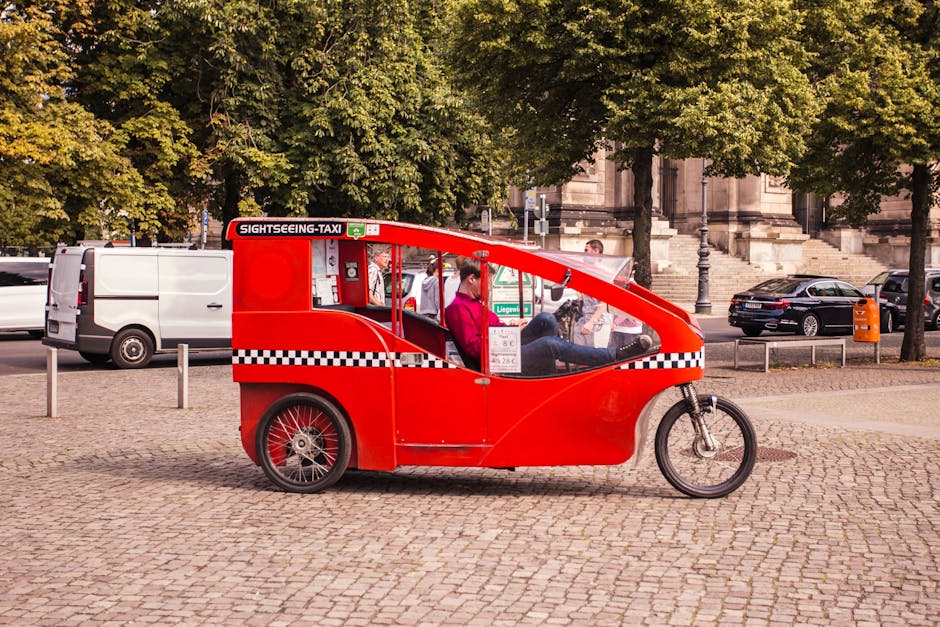
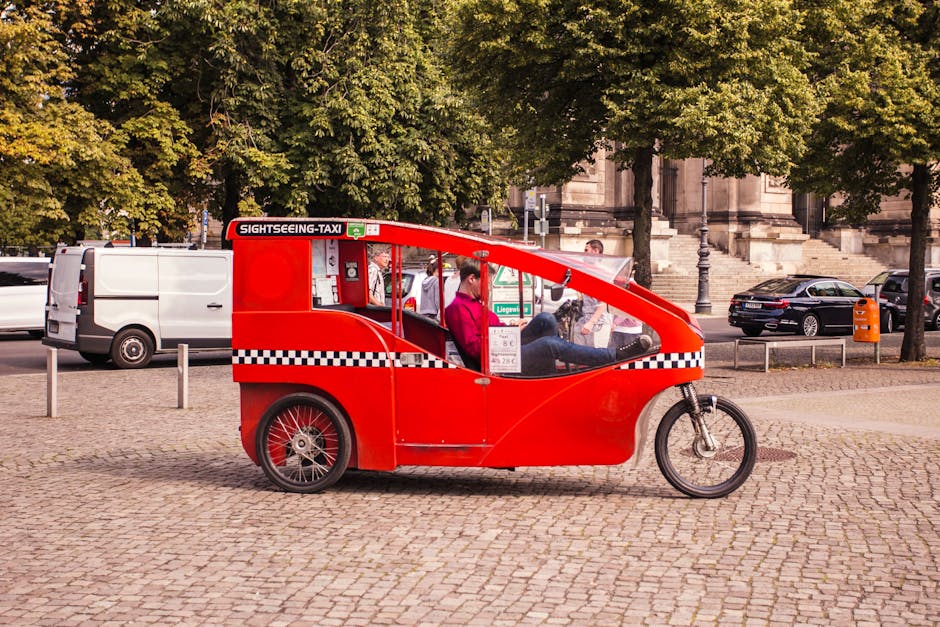
Sir Clive Sinclair launched the C5 at Alexandra Palace on 10 January 1985, promising a £399 electric machine that could move through British streets at 15 miles per hour while its driver sat lower than the bonnet line of many cars. It was not licensed like a car. It was not protected like one either.
The driver sat close to the road, legs stretched forward, hands on a steering bar beneath the knees. In mixed traffic, the white plastic shell put a human head near the wheel arches and exhaust lines of vehicles built on a completely different scale.
The legal trick was that the C5 was treated as an electrically assisted pedal cycle. In practice, that meant a fourteen-year-old could ride it on public roads without a driving licence, vehicle tax, registration, or insurance, provided it stayed within the rules for the class.
A trike classified as a bicycle
The opening came from the Electrically Assisted Pedal Cycles Regulations 1983, which prescribed a class of electrically assisted pedal cycles that were not to be treated as motor vehicles under older road traffic law. Modern government guidance still describes an EAPC as a cycle that can be used by someone aged fourteen or over without being registered, taxed, or insured.
The C5 was built to sit inside that category. It had pedals. Its electric assistance was limited to 15 miles per hour. It used a 250-watt motor and a 12-volt lead-acid battery, with Sinclair advertising a range of about 20 miles.
Those numbers made the machine legal. They did not make it feel safe.
Sinclair had not produced a normal bicycle with a discreet motor. He had produced a recumbent three-wheeler with a polypropylene body, a steel frame, a low cockpit, and a silhouette that invited people to call it a tiny car even while the law treated it as a pedal cycle.
That mismatch was the whole story. On paper, the C5 belonged with bicycles. On the road, it asked its rider to share space with Ford Cortinas, buses, vans, and heavy goods vehicles.
Hoover built it, Lotus helped engineer it
The C5 was not a shed-built oddity. Sinclair Vehicles contracted Hoover to assemble it at the company’s washing-machine plant in Merthyr Tydfil, and the Science Museum’s collection records Hoover as the maker of a surviving 1985 Sinclair C5. Lotus Cars also worked on the chassis and drive engineering.
Sinclair had spent the previous years as one of Britain’s most famous technology entrepreneurs. The ZX Spectrum, launched in 1982, had put home computing into millions of British bedrooms, and Sinclair was knighted in 1983. The C5 arrived with the aura of a man who had already made the future cheap enough to buy.
The manufacturing plan was built for scale. Hoover prepared production capacity far beyond the early sales that actually materialised, while Sinclair expected demand measured in tens of thousands rather than thousands.
For readers used to modern battery scooters and power stations, the primitive power system is the sharpest contrast. The C5 relied on a heavy lead-acid battery, not the lithium packs that now shape consumer devices, portable power stations, and the electric scooters reviewed on Make Tech Easier. The distance between that battery and today’s solid-state battery hopes is part of why the C5 feels both prophetic and stranded.
The launch made the problem visible
Alexandra Palace now marks the launch as one of the stranger episodes in its long public life. The C5 was unveiled there on 10 January 1985, inside a temporary pavilion built after the palace fire of 1980, with press attention high and the British winter doing the machine no favours.
The vehicle’s most obvious defect was not hidden in the specifications. It had no roof, no doors, no heater, and no built-in weather protection. A clip-on windscreen and a visibility mast were accessories, not the emotional centre of the product.
A commuter did not need to read a technical paper to understand the problem. Fifteen miles per hour in January rain, with spray rising from the road and traffic passing above shoulder height, was enough.
The Transport and Road Research Laboratory later examined the safety aspects of the Sinclair C5 as an electrically assisted pedal tricycle. Its existence as a safety study said what the launch photographs already showed: this was a legal bicycle that created hazards different from a bicycle’s.
Museum Wales describes the C5 as an electrically assisted pedal cycle made in Merthyr Tydfil and intended as quiet, economical, pollution-free transport for the 1990s. That was the clean version of the idea. The road version put the driver at bumper height.
The sales collapse came quickly
Sinclair’s first problem was not that nobody noticed the C5. Everyone noticed it. The problem was that the noticing turned almost immediately into ridicule, anxiety, and hesitation.
Production was cut back within months. According to contemporary histories summarized by the Science Museum and specialist C5 records, production stopped in August 1985, and Sinclair Vehicles was in receivership by mid-October.
The safer production figure is about 14,000 assembled, with only about 5,000 sold before receivership. Some later retellings use a higher 17,000 figure, but the 14,000 figure is better supported by the detailed production histories and receivership accounts.
The remaining vehicles became clearance stock. Retailers cut prices sharply. What had launched as a futuristic £399 commuter machine could soon be found at toy-like discount prices, stripped of the confidence that had surrounded the January unveiling.
Sinclair’s wider computer business was also under pressure. In April 1986, Amstrad bought the Sinclair computer product range and brand rights for £5 million, a deal recorded by the Centre for Computing History as the end of Sinclair Research as the public had known it.
The afterlife made it stranger
The C5 did not disappear. It became collectible, comic, beloved, and technically irresistible to the kind of enthusiast who sees a failed machine as a question rather than an answer.
Surviving examples now sit in museum collections, including the Science Museum Group and Museum Wales. Others are kept running by owners who replace old lead-acid batteries with modern packs, rebuild tired electrics, and treat the vehicle less as a transport solution than as a moving artifact of British technological optimism.
That is why the C5 still works as a fact explainer rather than just a product flop. The funny part is not simply that it failed. The funny part is that the law, the engineering, and the marketing all briefly agreed to pretend that a low white battery trike belonged safely in the same road category as a bicycle.
Electric scooters and e-bikes later succeeded by being clearer about what they were. They kept riders visible, or at least familiar, within the grammar of city traffic. A modern scooter review can talk about detachable batteries, range, and convenience without asking the rider to recline between lorries.
The C5 asked for a different kind of faith. It asked a British commuter to sit inches above wet tarmac, trust a 12-volt battery, and believe that a machine legally descended from the bicycle could survive in lanes designed for motor vehicles.
Sir Clive Sinclair died in London in September 2021 at the age of 81. His C5 remains in museums beside the calculators and computers that made his name, a small white shell from 1985 with pedals, a battery, and a legal fiction still clinging to it like road spray.
