

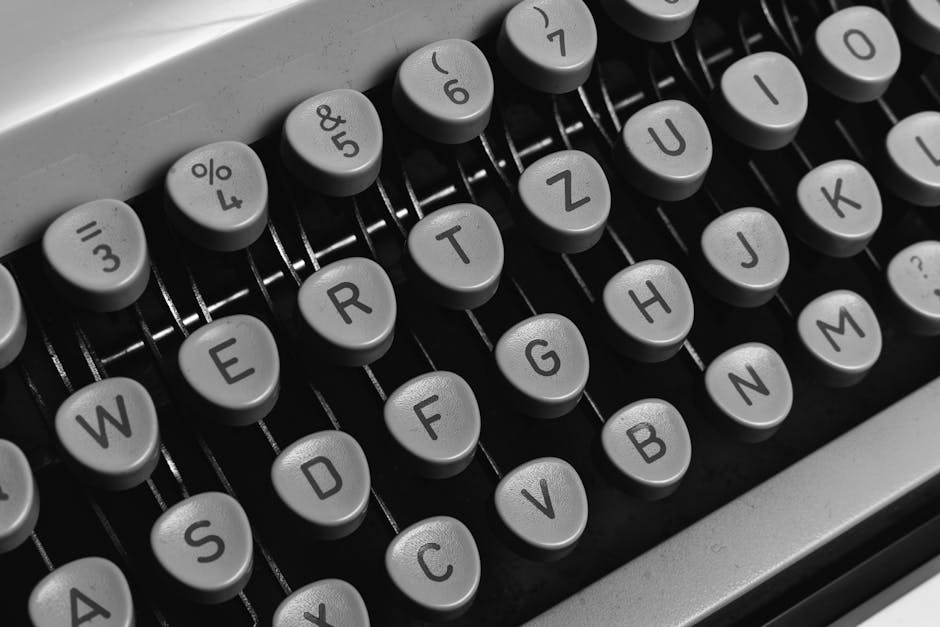
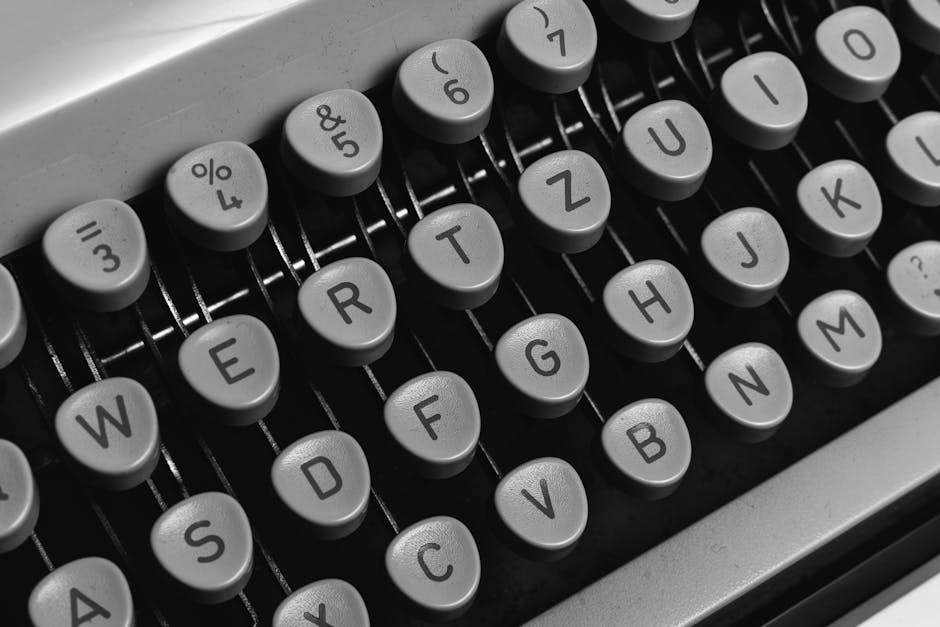
Christopher Latham Sholes patented the layout that now sits under the thumbs of nearly every smartphone owner on Earth in 1878, and he did it in a Milwaukee workshop while trying to stop slender metal arms from tangling together inside a machine called the Sholes and Glidden Type-Writer. The arms were called typebars. When two of them next to each other swung up at nearly the same instant, they would clash mid-air and freeze the carriage. Sholes’s fix was to scatter the most common letter pairs across the keyboard so that adjacent typebars rarely fired in sequence. The original prototypes are still preserved in Wisconsin, where the layout was born.
The mechanical typewriter he was protecting has been functionally obsolete for decades. The layout designed to protect it is now in the hands of billions of people.
A jam, not a theory of typing
The first Sholes prototypes used an alphabetical arrangement. A-B-C-D across the top, straight through the alphabet. It looked elegant on paper and failed almost immediately in practice. Common English pairs like “th,” “he,” and “er” sat next to each other, which meant their typebars sat next to each other in the basket underneath, which meant the basket jammed constantly.
Sholes spent the better part of six years rearranging keys with his collaborators James Densmore and Amos Densmore. The goal was mechanical, not linguistic. Move T away from H. Move E away from R. Frequent letter pairs were separated in the basket so typebars had time to fall back before the next one rose, producing the Q-W-E-R-T-Y top row recorded in U.S. Patent 207,559, issued to Sholes on August 27, 1878.
A widely repeated detail about the final arrangement — sometimes told as historical fact, sometimes flagged by typewriter historians as marketing legend — is that the keys spelling out “TYPEWRITER” all sit on the top row, reportedly so salesmen could hammer out the product name quickly during demonstrations. The letters do all sit on that row. Whether the placement was deliberate or coincidence is one of the parts of the QWERTY story nobody can fully settle.
Remington bought the patent and the world followed
Sholes sold the rights to E. Remington and Sons, the gunmaker, in the early 1870s. Remington had spare factory capacity after the Civil War and a workforce that knew how to manufacture precise metal mechanisms. The Sholes and Glidden Type-Writer hit the market in 1874, painted in floral decals lifted from sewing machines, with a foot treadle that returned the carriage.
Mark Twain was an early adopter. The machine was loud, expensive, and only typed in uppercase. It also locked QWERTY into the muscle memory of every typist who learned the new trade.
By the time competitors arrived with better mechanisms in the 1880s and 1890s, retraining a generation of touch typists was unthinkable. Typing schools taught QWERTY. Stenographers learned QWERTY. The Underwood No. 5 became the dominant office typewriter by the early 20th century and used QWERTY because that is what the typing pool already knew.
The Dvorak challenge that never landed
August Dvorak patented an alternative layout in 1936 with his brother-in-law William Dealey. He put the most common English letters on the home row, balanced the workload between hands, and ran studies suggesting his arrangement was faster and less fatiguing.
It went nowhere commercially. The US Navy reportedly tested Dvorak typists in the 1940s and found gains in speed, but the cost of retraining the existing workforce killed any rollout. Every office in America already ran on QWERTY. Every replacement typist already knew QWERTY. The switching cost was infinite for any single firm to bear.
The Dvorak layout still ships as a software option in Windows, macOS, Linux, iOS, and Android. Almost nobody uses it.
Why phones inherited a typewriter problem
When the first smartphones with full keyboards arrived in the early 2000s, designers had a clean slate. There were no typebars on a BlackBerry. There was no carriage on an iPhone. The physical reason for QWERTY had vanished entirely.
The layout stayed anyway. The reason is the same reason Remington won: switching cost. Every adult buyer in 2007 already knew where the letters were. A phone that shipped with an alphabetical or optimised layout would have felt broken on first use, regardless of whether it was theoretically faster after a month of practice.
So the iPhone’s onscreen keyboard mimicked the Underwood No. 5, which mimicked the Sholes and Glidden, which had been designed to keep metal arms from clashing in a Milwaukee workshop in the 1870s.
Even on a clean slate, designers still reach for QWERTY
QWERTY is now so deeply embedded that it shows up as the assumed input method in fields the original designers could not have imagined. A 2026 paper by Sung-Sic Yoo and Heung-Shik Lee in Sensors describes a system that uses a single RGB camera to track finger motion and reconstruct words a user is typing on a flat surface with no physical keys at all, with the QWERTY layout assumed as the underlying spatial map.
Virtual reality systems face the same gravitational pull. Researchers studying password entry in VR environments have built shoulder-surfing defences around QWERTY because that is what users instinctively reach for when asked to type in a headset, even though no physical keys exist there either.
Smartphone makers have tried curved variations to fit larger screens. An empirical study of curved keyboard layouts on large smartphones tested whether bending the rows to match thumb arcs improved usability. The underlying letter arrangement stayed QWERTY. Nobody seriously proposed changing it.
The depth of the grip on motor memory shows up even after the brain has been disrupted. A 2020 study by Jessica Gormley and Susan Fager compared QWERTY and alphabetical onscreen keyboards in adults with and without acquired brain injury. Every participant in both groups had used QWERTY on mobile devices before being studied, and both groups strongly preferred it. Eye-tracking analysis revealed lower visual-cognitive processing demands for the QWERTY layout, even though alphabetical maps onto a sequence everyone learned as a child. The familiarity built up through years of phone typing dominated the apparent logic of A-Z.
For most adults, the QWERTY pattern is so overlearned that it has become a kind of motor reflex. Touch typists can produce fast typing speeds without consciously locating any key. The layout is not optimised. It is just old.
The fossil in the pocket
A modern iPhone contains a processor with billions of transistors, a camera system that can capture astrophysical detail, and a software keyboard that updates itself with machine-learned autocorrect models trained on terabytes of text. The arrangement of the letters on that keyboard was finalised by a newspaper editor in Wisconsin in 1878 to prevent the brass arm labeled T from hitting the brass arm labeled H.
The brass arms are gone. The Sholes and Glidden lives in museum cases. Remington stopped making typewriters for the consumer market decades ago. The mechanical problem QWERTY solved has not existed for the working lifetime of most people now using it.
The fix is still there, though. It is there every time a teenager taps out a message on a bus, every time a programmer hammers out a line of code, every time someone searches for directions with their thumbs. Billions of pairs of hands, moving across a 19th-century workaround, fast enough that the original jam has been forgotten and slow enough that, somewhere in the muscle memory, the typebars are still being kept apart.
