

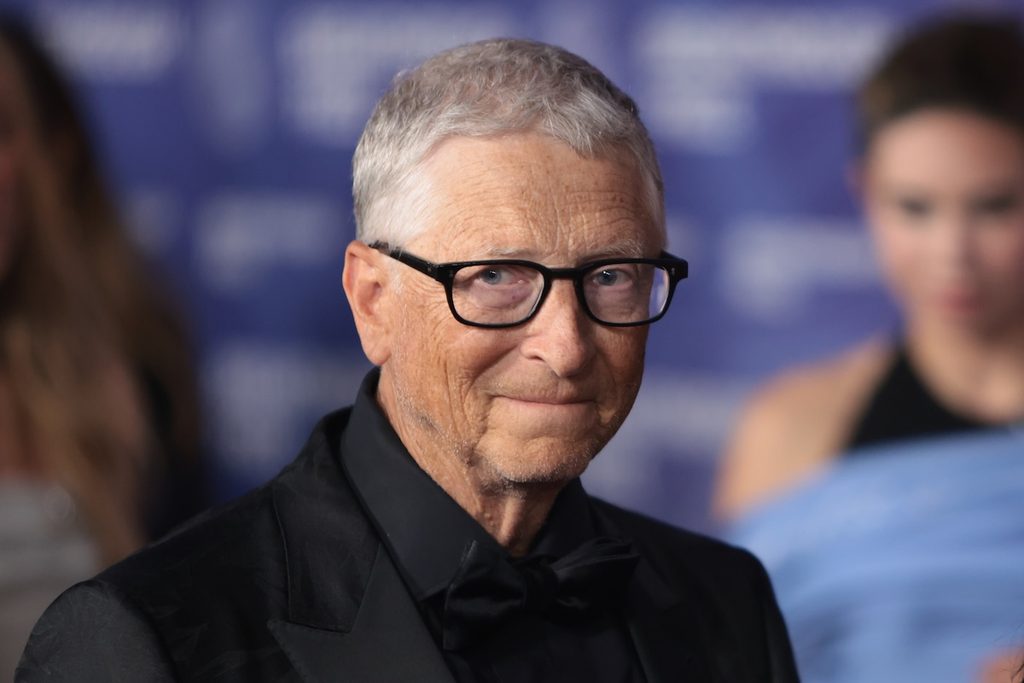

Bill Gates published a 6,000-word essay on the AI transition, calling it “one of the most turbulent times in human history” and arguing the world has no real plan for it. He organizes the essay around three key risks (permanent job losses, AI-empowered bad actors, and damage to how kids develop and their education), at a moment when AI anxiety is already boiling over on campuses.
The line that should stop educators cold: Gates writes that the same tool that will allow people to learn more than ever “could also lead to many people learning less.”
He points to a preliminary survey that associated heavier AI use with weaker critical thinking, with the effect strongest among younger users.
Would you like to save this?
Why It Matters
The price of getting higher education wrong continues to rise. Families spent $34,019 on college last year, up 10%, and new analysis projects the Class of 2026 will borrow $43,500 for a bachelor’s degree. If AI use quietly erodes the critical thinking skills that degree is supposed to build, students end up paying record prices for less learning.
Students already sense the ground shifting. A Gallup and Lumina Foundation survey found 47% of college students have considered switching majors over AI, and Americans’ confidence in higher education has fallen to 38%, with AI doubts a named driver of the decline.
The risks translate to K-12 education as well, where many fundamentals of learning need to be build, but heavy dependence on AI tools and online learning tools may prevent them from forming.
The Three Risks Gates Lays Out
Jobs disappear forever. Entry- and mid-level roles are most vulnerable, and the new jobs AI creates will mostly require skills that take years to build. Gates says he’s especially worried about young people entering a workforce with fewer entry-level openings and notes employment has already fallen among young workers in AI-exposed jobs, but not among their older colleagues.
Bad actors get more power. AI-enabled fraud, deepfakes, and cyberattacks against hospitals, power grids, and benefits systems top his list, because attack capabilities are spreading faster than defenses.
Kids’ development gets stunted. This is the risk Gates frames most personally, and it goes well beyond friendships. He says he doubts he would have put in the hard work of building social skills as a kid if an AI companion had been available. They’re always there, never get mad, and, as he puts it, “They don’t push you outside your comfort zone.” Emotional growth is at stake because kids build the capacity to handle life’s bigger risks by facing small ones, and a companion designed to never upset you is, in his words, “a big, protected greenhouse.”
He also warns AI could magnify the harms already showing up with social media (compulsive use, disrupted sleep, cyberbullying, and exposure to harmful content) by making them more persuasive and harder to escape. Early evidence supports the concern: a study of more than 1,100 AI companion users by Stanford and Carnegie Mellon researchers found people with smaller social networks were most likely to turn to chatbots for companionship, and the heavier and more emotionally personal the use became, the worse they felt. Countries including Australia, the UK, and Norway are adopting protections for kids online in response, and China has gone furthest by restricting AI companion apps broadly and banning virtual romantic partners for minors.
What Gates Says About Learning Specifically
The education warning sits inside that third risk, and Gates is blunt about the timing: this is “the worst possible time for humans to lose their critical thinking skills,” because deepfakes and misinformation tailored to individuals make judging what’s true a basic survival skill. The evidence he cites is preliminary (one survey) but it comes when most college admissions offices can’t even tell applicants whether AI is allowed.
He’s not arguing for keeping AI out of school. Gates says AI tutoring can strengthen learning if it preserves what researchers call productive struggle — “the cognitive work that builds understanding.” Done right, the AI explains a new concept up front, then later “holds the answer back and helps them arrive at it on their own.” He also sees AI freeing teachers for one-on-one and small-group time, a real upside when colleges still can’t reliably detect AI-written work and are policing outputs instead of designing better instruction.
Gates also gives education a specific place in his thinking. He proposes a category he calls Human Reserved (jobs societies deliberately set aside for people, the way land gets set aside for nature reserves) and says education and mental health care should be a mix, with a human in charge who uses AI to extend their reach.
How This Connects
Gates’ two education worries compound each other. AI is shrinking the bottom rungs of the career ladder (Stanford research found entry-level software jobs down nearly 20% since 2022) at the same time heavy AI may be making that same cohort of individuals underprepared for the workforce.
The College Board’s Education Pays 2026 report shows the degree premium still holds, but that premium is still backward looking and assumes the graduates built the skills expected in college. The ROI math on college tightens from both ends if they didn’t.
What’s Next
Gates says he’ll publish more on each of the three risks in the coming months, and he floats early policy ideas: national planning for the AI transition, the Human Reserved concept, and a targeted tax on AI to slow the rush away from human labor and fund retraining.
For schools, watch for follow-up research that confirms or refutes the critical thinking concerns he cites. Also, continue to see how colleges formalize AI rules as some are already dropping supplemental essays for 2026-27 rather than fight AI-written applications.
The Gates Foundation, meanwhile, is putting its education dollars behind personalized learning tools, so expect Gates to keep making the case that classroom AI can be built to make students think more, not less.
Editor: Colin Graves
The post Bill Gates Says Heavy AI Use Could Cause Students To End Up Learning Less appeared first on The College Investor.
