


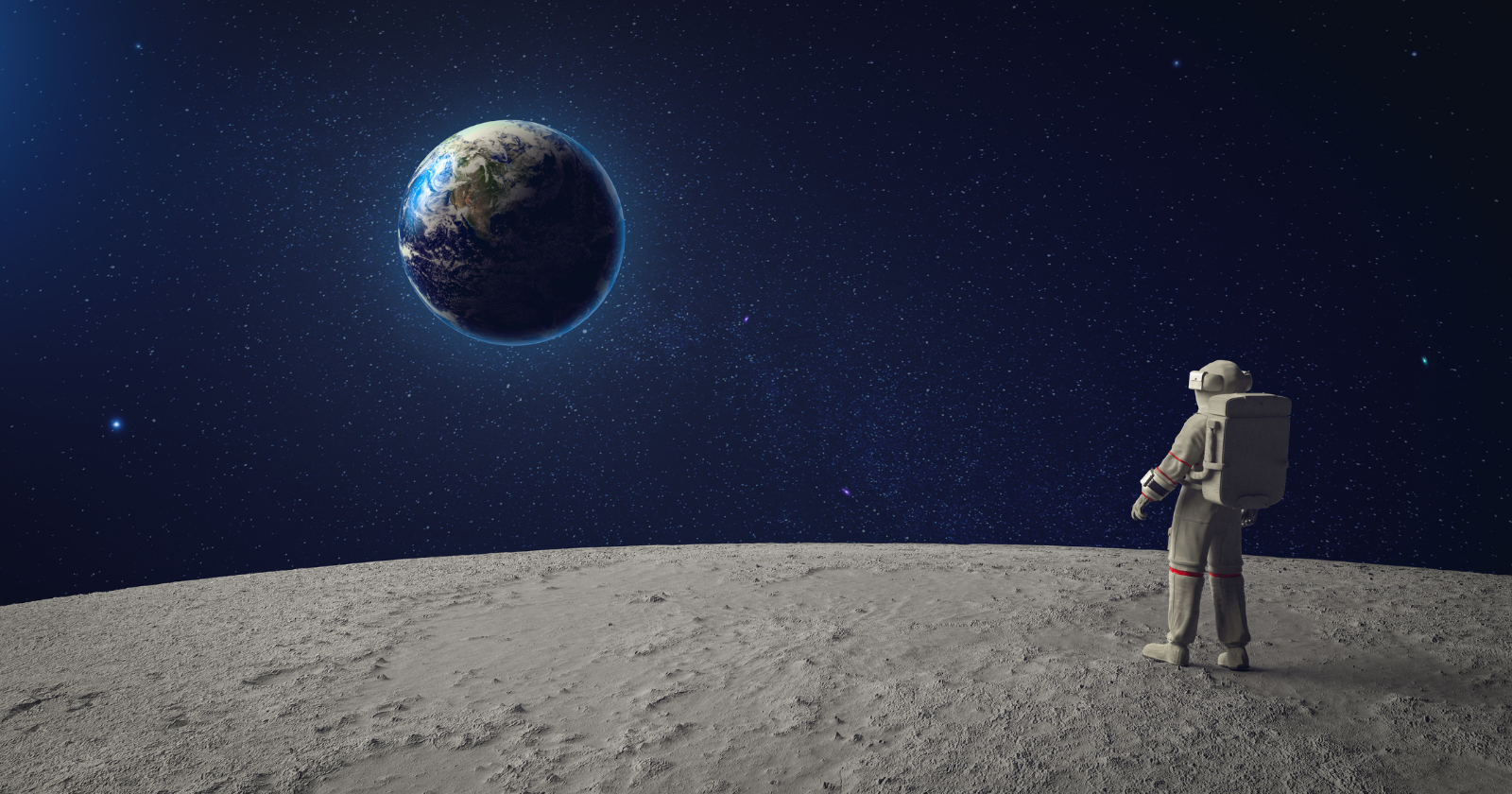

Read enough astronaut interviews and a pattern starts to repeat. People who have spent months aboard the International Space Station come home and describe the view of Earth in strikingly similar terms. They mention the thinness of the atmosphere, the absence of visible borders, and a sense that the planet is at once more fragile and more whole than it had appeared from the ground. Many add that the experience was hard to put into words, even though they had read about it, trained alongside people who had felt it, and been told what to expect.
The phenomenon has a name. The writer and space philosopher Frank White called it the overview effect in a 1987 book of the same title, after working through what it might mean for people to see Earth from orbit as an ordinary part of their working lives. The term has since been picked up by astronauts, journalists, and a smaller number of researchers.
What follows is a reading of that research and those accounts. The question we find more useful than the usual retelling is a narrower one: what the available evidence actually supports, and where the familiar version of the overview effect quietly overstates it.
What the research actually measured
The most frequently cited study is a 2016 paper by David Yaden and colleagues, published in the journal Psychology of Consciousness: Theory, Research, and Practice, titled “The Overview Effect: Awe and Self-Transcendent Experience in Space Flight.” Yaden, a researcher at the University of Pennsylvania’s Positive Psychology Center, studies self-transcendent experiences: intense states in which a person’s sense of being a separate self softens and attention shifts toward something larger. The University of Pennsylvania’s account of the study sets out the basic approach.
The paper is a thematic analysis. Yaden and colleagues gathered written and interview-based accounts from astronauts who had described seeing Earth from space, and looked for recurring ideas. Themes emerged around unity, connectedness, a perception of vastness, and a strong, sometimes unexpected emotional response. The authors placed these accounts within existing psychological work on awe, drawing in particular on research by Dacher Keltner and others.
This is one study, not settled consensus. It analyses language, not biology. The sample is small, and astronauts are an unusual group: selected, screened, highly trained, and practised at describing what they see for a public audience. The study identifies a pattern in how a particular set of people talk about a particular experience. It does not measure changes in brain function, hormone levels, or long-term psychological state, and the authors do not claim that it does. Some of those limits are not flaws in the design. Nobody can run a controlled trial of seeing Earth from low Earth orbit.
Why the six-month figure misleads
The framing that astronauts who pass six months in orbit return changed is worth slowing down on, because it is the part most likely to be misread.
Six months is roughly the length of a standard ISS expedition. That is a scheduling fact, not a psychological threshold. Because long-duration crew make up most of the modern, well-documented astronaut population, most recent first-person accounts of the overview effect happen to come from people who were up there for around half a year. That reflects who flies and for how long. It is not evidence that the experience switches on at a particular date.
The longer history points the other way. The reflections that prompted Frank White’s original framing came partly from Apollo-era missions measured in days. The crew of Apollo 8, who orbited the Moon over Christmas 1968, are often cited for exactly this shift in perspective, and their flight lasted six days. Accounts of awe and reorientation also appear among people who have flown far shorter missions than a station rotation.
So the accurate version of the headline is less tidy than the headline. A recognisable pattern recurs in how astronauts describe seeing Earth. It has not been shown that crossing the six-month mark is what produces it.
Why being warned in advance does not seem to help
The second half of the title points at something the research handles better than it might first appear. Astronauts are, by any measure, prepared people. They are briefed extensively, they train for years, and many have heard colleagues describe the overview effect in detail. Yet a recurring note in their accounts is that the actual experience still outran the description.
The awe research offers a plausible reason. Dacher Keltner and Jonathan Haidt’s influential 2003 account framed awe as a response to something vast enough that it does not fit a person’s existing mental categories, which then forces those categories to stretch and accommodate it. If that framing holds, the experience is defined partly by not matching what a person already had in mind. A briefing supplies the concept. It does not supply the part of the experience the concept fails to contain. Being told in advance that something will be hard to describe is not the same as having the words ready when it arrives.
This is worth stating carefully, because it is easy to romanticise. The claim is not that the overview effect is mystical or beyond explanation in principle. It is that reports of the experience being hard to put into words recur across studies of awe and self-transcendent states, and that astronaut accounts are consistent with that broader pattern. That is a modest claim, and it is the one the evidence supports.
What the accounts cannot settle
Two questions remain genuinely open.
The first is durability. Some astronauts describe a shift that stayed with them for decades. Edgar Mitchell, who flew on Apollo 14, founded the Institute of Noetic Sciences to study human consciousness after his return. Ron Garan, who spent 178 days aboard the ISS, has written and spoken at length about an “orbital perspective” that reshaped how he weighs economic and environmental priorities. Other accounts suggest the intensity fades as ordinary life reasserts itself. The research has not resolved which pattern is typical, and a thematic analysis of public statements is not well suited to settling it. People who felt a lasting change have a reason to keep describing it. People for whom it faded have less reason to say so.
The second is what the effect would mean for people who never leave the ground. A separate line of work has examined whether the overview effect shifts astronauts’ environmental attitudes, including a 2020 study in the Journal of Environmental Psychology reporting changes in ecological awareness after spaceflight, and earlier work by Ihle and colleagues in 2006 that found a measurable rise in astronauts’ involvement with environmental causes. Commercial spaceflight companies sometimes cite this kind of research when describing the value of sending paying passengers to orbit. The studies were conducted on career astronauts, though, and it does not follow that a brief tourist flight reproduces the same result. That is an extrapolation, and it should be labelled as one.
The part that survives the caveats
Strip away the overstatement and something durable is left. Across a small and unusual group of people, a particular vantage point produces a recognisable family of responses: a heightened sense of the planet’s fragility, a felt rather than merely known sense of its wholeness, and an emotional reaction that tends to outrun the language prepared for it. That is a real observation about how a specific perception lands on the human mind.
What it is not is a rule. The shift does not arrive on a schedule, it has not been shown to last in any consistent way, and it has not been demonstrated in people who have not flown. The overview effect is best understood as a well-described pattern in a small population, real enough to take seriously and still mostly unexplained. The astronauts who keep insisting that the view exceeded their preparation for it are, in their way, describing the steadiest finding here. The gap between being told about something and meeting it is one of the few parts of this that nobody disputes.
