


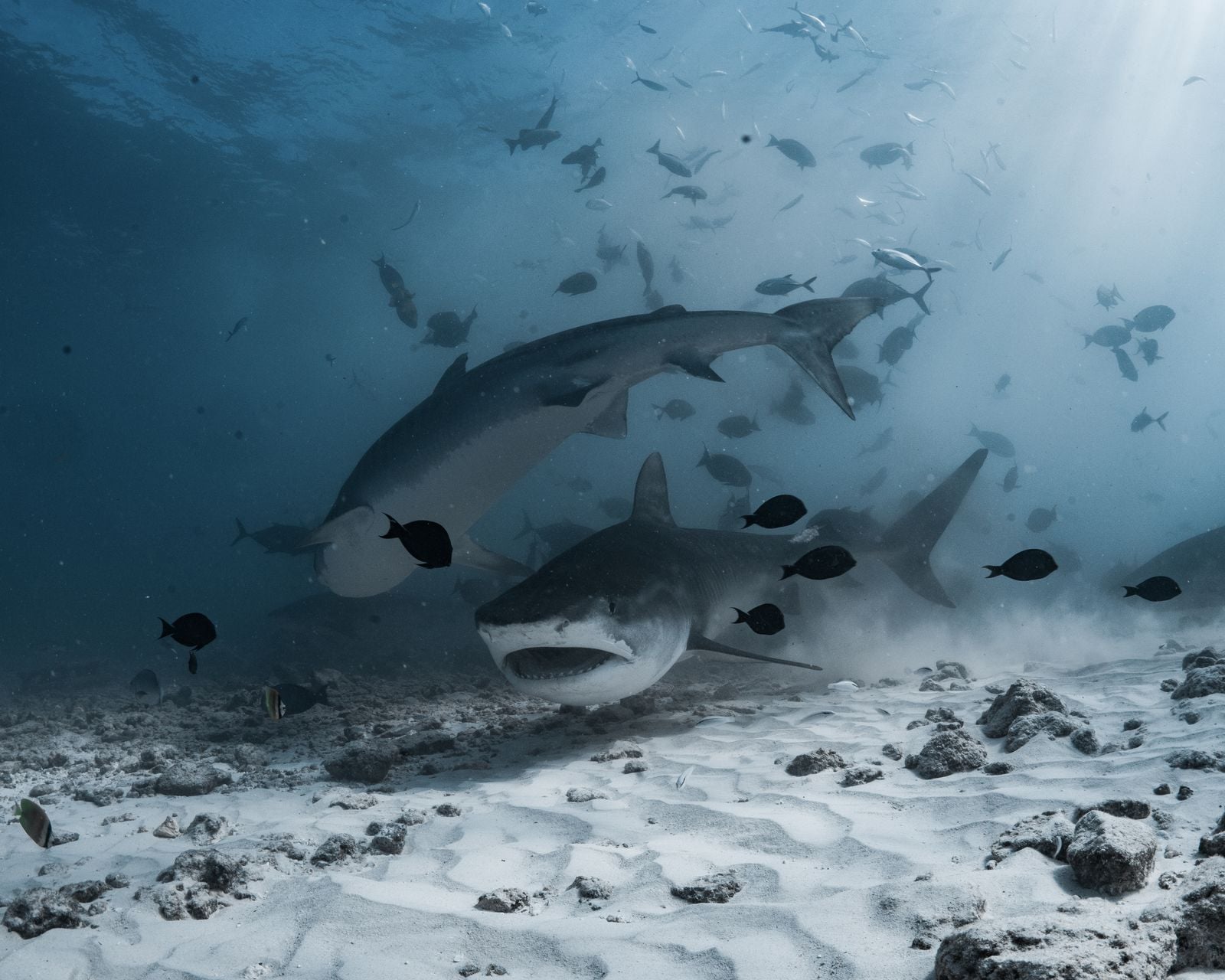

A Greenland shark can spend more than a century swimming through water cold enough to numb exposed human skin, yet the cells inside its eyes may still show no obvious signs of degeneration. Its retina remains organised, its light-sensing machinery remains active, and its DNA continues to be read and repaired long after most vertebrate bodies would have failed.
In 2026, two research teams approached that endurance from different directions. One assembled a 5.9-billion-base-pair genome and searched it for systems associated with damage control, cancer resistance and cellular stability. The other examined the eyes of sharks estimated to be more than 100 years old and found a visual system that was not merely present, but highly specialised and apparently still functional.
The findings do not reveal a single gene that grants a four-century lifespan. They do, however, replace the vague idea that Greenland sharks survive simply because they live slowly in cold water with something more detailed: a body containing overlapping systems for protecting DNA, controlling iron, maintaining chromosomes and preserving fragile nerve tissue across stretches of time no human organ has experienced.
A genome almost twice the size of ours
The first major clue came from a chromosome-level Greenland shark genome published in PNAS in May 2026. Led by Kaiqiao Yang and colleagues at the University of Tokyo, the team assembled a genome measuring approximately 5.9 billion base pairs, compared with roughly 3.2 billion in a human genome.
A large genome is not automatically a better-maintained genome. Many organisms carry enormous quantities of repetitive DNA without gaining unusual longevity. What mattered was the pattern the researchers found when they compared the shark’s genes with those of related species and looked for families that had expanded or changed during its evolution.
The analysis identified changes associated with several familiar components of long life: immune regulation, resistance to cancer and the repair of damaged DNA. It also pointed toward less obvious systems involving the physical packaging of chromosomes and the management of iron inside cells.
This matters because living for centuries creates a problem that cannot be solved by metabolism alone. DNA is continuously exposed to errors caused by replication, chemical reactions and environmental stress. Proteins lose their shape. Cellular membranes oxidise. Abnormal cells appear, and mechanisms must either repair them or remove them before they multiply.
A shark that survives for 300 or 400 years does not merely need to avoid a fatal injury. It needs trillions of individual cells to keep performing maintenance work through centuries of molecular wear.
The proteins that hold DNA together
One of the most intriguing findings involved linker histone H1.0, a protein that helps organise DNA inside the nucleus. DNA does not float freely inside a cell. It is wrapped around proteins, folded and compacted into a structure called chromatin, allowing an immense molecule to fit inside a microscopic space.
The researchers identified unusual amino-acid substitutions in the globular region of the Greenland shark’s H1.0 protein. Computer modelling suggested that these changes could strengthen chromatin compaction and stability, potentially giving the shark’s DNA greater physical protection against accumulated molecular damage.
That interpretation is still a prediction, not a demonstrated anti-ageing mechanism. The study did not place the shark protein inside another animal and show that it extended lifespan. It identified a structural difference that now gives researchers something specific to test.
The genome also contained signs of expanded or positively selected gene families involved in DNA repair, immune activity and cancer resistance. These systems are closely connected. DNA damage can produce mutations, mutations can produce abnormal cells, and the immune system helps detect cells that no longer behave as they should.
Extreme longevity would therefore be unlikely to come from one spectacular defence. It would require layers of protection: fewer damaging events, more effective repairs, tighter control of abnormal growth and reliable removal of cells that cannot be saved.
The researchers also found an expansion of genes connected with ferritin, the protein complex that stores iron. Free iron can drive destructive chemical reactions, and iron-dependent cell death, known as ferroptosis, can damage tissues when it is poorly controlled. The shark’s unusual gene repertoire led the team to propose that iron management and resistance to ferroptosis may be another part of its longevity, although that link remains a hypothesis requiring laboratory confirmation.
An eye built for centuries of darkness
The second 2026 study examined one of the most delicate parts of any vertebrate body. A Nature Communications investigation of the Greenland shark’s visual system combined genome analysis, retinal imaging, gene-expression measurements, lipid analysis and tests of the animal’s light-sensitive proteins.
Greenland sharks were once widely described as nearly blind. They live in dark Arctic and North Atlantic water, and their corneas are frequently colonised by the parasitic copepod Ommatokoita elongata, which attaches itself to the eye and leaves visible damage.
The tissue told a different story. The researchers found all the essential cell types required for rod-based vision, including photoreceptors, bipolar cells, amacrine cells, ganglion cells and supporting Müller glia. The layers of the retina were intact, even in specimens estimated to be more than a century old.
The shark appears to have abandoned most of the machinery used for colour and daylight vision. Several cone-related genes were missing or had become non-functional, while the complete system required for rod-based low-light vision remained active. Its retina was filled with densely packed, elongated rods designed to capture extremely small quantities of light.
The shark’s rhodopsin, the pigment that allows rods to respond to light, was most sensitive at a wavelength of approximately 458 nanometres. That shift toward blue light matches the part of the spectrum most capable of penetrating clear, deep ocean water.
Even the damaged-looking corneas remained surprisingly transparent. Tests on six shark corneas found that they transmitted between 70 and 100 percent of visible light overall. In the blue range most relevant to the animal’s vision, transmission remained between 66 and 100 percent despite parasites being attached near the corneal edges.
Inside the retina, researchers found no obvious signs of the progressive breakdown expected in an old vertebrate eye. A test designed to detect fragmented DNA and dying cells returned no positive cells in the untreated shark tissue. The team also detected strong expression of genes associated with DNA repair, including components of the ERCC1-XPF repair system.
The retina therefore offers something the genome alone cannot. A genome can reveal machinery that might protect a body, but the eye provides physical tissue showing what long-term preservation looks like: ordered layers of nerve cells, working visual genes and light-sensitive structures still maintained after more than 100 years.
Cold water slows the clock, but does not stop it
None of this means the shark’s environment is irrelevant. Greenland sharks are ectotherms, so their body temperature and chemical reaction rates follow the surrounding water. Many spend much of their lives in temperatures below 5 degrees Celsius, although tracking studies show that they can move through a wider range of depths and temperatures.
Their movement reflects that reduced pace. A tagging study of six free-swimming Greenland sharks recorded an average cruising speed of 0.34 metres per second and a tail-beat frequency of only 0.15 hertz. Relative to body size, both were the lowest measured among the fish included in the comparison.
Cold can reduce the speed of damaging chemical reactions, lower energy demands and decrease the frequency of cell division. Fewer divisions mean fewer opportunities for copying errors. A slow metabolism may therefore reduce the amount of damage the shark must repair in the first place.
But cold cannot be the entire explanation. Numerous fish live in cold, deep water without reaching comparable ages. The newer research suggests that the environment reduces the rate of wear while the shark’s cellular systems manage the damage that still occurs.
A 2026 review of potential Greenland shark longevity mechanisms reached a similarly cautious conclusion. Slow metabolism, delayed reproduction, DNA repair, protein maintenance, immune adaptations and resistance to age-related decline may all contribute, but none has yet been isolated as the decisive mechanism.
The difference between clues and a cure
The Greenland shark’s biology will inevitably attract comparisons with human ageing. Genes that stabilise chromosomes, control iron or repair damaged DNA are also active in human cells, and failures in those systems are associated with cancer, neurodegeneration and other age-related conditions.
That does not mean a protein copied from a shark can make a human live for 400 years. Evolution built the shark’s biology as an integrated system operating inside a cold, slow-growing animal. Changing one pathway in a warm-blooded mammal could produce unintended effects, including excessive cell survival or increased cancer risk.
Comparative ageing research is valuable because it reveals what biology is capable of producing, not because every adaptation can be transferred directly. The Greenland shark maintains one body for centuries. The so-called immortal jellyfish repeatedly rebuilds its adult body as a juvenile polyp. Both resist ageing, but they do it through profoundly different biological strategies.
The age attached to the Greenland shark also deserves careful wording. The original 2016 radiocarbon study of eye-lens proteins analysed 28 female sharks and estimated the largest individual at 392 years, with an uncertainty of plus or minus 120 years. The study established a minimum lifespan of at least 272 years, but it did not prove that one precisely identified shark was exactly 392 years old.
The eye-lens dating work also placed female sexual maturity at approximately 156 years, with its own margin of uncertainty. That delay means a shark can survive for longer than a human lifetime without producing offspring.
A body that cannot be quickly replaced
The same biology that makes the species remarkable also makes it vulnerable. Greenland sharks are still caught unintentionally in commercial fisheries, and a population made of animals that grow slowly and reproduce late cannot replace mature individuals on ordinary management timescales.
A 2025 analysis of 1,610 Greenland sharks across the northern North Atlantic found that life stages were unevenly distributed between regions. Mature females were scarce or absent in several sampled areas, while particular waters around southwestern Greenland and Iceland appeared disproportionately important for adults.
Researchers are therefore trying to understand the animal while many of its basic behaviours remain hidden. Mating has rarely been observed. Gestation length remains uncertain. Scientists do not yet know how often females reproduce, where all the important breeding grounds are or how many animals survive encounters with fishing gear.
The 2026 genome and retina studies have moved the question of longevity from speculation toward testable biology. Researchers can now alter the shark’s unusual histone proteins in laboratory systems, examine how its repair genes respond to damage and test whether its ferritin changes really reduce oxidative stress or ferroptosis.
Until those experiments are completed, the answer remains distributed across the animal rather than contained in one gene. It is present in DNA packed tightly around specialised proteins, in repair enzymes active inside old nerve cells, in iron held away from destructive reactions and in rods still waiting for blue light beneath hundreds of metres of Arctic water.
Somewhere in the North Atlantic, a Greenland shark older than every living human is moving through the dark at a fraction of walking speed. Its eyes are gathering the few photons that reach it, its chromosomes are being folded and repaired, and the same body may continue performing that quiet maintenance long after another human generation has disappeared.
