

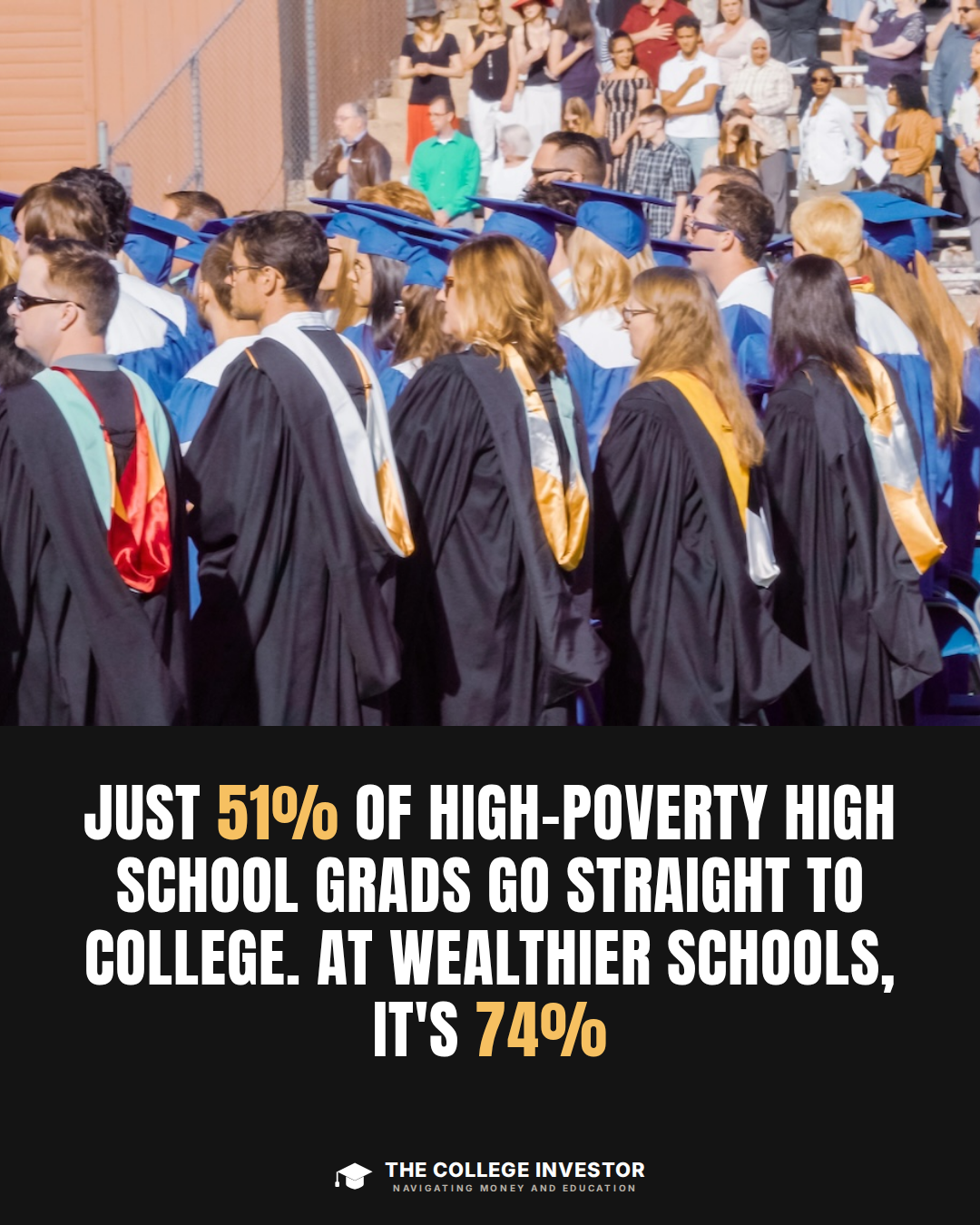

The National Student Clearinghouse Research Center released its 14th annual High School Benchmarks report on September 17, 2026, tracking where the high school class of 2025 landed after graduation. At low-poverty high schools, 73.9% of graduates enrolled in college right away. Meanwhile, at high-poverty high schools, 51.2% did, a 22.7-point gap that lands as more students pick work over college.
Both figures were nearly unchanged compared to the class of 2024, when the rates were 73.1% and 50.8%. The Clearinghouse reported that immediate enrollment shifted by less than one percentage point across every school type it measures, even as colleges received a record 10.8 million applications.
The report’s methodology defines a high-poverty school as one where at least 75% of students qualify for free or reduced-price lunch, and a low-poverty school as one where fewer than 25% do.
Why It Matters
The enrollment gap is only the first issue. When looking at students from the class of 2023 graduates who started college, 90.6% from low-poverty schools came back for a second year, compared with 76.0% from high-poverty schools. That 14.6-point difference is the group that leaves college with no degree.
Then there is total completion rates. The National Student Clearinghouse put the difference in six-year completion rates between graduates of high- and low-poverty high schools at 34.2 percentage points for the class of 2019. Nationally, the six-year college graduation rate sits at 61%, so students from the poorest schools fall well below an average that already leaves one in three without a degree.
For families, the takeaway is financial. A student who borrows, enrolls, and exits after a year owes the debt without the wage premium, which is the real cost of dropping out of college.
The Divide by the Numbers
The report sorts outcomes by school poverty level, and the divide grows at each stage:
- Immediate enrollment, class of 2025: 73.9% at low-poverty schools and 51.2% at high-poverty schools.
- Four-year college attendance: 60.1% of low-poverty graduates went straight to a four-year school, more than double the 28.9% of high-poverty graduates.
- Two-year college attendance: High-poverty graduates led here, 22.3% to 13.8%, which tracks with rising community college enrollment among 18-to-20-year-olds.
- Enrollment within two years, class of 2023: 77.9% versus 58.7%, a 19.2-point spread.
- Second-year persistence, class of 2023: 90.6% versus 76.0%. Among students who started at two-year colleges, the rates were 76.7% and 66.6%.
- STEM degrees within six years, class of 2019: 22.3% of low-poverty graduates earned one, nearly three times the 7.5% rate for high-poverty graduates.
The STEM figure carries the largest long-term price tag, because field of study drives the return on a college degree. The Clearinghouse found that school poverty level predicted STEM completion more strongly than whether a school was urban, suburban, or rural, or its minority enrollment.
Where High-Poverty Schools Gained
The report’s best news belongs to the same group. Second-year persistence for high-poverty graduates rose 1.7 points to 76.0%, the largest increase of any school category, and enrollment within two years of graduation climbed 2.1 points to 58.7%. Students who start at a two-year school can cut the bill further in states with free community college.
“The improvements in persistence are modest, but they point to more students enrolling and persisting in college,” said Matthew Holsapple, senior director of research at the National Student Clearinghouse, in the organization’s release. “What stands out most is that graduates of high-poverty high schools saw the largest gains in both enrollment and persistence.”
A one-year gain of 1.7 points leaves most of the 14.6-point gap in place, and the country already counts 43 million Americans with some college but no degree.
Persistence also rose 0.7 points at urban schools and 0.8 points at rural schools, while suburban schools ticked up 0.3 points to 86.8%. Urban graduates posted a larger two-year enrollment jump, from 65.2% to 67.1%, than rural graduates, who moved from 60.5% to 60.9%. Those rates count college enrollment only, and a separate survey found 66% of high schoolers say school staff push four-year college while trades and community college get little airtime.
One caveat applies to every figure above. The National Student Clearinghouse notes that its data comes from a voluntary sample of 12,023 public non-charter high schools, 1,555 charter schools, and 221 private schools, and is not nationally representative. Private schools are thinly covered at 4.2%, so the results say the most about public school students, the group most likely to depend on need-based aid through the FAFSA.
How This Connects
The report lands during the first academic year under the new federal student loan limits and the rule that low-earning degree programs will lose access to federal student loans.
Graduates of high-poverty schools are the group this data shows is least likely to finish, which raises the stakes on any student loan borrowing. Separate research found that free community college raised earnings 8% and cost taxpayers nothing, and the two-year path is where high-poverty graduates already lead.
What’s Next
The National Student Clearinghouse publishes this report annually, so the 2027 edition will show whether the class of 2026 held the gains among high-poverty graduates and whether the class of 2024 kept returning for a second year. Families weighing the decision now can compare what students really pay for college after financial aid before ruling a school out on sticker price.

Robert Farrington is the founder of The College Investor and is widely recognized as one of the nation’s leading voices on student loan debt and saving for college. He holds an MBA from UC San Diego Rady School of Management and has spent over 15 years researching, writing, and advising on student loans, 529 plans, financial aid programs, and saving and investing for young professionals.
Robert has been featured in the The New York Times, The Wall Street Journal, The Washington Post, NBC News, and Forbes, where he has been a regular personal finance contributor for over a decade. His work combines both professional expertise and personal experience – he successfully navigated his own student loan repayment journey and has helped thousands of readers do the same.
He is committed to making the intersection of personal finance and education transparent and accessible. You can learn more about Robert on the About Page or on his personal site RobertFarrington.com.
