


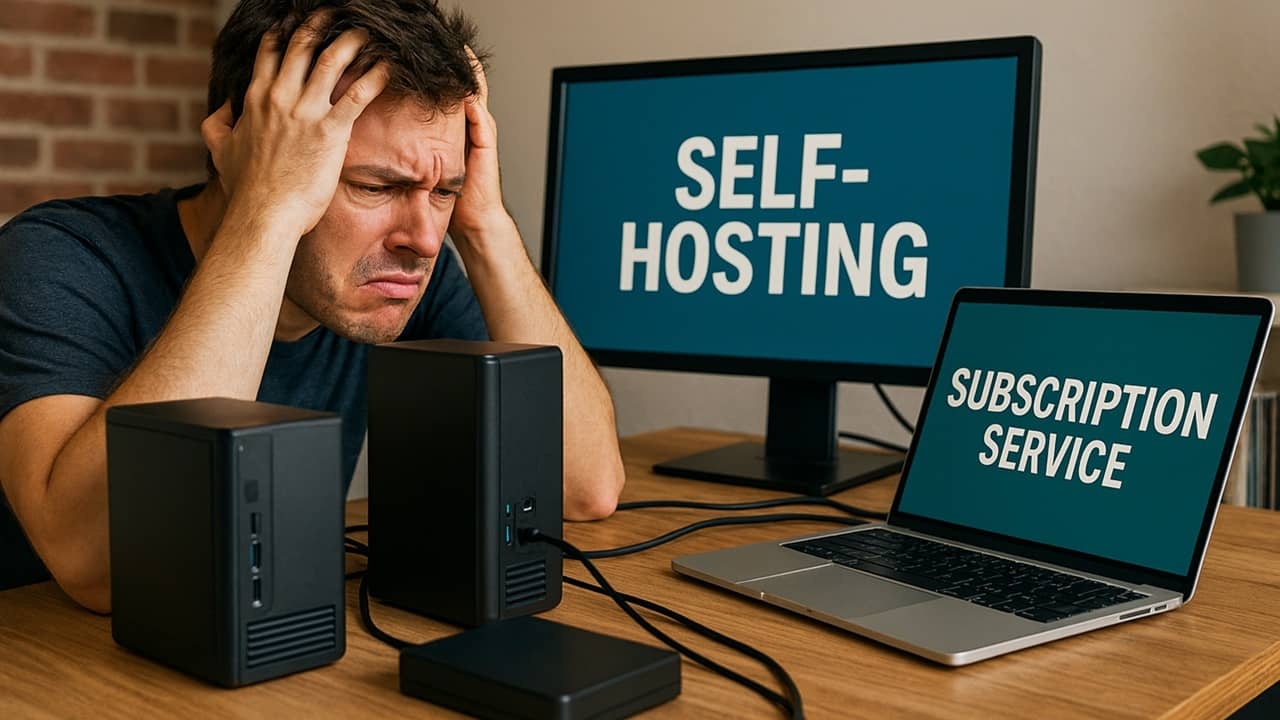
I love having full control over my files, so self-hosting everything sounded great. No more relying on costly subscriptions that constantly change content and features in and out. However, after several attempts to try to self-host everything, I discovered so many cons that I went back to my subscriptions.
Why Self-Hosting Is Tempting
Have you ever subscribed to a streaming service only to have them drop your favorite show or movie? With self-hosting, you always have full control over what’s in your content library.
I tried going all in on self-hosting. I wanted everything in-house, including:
- Cloud storage, all hosted on my own server
- Music and video streaming
- Photo storage
- Video games
- E-books
The idea was to save hundreds per year on subscriptions. If you’re like me, you subscribe to multiple services to store files, stream music, stream TV and movies, play video games, and even read e-books. The promise was I’d save money and time, while being in full control over my content.
I loved the idea of keeping all my content under my control, which ensured more privacy too. I just didn’t consider all the self-hosting cons that can make this a nightmare to actually achieve.
Extremely Complicated Setups
I’m tech-savvy, but I still struggled to pick the right open-source tools, connect systems, and keep everything running smoothly. For instance, take a look at this self-hosted music streaming stack. It combines Navidrome, Feishin, and Lidarr to mimic Spotify.

All of that is just for music streaming. Now, imagine the same process for everything you want to self-host. For TV and movies, Plex worked well enough and I even enjoyed playing around with ErsatzTV to create curated “live TV” channels.
But, all of those setups took me hours. With subscriptions services, I enter my details, pay a fee, and tada! I have access to endless content on my computer, phone, TV, etc. It only takes minutes.
If you’re not tech-savvy, it’ll take you far longer. And, in some cases, some open-source tools work best on Linux. You can switch to Linux from Windows, but Linux isn’t for everyone.
You Must Own All Content
Can’t wait to watch the latest show on Netflix? Tough. Unless you own a physical or digital copy, it’s not going to be in your self-hosted streaming library.
I own thousands of movies, TV shows, and songs. Many are on physical discs, which meant ripping them to my computer to add to my libraries. This took weeks to accomplish.

But, I then discovered one of the biggest self-hosting drawbacks. Unless you want to watch the same content over and over, you’re constantly having to buy more digital files to keep your library up to date.
Have you looked at the price of TV shows and movies? For instance, one of my favorite shows is Supernatural. To buy all 15 seasons is around $200. I could watch Netflix for 10 months for that price and not be limited to just one show.
If you don’t own a massive library of content already, get ready for massive sticker shock. Owning content is why CDs and DVDs are making a comeback, but that comes at a price you might not be willing to pay all at once.
Maintaining Hardware Costs Time and Money
When your favorite streaming service or cloud storage provider goes down, you complain and hope for a partial refund for the month. If your self-hosted solution goes down, it’s up to you to fix it.
Self-hosting isn’t just setting everything up and not having to touch it again. You have to constantly maintain it. I had a monthly checklist, including checking hard drive health to prevent any sudden failures.
And, hardware does fail over time. So, factor in the cost of replacing hard drives, computers, and network equipment regularly.
There’s Never Enough Storage
As I said, I have thousands of media files, along with numerous pictures and documents to self-host. For me, this was terabytes of data to find a home for. As your library grows, so does the need for more storage.

Spending an extra $100 or so a year for cloud storage is nothing compared to spending $200 or more per hard drive to store all my content. Then, I have to replace it later on.
Now, you also have to account for backups. One of the most costly self-hosting cons is buying enough storage for all your files plus backups.
Self-Hosting Isn’t Free
I think the biggest self-hosting myth is it’s free. No. It’s not. Most of the apps you need are free. The hardware isn’t. Most users will need to invest at least $1,000 in the initial setup to replace cloud storage, music/TV/movie streaming, photo hosting, and any other services.
I had much of the hardware already. When I added up everything, it would take at least five years before I started saving money. Which is about when I’d need to start replacing some hardware.
Customizing is a Headache
Self-hosting is starting from scratch. I had to customize everything. I set up new playlists, adjusted themes, customized settings, and tested various apps. I spent weeks on this and still didn’t have everything the way I wanted it.
And, it gets even worse when you have to update the apps you use. Features change, setups break, and you have to start all over.
Self-Hosting Isn’t For Everyone
I like the idea of self-hosting for privacy and content ownership. What I hate is the constant management and high cost. For small setups, the self-hosting cons might not apply. For true streaming, file storage, and even local AI LLMs, the downsides of self-hosting simply make it unrealistic for most of us.
