


We often need to resize what we see on a laptop or desktop screen. It gives relief to tired eyes, varies file‑and‑folder density, displays clearer graphics, and improves code readability. The following is a basic guide on how to resize desktop icons, fonts, and other common display items in Windows.
Resizing Desktop Icons in Windows
To personalize the size of your desktop icons, follow one of these different methods for Windows 11 and Windows 10.
Windows 11
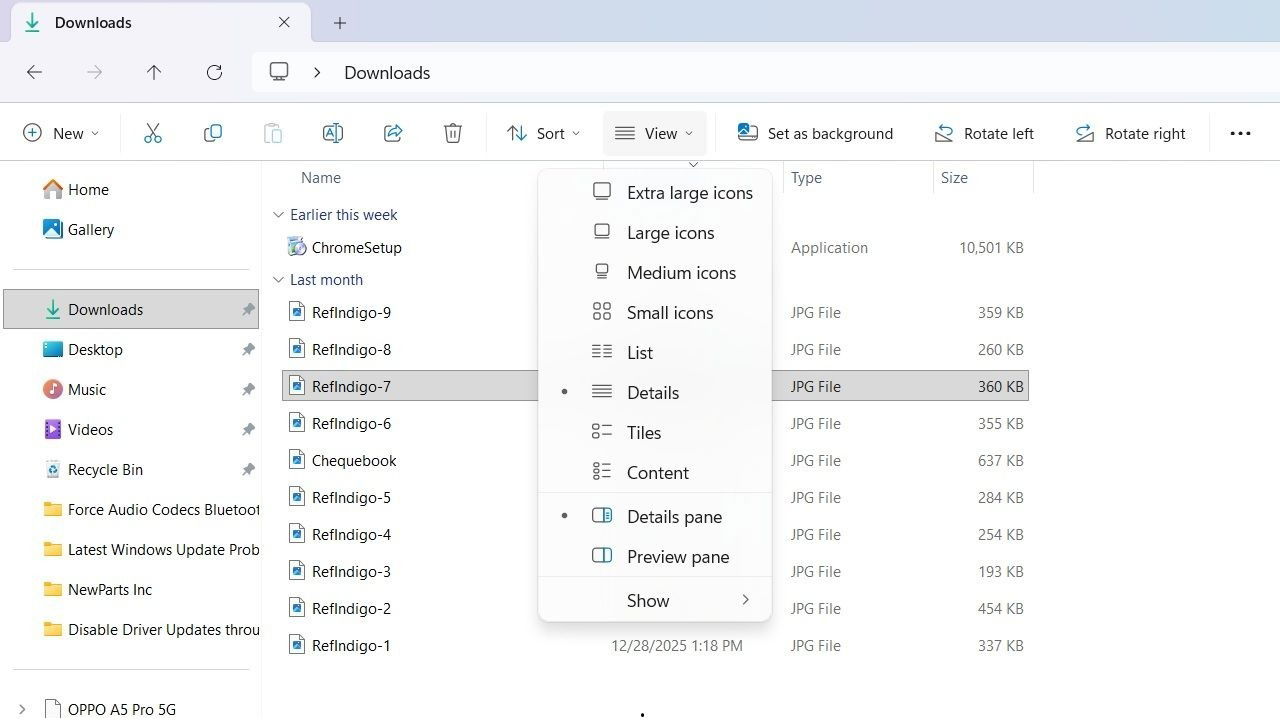
On Windows 11, the most common way to resize desktop icons is from the command bar. It replaced the old Ribbon interface from Windows 10.
Open any File Explorer window. Click the View button on the command bar. Here you can choose from Small icons, Medium icons, Large icons, and Extra large icons. Or you may go for List, Details, Tiles, and Content.

Alternatively, you can resize file explorer icons by right-clicking anywhere in the white space. Next, select View → icon menu size.
 Icon size” in Windows 11 along with shortcut keys.” class=”wp-image-850028 lazyload” srcset=”https://www.maketecheasier.com/assets/uploads/2026/01/Resize-Icons-White-Space-Win11-View-Options.jpg 700w, https://www.maketecheasier.com/assets/uploads/2026/01/Resize-Icons-White-Space-Win11-View-Options-300×225.jpg 300w, https://www.maketecheasier.com/assets/uploads/2026/01/Resize-Icons-White-Space-Win11-View-Options-600×450.jpg 600w, https://www.maketecheasier.com/assets/uploads/2026/01/Resize-Icons-White-Space-Win11-View-Options-601×451.jpg 601w” sizes=”(max-width: 700px) 100vw, 700px” loading=”lazy”>
As shown above, you can also use keyboard shortcuts to reduce or increase file icon or folder size.
| Action | |
|---|---|
| Ctrl + Shift + 1 | Extra large icons |
| Ctrl + Shift + 2 | Large icons |
| Ctrl + Shift + 3 | Medium icons |
| Ctrl + Shift + 4 | Small icons |
| Ctrl + Shift + 5 | List |
| Ctrl + Shift + 6 | Details |
| Ctrl + Shift + 7 | Tiles |
| Ctrl + Shift + 8 | Content |
Windows 10
Similar to Windows 11, Windows 10 users can resize file/folder icons by right-clicking in the white space and selecting View → Icon menu size.
 Icon size.”” class=”wp-image-333866 lazyload” loading=”lazy”>
In another method, click the Ribbon menu on top, tap View, and select one of the icon sizes. As a default setting, the size of the Windows file explorer icons and text are calibrated according to your screen dimensions. When you resize them, they will retain the same proportions.

Did you know? Many users prefer granular controls in how the icons are resized. For this, you must connect your laptop with an external mouse. Hold down the Ctrl key and slowly rotate the mouse wheel. This method of resizing works equally well for Windows 11 and Windows 10.
Resizing Fonts in Windows
Again, there are multiple ways to resize font size in Windows.
Windows 11
In Windows 11, open Settings → Accessibility → Text size.
 Accessibility –> Text size”.” class=”wp-image-850030 lazyload” srcset=”https://www.maketecheasier.com/assets/uploads/2026/01/Resize-Fonts-Win11-Settings-Accessibility-Text-Size.jpg 700w, https://www.maketecheasier.com/assets/uploads/2026/01/Resize-Fonts-Win11-Settings-Accessibility-Text-Size-259×225.jpg 259w, https://www.maketecheasier.com/assets/uploads/2026/01/Resize-Fonts-Win11-Settings-Accessibility-Text-Size-518×450.jpg 518w, https://www.maketecheasier.com/assets/uploads/2026/01/Resize-Fonts-Win11-Settings-Accessibility-Text-Size-519×451.jpg 519w” sizes=”(max-width: 700px) 100vw, 700px”>
Drag a slider below Text size to your desired levels. You can see the effect in Text size preview. Click Apply when you’re done. You might see a Please wait screen which displays while your monitor adjusts to the new text size.

Alternatively, you can use Windows 11’s screen magnifier feature to zoom in to a section of your screen. Next, it can be accessed from Settings -> Accessibility -> Magnifier.

If you can’t read the text properly on an app window, the Magnifier lets you do that. You can summon it anywhere through the shortcut Win + + key. After you’re done reading, you can dismiss the Magnifier using Win + - key.

There is a third way to impose across-the-board text size changes. Go to Settings → System → Display → Scale & layout. Here, you can modify text size from the default, recommended 125 percent to 100, 150, or `175 percent.

Windows 10
To resize the default font size in Windows 10, go to Start menu and type Ease of Access display settings. Or you can use Settings → Ease of access → Display.

You will be able to see a display text slider which is set at 100 percent as a default value. Next, drag the slider and review the text size in the sample box to get your comfortable values.

You can get another 25 percent boost in font and app size using the Make Everything Bigger option. It is located right below the display slider.

Also read: check out this list of old Windows apps that are still around in Windows 11.
Resize Taskbar Items in Windows
To reduce the size of taskbar items in Windows 11 or 10, right-click anywhere in a blank taskbar space. Following this, select Taskbar settings.
Go to Show smaller taskbar buttons, which is set by default to When taskbar is full. Clearly, it can be modified to Always.

As shown here, the taskbar items are smaller in size compared to their default settings.

In certain older Windows 10 builds, there is another way to increase the taskbar size. Right-click anywhere in the empty taskbar space and uncheck Lock the taskbar.

Consequently, in the next step, you will be able to drag the taskbar upward and accommodate more files and window items.

Both Windows 11 and 10 users can use a minor registry editor tweak to shrink the taskbar size. Afterward, open Run and type regedit. Go to:
HKEY_CURRENT_USER\Software\Microsoft\Windows\CurrentVersion\Explorer\Advanced
Here, create or edit a DWORD (32‑bit) value named: TaskbarSi. (also, check if it’s available on the right panel.)

The value can be changed to 0, 1, or 2, with 0 representing Small, 1 representing Medium (default), and 2 representing Large taskbar size.
To resize the Start menu display in Windows 11, go to Settings → Personalization → Start, and select More pins.
 Start.” class=”wp-image-850048 lazyload” srcset=”https://www.maketecheasier.com/assets/uploads/2026/01/Resize-Start-Menu-Win11-More-Pins.jpg 700w, https://www.maketecheasier.com/assets/uploads/2026/01/Resize-Start-Menu-Win11-More-Pins-357×225.jpg 357w” sizes=”(max-width: 700px) 100vw, 700px”>
In Windows 10, click the Start menu and hover your mouse near its edge. You will now be able to see arrow keys which can be dragged top to bottom in order to resize these icons.
In this guide, we saw simple techniques to change the display icons, font sizes, taskbar and start menu items in both Windows 10 and 11. Obviously, you might want to find out how to customize the taskbar in Windows which has many applications.
