

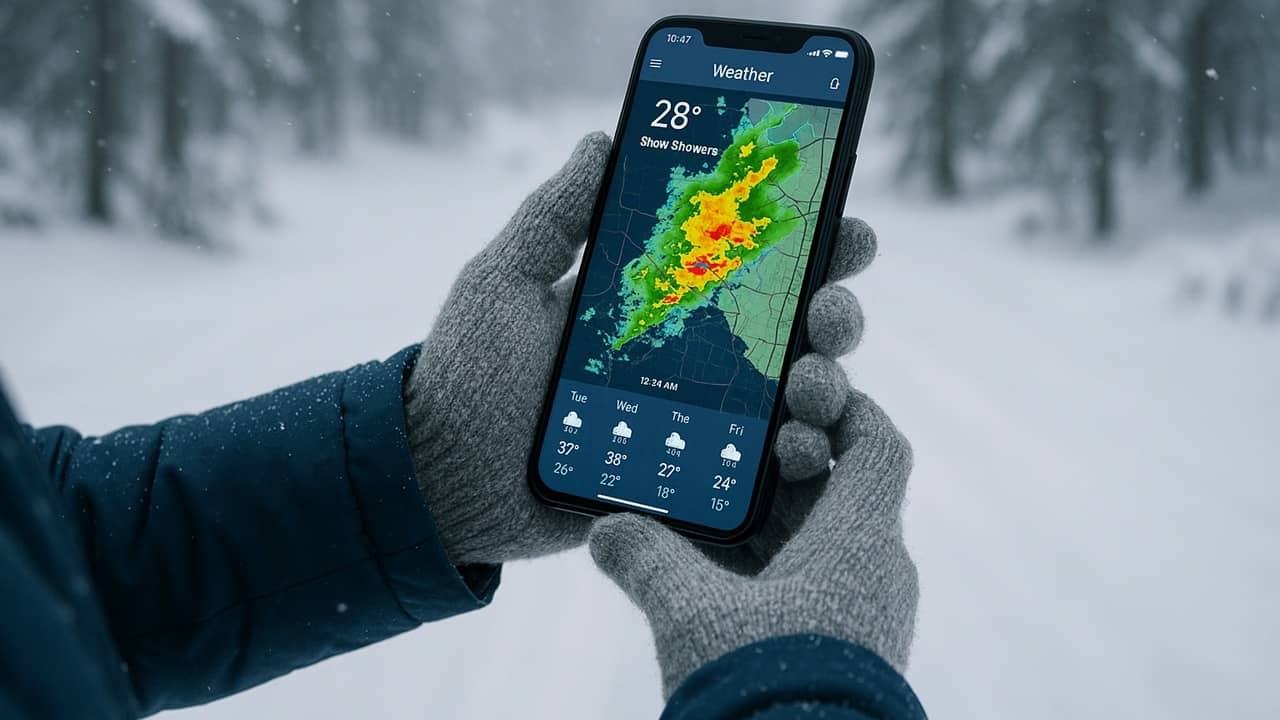
During Winter Storm Fern, one thing remained constant. Meteorologists begging people not to trust Apple Weather for forecasts. Apple Weather problems just seem to keep getting worse, making it more difficult to rely on the app during severe weather.
Major Apple Weather Problems
I was in the path of Winter Storm Fern this January. All my local meteorologists kept asking viewers to stop using Apple Weather due to its highly inaccurate forecasts during the storm. This was occurring all across the United States. The app claimed some areas would get nearly two feet of snowfall, when they were only actually forecasted to get less than half that.

Apple Weather struggles most often with frozen precipitation, which is notoriously difficult for all weather apps. But, Apple acquired the weather app Dark Sky, which was praised for its accuracy. Instead of users getting the benefits of Dark Sky within Apple Weather, they just get horribly inaccurate forecasts and even current temperatures.
This is an ongoing problem that Apple still hasn’t addressed years after gaining exclusive access to Dark Sky.
All you have to do is check Reddit to see the complaints. For example, one user was supposed to get two feet of snow, but the app claimed only up to five inches. Another user stated Apple Weather got the forecast completely wrong three times in a row.
Pixel Weather Joined Apple Weather Problems
Usually, I’d say native mobile apps are typically more reliable, but both Apple Weather and Pixel Weather have proven me wrong. Yes, Pixel Weather, the native weather app on Google Pixel devices also left users confused over the winter storm forecast.

The AI report within the app even created a new word “flurzy” to describe the snowfall. Reddit users complained the app kept showing less and less snowfall, despite the area getting far more snow than the app had forecasted.
So, it’s not isolated to just Apple Weather.
How Did the Forecasts Go So Wrong?
Meteorologists will tell you winter weather is difficult to forecast. But, the Apple Weather problems stem from a few faults in how the app works, including:
- Often relying on a single weather model. Professional forecasts combine multiple models to determine the most likely scenario. A single model may greatly exaggerate or underestimate precipitation and temperatures. The most accurate forecasts and apps combine multiple models.
- Incorrect snow to liquid ratios. Snow, ice, and sleet all have different liquid ratios. Different types of snow also have different ratios. Apple Weather assumes one ratio. For instance, fluffy snow has a 10:1 ratio, where heavy wet snow may have a 5:1 ratio. This leads to large discrepancies in actual snow, ice, and sleet totals.
- All computer generated. Forecasters use computer and AI weather models to help generate their forecasts. They then use their local experience, understanding of model bias, and climate knowledge to adjust the forecast to better fit the area, leading to more accurate forecasts. With Apple Weather, it’s more of a one-size-fits-all approach.
- Reliance on weather stations too far away. Rural and mountainous areas don’t always have major weather stations for Apple Weather to access. This leads the app to generate forecasts based on areas that are miles away.
Pixel Weather faces some of the same problems. Of course, this app also relies more heavily on AI, which is known to hallucinate. This just adds to the forecast inaccuracies.
Should You Trust Weather Apps?
Yes and no. Both Apple Weather and Pixel Weather proved to be unreliable during winter storms recently. And, Apple Weather problems have been popping up for a couple of years now with no fix in sight. Also, it’s hard to trust a weather app that lets its AI make up weather terms.
We all rely on weather apps to help us make informed decisions when traveling or at home to prepare for upcoming storms and changes. But, when they’re constantly wrong, it makes it hard to trust anything they say.

First off, all weather apps and even trust meteorologists make mistakes. Predicting the weather has never been a perfect science, though the science is far more accurate than even a decade ago.
The other thing to remember is every weather app uses its own system, data sources, and model ensembles to generate forecasts. This means you’ll see varying forecasts on different apps. And, depending on the data sources, some apps are more reliable for certain areas.
When you see weather apps forecasting drastically different precipitation and temperatures than every other app and local news station, don’t trust it.
How to Get the Most Reliable Weather Forecast
I’m a weather geek, so I have nearly a dozen weather apps on my phone. I don’t recommend this for most people.
Instead, install at least two apps just to see if there are any major forecast differences. Or, bookmark one or two weather sites for comparison. Forecast Advisor helps you find the most accurate sites for your location.
I highly recommend comparing weather apps to the weather on your local news. Ideally, download your local weather app as well, if available. Test out various weather apps to see which ones are most accurate for your area. You can even compare forecasts from your mobile apps to those on Windows and Linux.
Sometimes, the most accurate forecasts come from physical weather stations. My advice is to never trust just one weather app, especially when they have a history of inaccurate forecasts. Trusting the wrong app could leave you unprepared in a weather emergency.
Forecast Advisor
Price: Free
