


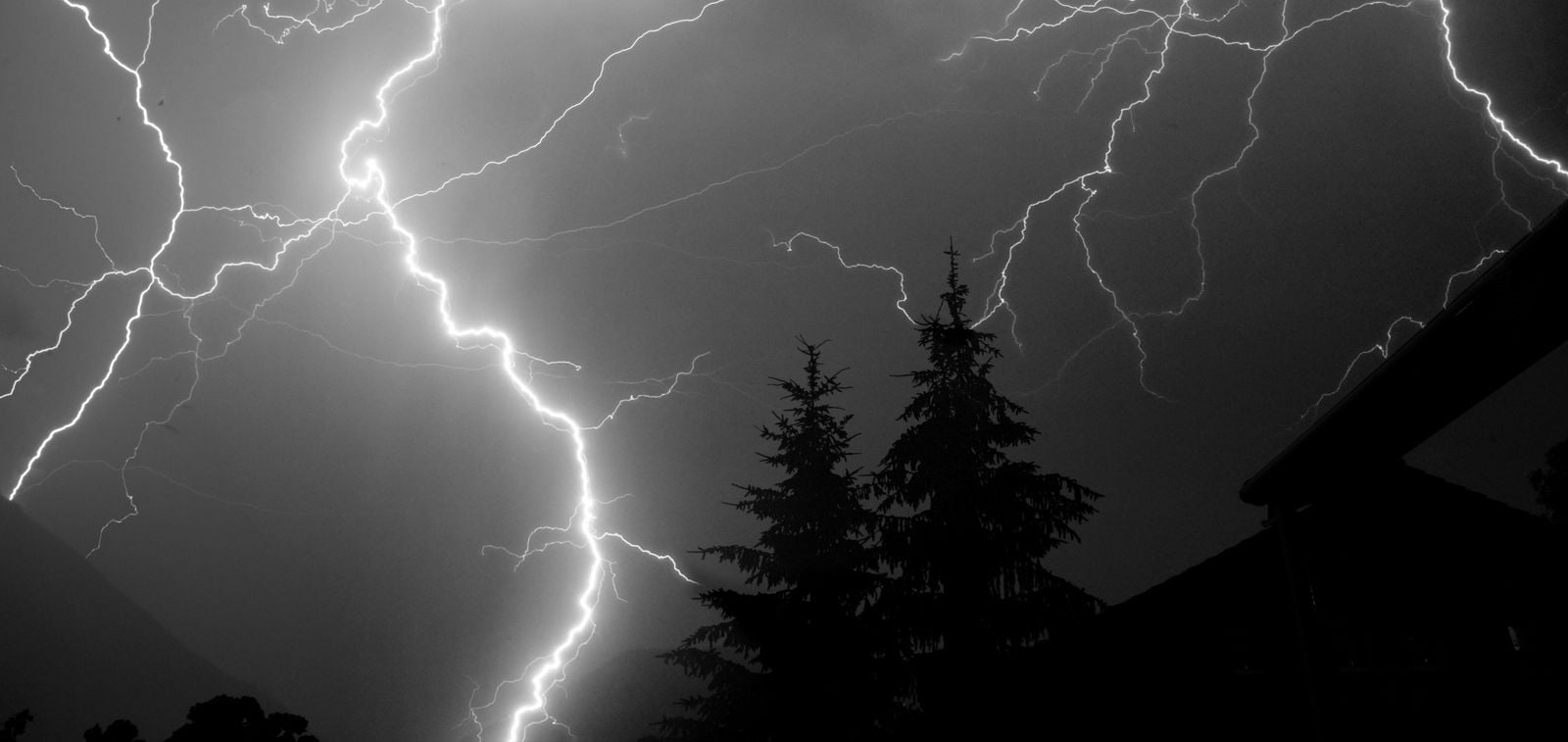

A cloud-to-ground lightning return stroke can heat the air inside its narrow channel to roughly 30,000 kelvin, more than five times the temperature of the Sun’s visible surface. The heating happens within millionths of a second, forcing the air to expand so violently that it produces the shock wave we hear as thunder, according to the National Severe Storms Laboratory.
The light and the sound are therefore different stages of the same physical event. The flash is the intensely hot, electrically conducting channel, while the thunder is the atmosphere’s mechanical response to being heated almost instantaneously.
No instrument is placed inside a natural lightning channel to measure that temperature directly. Instead, researchers infer it through spectroscopy, separating the light into emission lines produced by ionised nitrogen and oxygen and using their relative intensities to calculate the plasma’s temperature.
In a 1968 time-resolved spectroscopic study, atmospheric scientist Richard Orville analysed ten return strokes and found peak temperatures between 28,000 and 31,000 K in five of them. The hottest calculated stroke reached about 36,000 K, although the measurements carried uncertainties of roughly 10 to 25 percent.
The comparison with the Sun needs one important qualification. NASA places the Sun’s visible photosphere near 5,800 K, while its corona reaches around two million degrees and its core reaches about 15 million, so lightning is hotter only than the relatively cool surface layer we see. The Sun’s large-scale effects on Earth, including the kind associated with the Carrington Event, involve an entirely different scale of energy.
Why the channel gets that hot
Inside a thunderstorm, rising ice crystals, falling graupel and supercooled water collide within powerful updrafts. Those collisions transfer electrical charge, commonly leaving a region of positive charge higher in the cloud and a region of negative charge below it.
Air normally resists the movement of electrical current, but that insulation begins to fail when the electric field becomes strong enough. A faint, negatively charged channel called a stepped leader then moves downward in segments that are often around 50 metres long.
The timing is easy to misstate. The National Weather Service’s detailed account says each luminous step lasts about one microsecond, followed by a pause of roughly 50 microseconds before the leader advances again.
As the leader approaches the surface, positively charged streamers can rise from trees, buildings, masts and other objects below it. When one streamer connects with the descending leader, the cloud and ground are joined by a conductive path.
The visible return stroke then propagates upward through that path in less than 100 microseconds. A typical peak current is around 30,000 amperes, although unusually strong strokes can reach approximately 300,000 amperes.
That current is concentrated inside a conducting core only a few centimetres across. Collisions between energetic electrons and air molecules strip electrons from nitrogen and oxygen, turning the gas into plasma and raising its temperature to tens of thousands of kelvin.
The peak does not last. The channel begins cooling almost immediately, although later currents can reuse the same conducting path and cause the bolt to flicker several times within a single flash.
From heat to sound
Air cannot expand gradually when its temperature rises from ordinary atmospheric conditions to tens of thousands of kelvin in a few microseconds. Pressure builds sharply inside and around the channel before the gas drives outward at supersonic speed.
Close to the channel, that disturbance is a cylindrical shock wave rather than an ordinary sound wave. NOAA explains that it weakens rapidly and becomes the acoustic wave recognised as thunder within roughly ten yards, or about nine metres, of the channel.
The channel’s shape determines how that sound reaches a listener. Lightning can extend for kilometres through a branching, crooked path, and every section of that path generates its own pressure disturbance.
Sound from the nearest section arrives first, while sound from more distant sections arrives later. A nearby stroke can produce a sharp crack or tearing noise, whereas a long or distant channel creates an extended rumble as overlapping waves reach the listener at different times.
Light reaches an observer so quickly over storm-scale distances that the flash appears effectively instantaneous. Sound travels through ordinary air at about 343 metres per second, which is why dividing the flash-to-thunder delay by roughly three gives the distance in kilometres.
Thunder is commonly audible for about 16 kilometres, although wind, rain and the atmosphere’s temperature profile can shorten or lengthen that range. Under ordinary conditions, cooler air aloft tends to refract sound upward, but a temperature inversion with warmer air above cooler surface air can bend some of it back toward the ground, as NOAA’s thunder explainer describes.
The silent flashes sometimes called “heat lightning” are not a separate form of lightning produced by hot weather. They are usually ordinary distant flashes whose thunder has become too weak, has been absorbed or has been refracted away before reaching the observer.
Lightning can therefore be present even when nobody nearby hears it. Some weather apps with lightning alerts can reveal strikes beyond the audible range, although official local warnings remain the most important source during severe weather.
What the channel leaves behind
The heat and current can alter the ground beneath a strike. When lightning passes through sand or silica-rich soil, it can fuse grains into a hollow, branching glass structure called a fulgurite that preserves part of the current’s underground route.
A tree can suffer a similarly abrupt transformation. Water and sap near the current path can flash into steam, building enough pressure to strip bark, split branches or blow sections of the trunk apart.
The plasma also changes the surrounding air chemically. At lightning temperatures, molecular nitrogen and oxygen can be broken apart and recombined into nitrogen oxides, which later participate in atmospheric reactions and can ultimately return to the surface in nitrogen-containing compounds.
A major review in Atmospheric Chemistry and Physics estimated that lightning produces about five teragrams of nitrogen globally each year, with an uncertainty range of roughly two to eight teragrams. That contribution is smaller than many biological and industrial sources, but it remains significant to upper-tropospheric chemistry.
The planet produces this process continuously. Measurements from NASA’s Optical Transient Detector yielded an estimate of 44 plus or minus five lightning flashes every second, equivalent to nearly 1.4 billion flashes in an average year.
Lightning is concentrated over warm tropical land rather than spread evenly around the globe. Later observations by the Lightning Imaging Sensor identified the Lake Maracaibo region of Venezuela as the leading hotspot, averaging about 233 flashes per square kilometre per year in the study that established its ranking.
What the number does not mean
The 30,000 K figure is a peak temperature inside a narrow plasma channel, not the temperature of the surrounding storm or the entire visible bolt. It also persists only briefly before expansion and cooling begin.
Temperature alone does not state how much total energy an event contains. Research estimating charge transfer and electrical potential found energies from roughly 200 million to seven billion joules per complete flash, depending on the type of flash and the storm’s electrical structure.
The Sun radiates vastly more energy because its hot material occupies an enormous volume and releases energy continuously. A lightning channel can briefly exceed the photosphere’s temperature while remaining incomparably smaller, shorter-lived and less energetic than the star as a whole.
What makes lightning remarkable is the concentration. For a few microseconds, tens of thousands of amperes pass through a channel scarcely wider than a finger, the trapped air becomes plasma, and the atmosphere punches outward before the delayed crack and rumble finally cross the distance to the ground.
